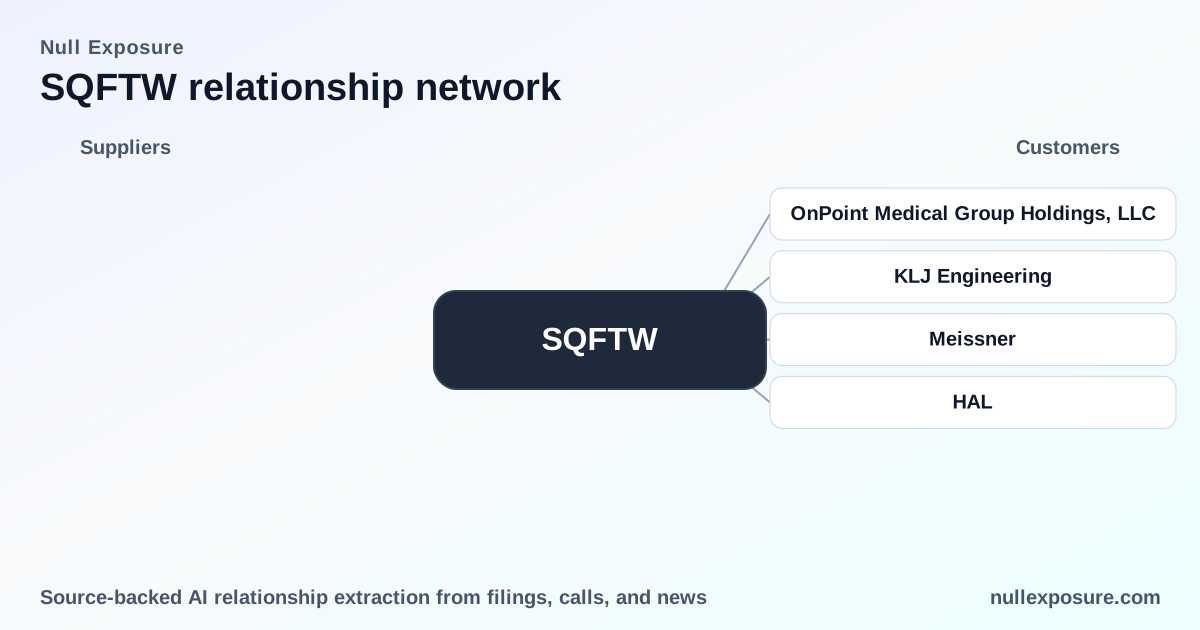
Presidio Property Trust (SQFTW) — Tenant map and what it says about revenue durability
Presidio Property Trust operates as an internally managed REIT that acquires and leases office, industrial, retail and model‑home properties, generating revenue primarily through base rents and triple‑net lease structures with a mix of short‑ and long‑term tenancies. The company monetizes by holding income‑producing real estate and collecting rent, with occasional sale-leaseback activity on model homes and selective tenant improvements to preserve occupancy. For investors evaluating tenant risk and customer relationships, the 2024 Form 10‑K lays out a small but concentrated book of notable commercial tenants and clear signals about term structure, geography, and counterparty mix. Learn more at https://nullexposure.com/.
Why tenant-level detail matters for a small REIT like Presidio
Presidio’s revenue profile is governed by lease length, tenant size, and geographic clustering. Long-term anchor leases provide cashflow stability, while turnover of large tenants or expirations can create material revenue volatility for a compact portfolio. The 10‑K shows both multi‑year, large‑space commitments and a steady flow of shorter leases in the one‑to‑five year band — a duality that defines the company’s operating posture and capital planning needs.
- Concentration: Historical reliance on a single large tenant (Halliburton) created a vulnerability when that lease expired.
- Term mix: The company carries both long-duration anchors and many short-term leases, producing predictable base rent but requiring active leasing effort.
- Geography: Properties are clustered in North America (California, Colorado, Maryland, North Dakota and Texas), limiting geographic diversification but simplifying asset management.
Tenant relationships: what the filings actually name
Below are the customer relationships disclosed in Presidio’s FY2024 10‑K, with one-line investor takeaways and source references.
OnPoint Medical Group Holdings, LLC
OnPoint took occupancy of an 11,831 square‑foot suite in January 2025 that was vacated by Nova Financial & Investment Corporation and signed an additional three‑year lease for that space; the company had also been directly leasing a 2,543 square‑foot unit in the Shea Center since October 2024. According to Presidio’s 2024 Form 10‑K, these moves represent near-term renewals and small‑to‑mid sized tenant growth in the portfolio (10‑K, FY2024).
KLJ Engineering
KLJ executed a major lease for the Grand Pacific Center in Bismarck, ND on December 7, 2022, covering approximately 33,296 usable square feet on a 122‑month term with starting annualized rent of $532,736, which removed the asset from held‑for‑sale status. The 10‑K highlights this transaction as a material, long‑term commitment that stabilizes an otherwise thin tenant roster (10‑K, FY2024).
Meissner
Presidio invested about $74,000 in building and tenant improvements for the Meissner tenancy, expanded the leased space and extended the lease term out to 2035, simultaneously reducing space used by the company. The 10‑K presents this as a landlord‑driven concession to secure a longer term, demonstrating active asset management to lock in revenue (10‑K, FY2024).
Halliburton (HAL)
Halliburton was identified as Presidio’s largest tenant, but the lease expired on December 31, 2022, indicating a material reduction in tenant concentration and a historic revenue loss that the company has since worked to fill. The expiration is disclosed in the 10‑K and signals a past concentration risk that has shaped subsequent leasing strategy (10‑K, FY2024).
The operating constraints that shape revenue and risk
The company’s own disclosures frame its operating model and constraints in investor‑relevant terms:
- Contracting posture — mixed term structure. Presidio runs a blended book: long‑term anchor leases such as KLJ’s 122‑month agreement provide durability, while many leases fall in the one‑to‑five year range, producing recurrent rollover risk (10‑K excerpts, FY2024). This mix demands disciplined leasing and capex planning.
- Counterparty mix — broad spectrum from small businesses to large enterprises. The 10‑K explicitly states tenants range from small businesses to public companies, indicating credit heterogeneity across the rent roll (10‑K, FY2024).
- Geographic concentration — North America regional cluster. Properties are located in California, Colorado, Maryland, North Dakota and Texas, which concentrates market and cyclical exposure to those submarkets rather than offering national diversification (10‑K, FY2024).
- Relationship roles — owner/lessor and occasional service provider. Presidio is primarily a lessor; it also acts as a service provider in special cases (payroll reimbursements, for example), indicating ancillary revenue lines that are modest but recurring (10‑K, FY2024).
- Stage and maturity — active asset management. Several relationships are current and active; the company proactively invested in tenant improvements and extended leases to secure terms, reflecting an operational emphasis on retaining occupiers (10‑K, FY2024).
Two named, company‑specific items in the filing further illuminate operational nuance: Presidio leased part of its corporate headquarters to Puppy Toes, Inc., a company wholly owned by the CEO, and the firm received full payroll reimbursements related to Centurion Counsel and Puppy Toes, Inc., recorded at cost for FY2024 and FY2023 (10‑K, FY2024). These disclosures speak to related‑party occupancy and intercompany service flows that investors should track for governance and cashflow clarity.
Investment implications and risks investors should focus on
- Revenue durability depends on successful re‑tenancy of large spaces. The KLJ lease is a positive example of re‑anchoring an asset; the Halliburton expiration underscores how quickly concentration risk can reduce cashflow.
- Capex to retain tenants is modest but strategic. The Meissner improvements and lease extension through 2035 exemplify targeted capital deployment to preserve income streams.
- Tenant credit and lease length variability require active leasing resources. The mix of large enterprises and small businesses increases administrative and credit costs relative to a homogeneous tenant base.
If the investor thesis values active asset management in niche regional markets and tolerance for episodic rollovers, Presidio’s model delivers predictable base rent with upside from re‑leasing. For those prioritizing scale and national diversification, the concentrated geography and past dependence on a single large tenant are points of caution.
For a deeper look at the filings and tenant disclosures, visit https://nullexposure.com/.
Bottom line
Presidio’s tenant book is small but strategically managed: long anchors stabilize cashflow while short‑term leases drive turnover risk. The 10‑K shows deliberate capital allocation to retain occupiers and replace a large departed tenant, but investors should price in concentration and regional exposure when modeling cashflow and valuation.