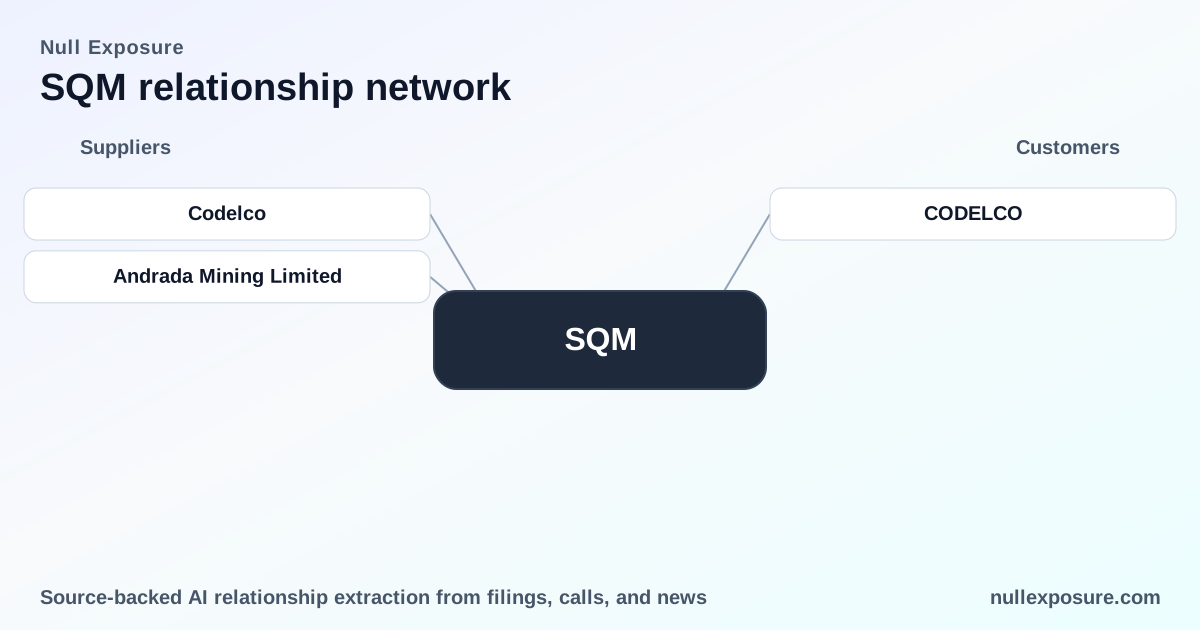
SQM’s customer footprint: commercial ties that shape production and pricing power
Sociedad Química y Minera de Chile (SQM) operates as an integrated producer of lithium, iodine, specialty plant nutrients and industrial salts, monetizing through long-cycle commodity and specialty-chemical sales, strategic joint ventures and contractual allocations to large industrial customers. Revenue stems from a combination of fixed long-term agreements, association vehicles for resource development, and spot-backed sales to battery, agricultural and pharmaceutical end markets, giving investors exposure to secular lithium demand while retaining diversification through iodine and fertilizer businesses. For deeper company relationship analytics visit https://nullexposure.com/.
How SQM contracts and where that matters
SQM runs a hybrid commercial model: contracted allocations for strategic counterparties, plus open-market sales to capture spot upside. That posture creates distinct risk and return dynamics:
- Contracting posture — SQM signs association agreements and allocation deals that secure long-term offtake for key buyers and partners, stabilizing cash flow for capital-intensive projects.
- Concentration — Production is geographically concentrated in Chile’s salt flats, and sales concentrate on a small set of large industrial customers and strategic partners that require guaranteed supply.
- Criticality — Lithium and iodine are mission-critical inputs for electric-vehicle batteries and medical imaging, respectively; a failure to supply large customers would be commercially and reputationally significant.
- Maturity — The business combines mature fertilizer and iodine segments with rapidly scaling lithium operations, yielding heterogenous margin and growth profiles across product lines.
No explicit contractual constraints were present in the available customer-scope data set; this absence is a company-level signal that the disclosed relationships are commercially oriented rather than legally encumbered in a way visible from the sources.
Relationship map: counterparties that matter to SQM’s customers and strategy
Codelco — strategic JV for Salar de Atacama lithium (earnings call)
SQM disclosed that it completed an association agreement with Codelco to create Nova Andino Litio, a vehicle designed to enable long-term lithium production from the Salar de Atacama; the disclosure came in the company’s Q4 2025 earnings call. According to the Q4 2025 earnings call transcript, this association formalizes joint development that locks in capacity and production profiles for decades, altering supply dynamics at a national scale.
Source: SQM Q4 2025 earnings call (disclosed March 2026).
Codelco — allocation volumes cited in public coverage
Public commentary around the earnings call quantified allocations, stating 33,500 metric tons of lithium are allocated to Codelco with the remainder retained by SQM, establishing a material production split that will influence SQM’s sellable volumes and pricing leverage. This allocation figure was reported in financial media coverage following the Q4 2025 call.
Source: News coverage summarizing SQM’s Q4 2025 earnings call (InsiderMonkey coverage, March 2026).
Ivanhoe Electric (IE) — access to caliche-covered concessions and exploration collaboration
SQM signed a cooperation agreement with Ivanhoe Electric to provide access to prospective caliche-covered mining concessions on major northern Chile copper belts and to support TyphoonTM-driven exploration for buried copper deposits; the arrangement positions SQM as a landholder and strategic enabler for exploration that could create optionality across base metals. The collaboration was announced in a March 2026 Newsfile release and frames SQM as a partner providing ground access and local licensing leverage.
Source: Newsfile press release announcing the Ivanhoe Electric–SQM collaboration (March 2026).
GE Healthcare — long-term iodine supply for pharmaceutical use
SQM has a supply agreement with GE Healthcare to secure iodine as a raw material for iodinated contrast media, part of GE’s broader capacity investments in Europe; this commercial tie highlights the critical role of SQM’s iodine business to pharmaceutical manufacturing chains. The supply arrangement was referenced in industry reporting covering GE Healthcare’s capacity expansion and raw-material sourcing strategy.
Source: ITN Online industry coverage noting GE Healthcare’s agreement with SQM and capacity investments (reported in the context of FY2022).
What these relationships imply for investors
- Strategic partnerships underpin material upstream optionality. The Nova Andino Litio JV with Codelco converts resource access into contracted production, supporting SQM’s lithium volume forecasts and underwriting capital allocation to expansion projects.
- Allocation mechanics create predictable off-take but reduce spot exposure. The cited allocation to Codelco—33,500 metric tons—represents a deliberate commercialization choice that stabilizes cash flow while constraining spot upside on that portion of output.
- Diversification across end markets reduces single-market cyclicality. Iodine supply agreements with pharmaceutical firms like GE Healthcare anchor margins in a different economic cycle than batteries and fertilizers, improving resilience.
- Land-access collaborations extend strategic optionality beyond primary commodities. The Ivanhoe Electric collaboration repurposes SQM’s concession footprint into an exploration enabler for copper discoveries, adding optional upside uncorrelated with lithium price cycles.
Company-level constraints and signals
The customer-scope data yielded no explicit legal or contractual constraints tied to specific relationships; presentationally, this is a company-level signal that disclosed partnerships and allocations are commercial arrangements rather than evidence of encumbering clauses visible in public filings or sourced press snippets. Investors should treat the absence of disclosed constraints as an information gap rather than definitive freedom — full diligence requires review of formal contracts and regulatory filings.
Investment implications and next steps
For investors evaluating SQM, the customer relationships reveal a deliberate strategy of balancing contracted stability with growth optionality: joint ventures and large-customer allocations protect near-term cash generation while exploration access and open-market sales retain upside exposure to battery and base-metal cycles. Given SQM’s mixed commodity mix and the scale of the Codelco association, monitor announced production allocations, JV capital schedules and iodine offtake renewals as immediate catalysts.
For a deeper read on customer counterparty networks and commercial disclosures, explore additional analysis and relationship mapping at https://nullexposure.com/.
Bold takeaways:
- Codelco JV establishes long-term lithium production and a material allocation framework.
- Iodine contracts with pharmaceutical customers insulate a revenue stream from battery-cycle volatility.
- Concession-access agreements expand optionality into copper exploration without large near-term capex commitments.
Contact the research desk via the NullExposure platform for tailored counterparty risk reports and contract-level diligence support.