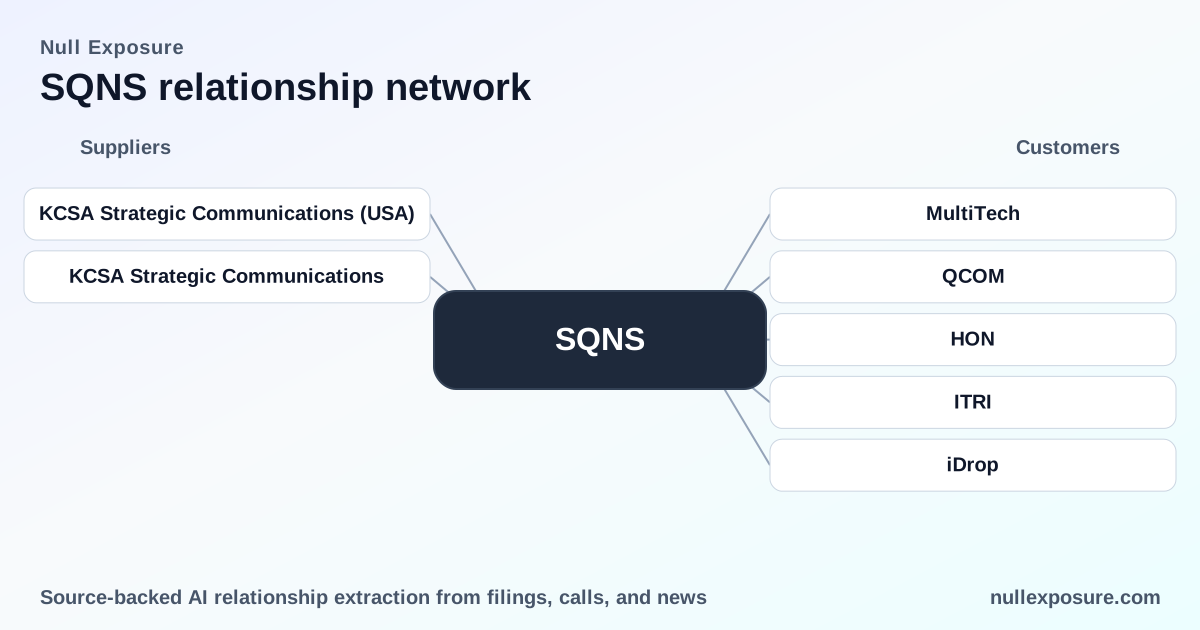
Sequans Communications (SQNS): customer relationships, commercial posture, and investment implications
Sequans designs and supplies 4G/5G cellular semiconductor modules and modem solutions for IoT OEMs and system integrators, monetizing through chip and module sales, development partnerships, and historically through IP licensing and services. After a material one‑time licensing transaction with Qualcomm in 2024, the company’s revenue profile is shifting back toward recurring product revenue driven by Cat‑M and NB‑IoT programs with OEMs and meter/asset‑tracking customers — an evolution that carries both validation and short‑term volatility. For a concise primer on Sequans’ coverage and signals, see NullExposure’s homepage: https://nullexposure.com/.
Why the customer map matters now
Sequans sits at the intersection of semiconductor economics and IoT systems procurement. The company’s commercial posture is a mix of product sales to OEM platforms and bespoke development partnerships that convert into production contracts. That hybrid model produces a set of practical characteristics investors should price into any thesis:
- Concentration risk is material: an outsized nonrecurring licensing deal with Qualcomm in 2024 produced significant prior‑period revenue, creating lumpy comparables and peak revenue distortions.
- Contracting posture is partner‑oriented: Sequans pursues OEM technology partnerships (development-to-production), which trade near‑term margin pressure for longer‑run customer lock‑in and volume scale.
- Customer criticality is rising in specific verticals: programs in Cat‑M asset tracking and smart metering are entering production with tier‑one vendors, which increases product stickiness and revenue visibility once unit ramps commence.
- Business maturity is transitional: the company is moving from the episodic income profile created by IP deals toward recurring module shipments, but operating margins and EBITDA remain challenged while capital allocation normalizes.
These are company‑level signals that explain why Sequans’ quarter‑to‑quarter financials can look volatile even as product pipelines firm up.
The customer roster — deal‑by‑deal read
MultiTech: a formal technology partnership for embedded modems
MultiTech selected Sequans as its technology partner to develop next‑generation embedded cellular modem platforms, signaling an OEM design win that positions Sequans’ silicon inside MultiTech’s modem roadmaps. This partnership was announced in a January 2026 Reuters distribution and reinforced in Sequans’ press releases and IoT‑industry coverage in early 2026. (Sources: Reuters/TradingView press release, Newsfile press release, IoT Business News, January 2026.)
Qualcomm: a large, nonrecurring IP sale and services swing in 2024
Sequans disclosed that prior‑period revenue included significant license and services revenue from Qualcomm tied to the 2024 sale and license of intellectual property; management also reiterated on its 2025 Q4 earnings call that this Qualcomm‑related revenue was meaningful and nonrecurring. That transaction materially inflated comparative revenue in 2024 and represents the principal driver of recent year‑over‑year volatility. (Sources: Sequans preliminary Q3 2025 and unaudited Q4/2025 results on Newsfile; Q4 2025 earnings call transcript.)
Honeywell: production programs in metering and tracking
Sequans called out Honeywell as a customer in expanded Cat‑M asset tracking and smart metering programs now entering production, a sign that the company’s modules are clearing engineering and qualification hurdles at a major industrial OEM. That progression increases the likelihood of recurring shipments if unit economics and supply commitments hold. (Source: Q4 2025 earnings call transcript, cited in industry press.)
Itron: metering program moving into production with tier‑one partners
Itron is referenced alongside Honeywell as a metering partner that has programs “finally entering into production,” indicating that Sequans’ modem solutions are being adopted by established metering suppliers and are progressing beyond prototyping. Production status with Itron supports a narrative of revenue ramp potential in utility metering verticals. (Source: Q4 2025 earnings call transcript / earnings‑call coverage.)
Microchip (MCHPP): developer‑board integration for faster adoption
Microchip partnered with Sequans in earlier product work to include the Monarch 2 GM02S single‑chip radio on a Microchip development board, a move that accelerates third‑party developer testing and can lower the barrier to productization for customers using Microchip MCUs. That integration is an indirect but meaningful commercial channel for Sequans technology in developer ecosystems. (Source: EEAsia coverage of Microchip development board, 2022.)
iDrop: an emerging Cat‑M customer cited in production programs
iDrop is listed by management among customers with expanded Cat‑M programs entering production, reinforcing the company’s wins in the asset‑tracking niche and providing a reference point for small‑to‑mid OEM demand beyond the largest industrial customers. (Source: Q4 2025 earnings call transcript / transcript coverage.)
What the relationship map implies for valuation and risk
Sequans’ current customer map combines validating OEM design wins with a recent large IP sale that distorts comparables. Investors should weigh these points:
- Positive: programmatic validation from Honeywell, Itron, MultiTech and developer access through Microchip enhances go‑to‑market prospects and supports the transition to higher‑frequency product revenue.
- Negative: revenue comparables will remain noisy until multi‑quarter product shipments replace the one‑time Qualcomm license as the dominant revenue source. This widens the range of plausible near‑term outcomes and elevates execution risk around production ramps.
- Operational risk centers on supply scaling and margin recovery. Moving from development partnerships to high‑volume module shipments requires inventory, contract manufacturing discipline, and sustained pricing power.
- Balance sheet and market signals are consequential. With negative operating margins and a small market capitalization, Sequans is sensitive to execution slippage; conversely, successful ramping of Cat‑M meters and trackers will validate the recurring revenue thesis.
Bottom line — how to track the story
Sequans is executing a deliberate shift from an episodic licensing profile to recurring IoT product revenue via OEM partnerships and module integrations. The next six to twelve months of production shipment data — book‑to‑bill by customer, unit ASPs, and margin trends — will determine whether the pipeline of MultiTech, Honeywell, Itron, Microchip and smaller OEMs converts into durable growth. For continued monitoring and signal aggregation on customer relationships and commercial momentum, visit NullExposure: https://nullexposure.com/.
Key datapoints to watch in upcoming releases: sequential revenue ex‑Qualcomm, product gross margin trend, disclosed production milestones for Honeywell/Itron programs, and volume commitments from MultiTech. These items will re‑price both the risk and upside embedded in SQNS.