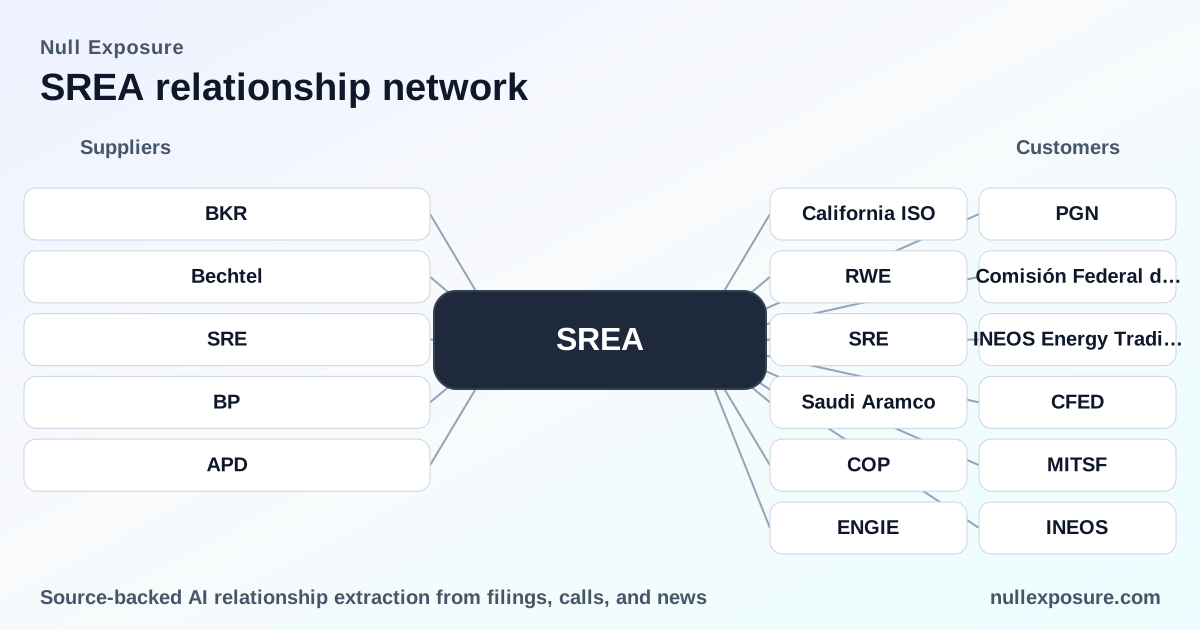
SREA — Counterparty Map and What It Means for Investors
SREA represents Sempra’s 5.750% junior subordinated notes due 2079, a fixed‑income exposure backed by Sempra’s diversified energy infrastructure businesses. Sempra monetizes through regulated gas and electric distribution in California, long‑term tolling and sale agreements for LNG export projects, and infrastructure development and lease income; the cash flow supporting SREA is therefore a blend of regulated utility receipts and long‑dated project contracts with international energy buyers. For credit and counterparty risk analysis, the dominant themes are long‑term contracting, geographic concentration in North America with strategic global off‑take partners, and a mix of regulated retail customers and large corporate counterparties. Learn more or run a bespoke counterparty audit at https://nullexposure.com/.
How Sempra’s customer mix underpins these notes
Sempra’s business model combines regulated utility cash flows (SDG&E, SoCalGas) with higher‑margin infrastructure projects (LNG export terminals, pipelines, power PPAs). Regulated distribution businesses provide revenue stability and predictable rate base returns, while LNG and power sale agreements bring long‑dated contractual cash flows that are critical to project financing and credit metrics. Key operating characteristics investors should internalize:
- Contracting posture: Sempra relies heavily on long‑term sale and purchase agreements (SPAs) and tolling contracts to underwrite capital‑intensive projects. This is a company‑level signal: Sempra’s disclosures and market filings repeatedly reference multi‑decade SPAs for LNG and long‑term transportation contracts for pipelines (constraint evidence: long_term contracts).
- Counterparty mix and concentration: Counterparties span municipal utilities and residential customers on one end and large integrated energy companies and national oil companies on the other; this creates a layered risk profile—stable retail/regulatory cash flows plus concentrated, large‑ticket counterparties for project revenues.
- Geography and criticality: North America is the operational heartland, but Sempra’s infrastructure contracts export to global buyers, increasing strategic revenue diversity while introducing geopolitical and commodity exposure.
- Maturity and spend scale: Project contracts are typically long dated (decades) and tied to material spend bands consistent with multi‑million dollar commitments, which supports project finance structures but concentrates performance risk on a few large counterparties.
If you want a deeper visualization of counterparties and contract vintage, see our platform at https://nullexposure.com/.
Detailed counterparty log — every relationship in the record
Below I cover each relationship entry from the company and news sources, with a concise, plain‑English summary and a source pointer.
California ISO (FY2024)
Sempra’s SDG&E has an arrangement allowing the California ISO to control certain high‑voltage transmission lines for FERC‑approved prices, reflecting regulated transmission coordination that impacts rate recovery and operating obligations. Source: Sempra Form 10‑K (FY2024).
Polish Oil and Gas Co. / PGNiG (FY2021)
Sempra LNG executed a memorandum of understanding with the Polish Oil and Gas Co. for potential purchases of LNG sourced from Sempra’s North American project portfolio, indicating pursuit of European off‑take opportunities. Source: Power‑Engineering coverage of the 2021 MOU (reported FY2021).
RWE Supply & Trading (FY2022 — press release)
Sempra Infrastructure announced a long‑term sale and purchase agreement with RWE Supply & Trading for about 2.25 Mtpa of LNG from the Port Arthur LNG Phase 1 project, establishing RWE as a committed project off‑taker. Source: Sempra press release (FY2022).
RWE (FY2022)
RWE’s corporate group is identified as a counterparty for Port Arthur LNG Phase 1 under long‑term SPA terms, signaling European utility demand anchoring the project. Source: Sempra press release (FY2022).
ConocoPhillips (FY2023)
ConocoPhillips is listed among parties that have contracted binding, long‑term capacity at the Port Arthur Phase 1 project, which supports the project’s financeable revenue base. Source: Offshore‑Energy reporting (FY2023).
Saudi Aramco (FY2024)
Reports indicate Saudi Aramco agreed to buy a stake in Sempra’s Texas LNG export plant with an arrangement that would include fuel shipments from the project, reflecting strategic upstream investor involvement in U.S. LNG capacity. Source: Energy Connects coverage (FY2024).
ENGIE (FY2023 / FY2022)
ENGIE is a long‑term buyer under binding agreements for capacity at Port Arthur and Phase 1 projects, adding a major European energy player to the project’s counterparty roster. Source: Offshore‑Energy (FY2023) and Sempra press materials (FY2022).
INEOS / INEOS Energy Trading Ltd. (FY2023 / FY2022)
INEOS is listed as a contracted off‑taker for Port Arthur Phase 1 and as a marketing counterparty during project development, representing industrial energy buyers anchored by multi‑year commitments. Source: Offshore‑Energy (FY2023) and EnergyConnects (FY2022).
PKN ORLEN (FY2023)
PKN ORLEN is cited among the binding long‑term agreements subscribing Port Arthur Phase 1 capacity, showing Central European refiners/utilities participating in U.S. LNG offtake. Source: Offshore‑Energy (FY2023).
SRE / Sempra (FY2023)
Sempra (ticker SRE) is centrally referenced as the corporate sponsor that markets and signs long‑term agreements for the infrastructure projects that ultimately support note cashflows. Source: Offshore‑Energy and Sempra press materials (FY2022–FY2023).
ConocoPhillips (Sempra press release, FY2022)
Sempra Infrastructure announced long‑term agreements with ConocoPhillips (among others) for roughly 7.3 Mtpa of LNG from proposed Phase 1 capacity, reinforcing the multi‑counterparty contractual backlog. Source: Sempra press release (FY2022).
COP (ticker reference, FY2022)
Market communications list ConocoPhillips under the COP ticker as a signed long‑term buyer for Sempra’s Phase 1 sales portfolio. Source: Sempra press release (FY2022).
Silicon Valley Power (FY2022)
Sempra Infrastructure signed a 20‑year power purchase agreement with Silicon Valley Power, a municipal utility, highlighting long‑dated renewable/power revenue secured with a municipal offtaker. Source: Mexico News Daily coverage of the PPA (FY2022).
Comisión Federal de Electricidad / CFE / CFED (FY2022 / FY2024)
Sempra Infrastructure sells natural gas to Mexico’s CFE under supply agreements and references supply directed to CFE‑backed generation projects in Baja California Sur and export pathways to Asian markets, showing important regional offtake and pipeline linkages. Source: Sempra newsroom (FY2022) and Sempra Form 10‑K (FY2024).
MITSF / Mitsui & Co. (FY2021)
The ECA LNG Phase 1 project has a definitive 20‑year SPA with Mitsui & Co. for about 0.8 Mtpa, adding a major Asian trading house as a long‑dated buyer. Source: Offshore‑Energy reporting (FY2021).
PGNiG / Polish Oil & Gas Company (FY2022)
Sempra announced non‑binding and subsequent marketing agreements with PGNiG as part of Phase 1 project commercialization, representing Eastern European state‑backed demand interest. Source: EnergyConnects reporting (FY2022).
(Entries above reflect every relationship record included in the reviewed results, drawn from Sempra regulatory filings and industry press between FY2021–FY2024.)
What these relationships mean for SREA holders
- Revenue profile is hybrid: regulated utility cash flows provide downside protection while long‑term SPAs underpin project revenue used in capital structures that ultimately support subordinated notes. This mix improves predictability but concentrates project risk among a handful of large offtakers.
- Contract tenor and counterparty credit matter: long‑term SPAs (often 20+ years) are a structural positive for project cashflow certainty; however, creditworthiness of major counterparties (national oil companies, European utilities, integrated majors) is the primary driver of project risk and therefore indirect support for SREA.
- Geographic diversification reduces single‑market exposure: North America remains the core operating region, but contracted LNG offtake spans Europe and Asia, which diversifies market risk yet introduces commodity and geopolitical vectors investors must price.
Final read
SREA’s credit support is rooted in Sempra’s regulated utilities and a set of long‑dated SPAs and tolling agreements with globally recognized energy buyers. Investors should focus diligence on counterparty credit quality and SPA tenure, regulatory outcomes in California and Mexico, and the pace of project execution at Port Arthur and related terminals. For tailored counterparty scoring and exposure mapping, visit https://nullexposure.com/ for a detailed review.