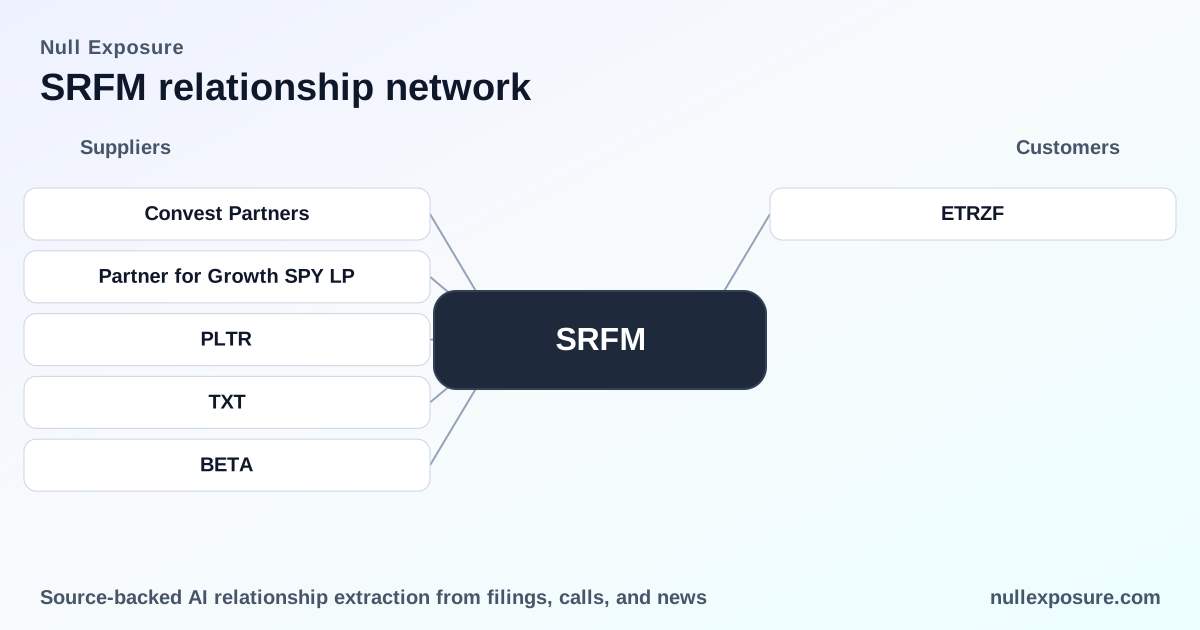
Surf Air Mobility (SRFM): customer relationships and commercial implications
Surf Air Mobility operates a regional air mobility platform that monetizes through scheduled seat sales, on‑demand charters, and subsidized U.S. DOT Essential Air Service (EAS) contracts, while pursuing fleet transformation to hybrid‑electric and battery‑electric aircraft and commercial partnerships to scale new airframe technology. This business model combines recurring route revenue with capital‑intensive fleet conversion and periodic institutional capital raises to bridge negative EBITDA to eventual scale. For a deeper look at how we assemble these signals, visit https://nullexposure.com/.
What the company’s operating posture tells investors
Surf Air Mobility runs as a single operating segment—Air Mobility—that sells services rather than hardware. Company filings and disclosures set clear commercial characteristics for the business:
- Contracting posture mixes long‑term subsidized route commitments and spot on‑demand revenue. The company holds U.S. DOT contracts typically lasting 2–4 years that underwrite scheduled service on underserved routes; simultaneously, it sells ad‑hoc charter flights on a per‑request basis. Company disclosure language describes both contract types as active parts of revenue generation.
- Customer base spans individuals and public agencies. The airline sells per‑seat scheduled service to regional business and leisure travelers while also contracting with government entities under the EAS program, creating a hybrid revenue profile with both retail and public counterparty exposure.
- Geographic concentration is U.S.‑centric with global positioning. Operational footprint and long‑lived assets are based in the United States and revenue is substantially U.S. sourced, though the business describes its platform as servicing passengers “in the U.S. and globally,” which signals ambition beyond the domestic network.
- Seller of services with platform characteristics. Surf Air is primarily a service provider—scheduled flights and on‑demand charters—augmented by a software and operations platform that could scale with new aircraft types.
- Maturity and capital structure constraints. Negative EBITDA and recurring capital raises indicate an early commercial scaling stage; institutional investors and insiders are active sellers/buyers in rollover financings.
These characteristics combine into a profile where route subsidy stability and government counterparty relationships reduce demand volatility on certain routes, while fleet conversion and certification timelines create timing and execution risk.
Customer relationship inventory: every mention in the filings and press
Below are the relationships flagged in our review; each entry is followed by a concise, plain‑English description and a source note.
Mokulele Airlines
Surf Air’s aircraft order activity connects to Mokulele as an operational deployment partner: Surf Air intends to initially deploy ordered all‑electric Beta Alia CTOL aircraft for cargo services under the Mokulele Airlines banner in Hawaii. This signals Surf Air’s strategy to place new airframes into regional, island‑route operations where short hops and logistics can be mission‑critical. According to PrivateJetCardComparisons (March 2026), the operator expects initial cargo deployment in Hawaii.
LamVen
LamVen participated as a buyer in Surf Air’s equity financing: Surf Air sold 13,318,181 shares to LamVen (and another institutional investor) in a registered direct offering priced at $1.10 per share as part of a roughly $15 million raise. That transaction demonstrates Surf Air’s reliance on institutional capital injections to fund operations and expansion. This was reported on TradingView (May 2026).
Electra (ticker referenced as ETRZF)
Electra’s electric aircraft program is positioned as a prospective supplier and strategic technology partner: Electra’s EL9 Ultra Short aircraft is cited as capable of leveraging Surf Air Mobility’s operations and software platform to scale the aircraft commercially once certification is complete, indicating a technology supplier relationship with commercial partnership potential. ASDNews covered the commercial demonstrations and potential linkage in August 2025.
ETRZF (duplicate reference to Electra)
The dataset includes a separate entry referencing Electra by its ticker, ETRZF, repeating the same commercial linkage: the EL9’s certification is a gating item for full commercial integration with Surf Air’s platform. This duplicate appears in the same ASDNews coverage (August 2025) and reinforces that Electra/ETRZF is treated as a supplier/partner in multiple feeds.
What these relationships imply for revenue, concentration and execution risk
- Revenue mix: recurring scheduled seats plus ad‑hoc charter and subsidized routes. The EAS contracts underpin reliable route cash flows on specified routes, while on‑demand charters provide marginal revenue opportunities and pricing flexibility.
- Concentration and criticality: supplier and partner dependencies are material. Electra’s EL9 represents a potential future fleet source; certification is a critical path item for fleet‑based scaling and decarbonization economics. Failure to certify or delayed certification would be commercially meaningful.
- Capital and ownership signals: external investors underwrite the runway. The LamVen placement is an explicit signal that Surf Air finances operations and growth through registered direct issuances to institutions and insiders, which compresses liquidity and can dilute equity when repeated.
- Commercial maturity: early commercial scale with operational footprint in select U.S. regions. The company’s negative EBITDA, uneven revenue growth, and concentration of activity in U.S. regional routes indicate growth stage economics; subsidies and contractual routes mitigate downside on select legs but do not eliminate network‑level margin pressure.
Risks and practical watch‑items for investors
- Certification and fleet execution risk is front‑and‑center: strategic partnerships with aircraft manufacturers are essential to the long‑term cost and environmental thesis, and these relationships are only productive if the aircraft clear regulatory certification and operational integration.
- Capital dependency—recent registered directs show a pattern of financing reliance; further dilution is probable if operating losses continue.
- Route concentration and subsidy exposure—EAS contracts provide stability but also create political and renewal risk tied to government program funding and regional demand shifts.
- Operational integration—deploying new electric aircraft into island and short‑haul logistics (e.g., Mokulele in Hawaii) is operationally complex and will test the company’s integration capabilities.
For more on how these commercial signals are assembled into investment insights and to track subsequent relationship changes, explore our coverage at https://nullexposure.com/.
Bottom line: what investors should take away
Surf Air Mobility is a service‑first regional airline with a bifurcated revenue model: stable, contract‑backed route revenue plus spot on‑demand sales, coupled with an ambitious fleet transition strategy that requires successful supplier partnerships and certification outcomes. Key value drivers are route subsidy stability and successful aircraft certification; key risks are execution on fleet transformation and ongoing capital needs. Investors should monitor certification milestones with Electra/ETRZF, deployment progress with Mokulele in Hawaii, and any additional institutional financings following the LamVen placement as leading indicators of the company’s trajectory.