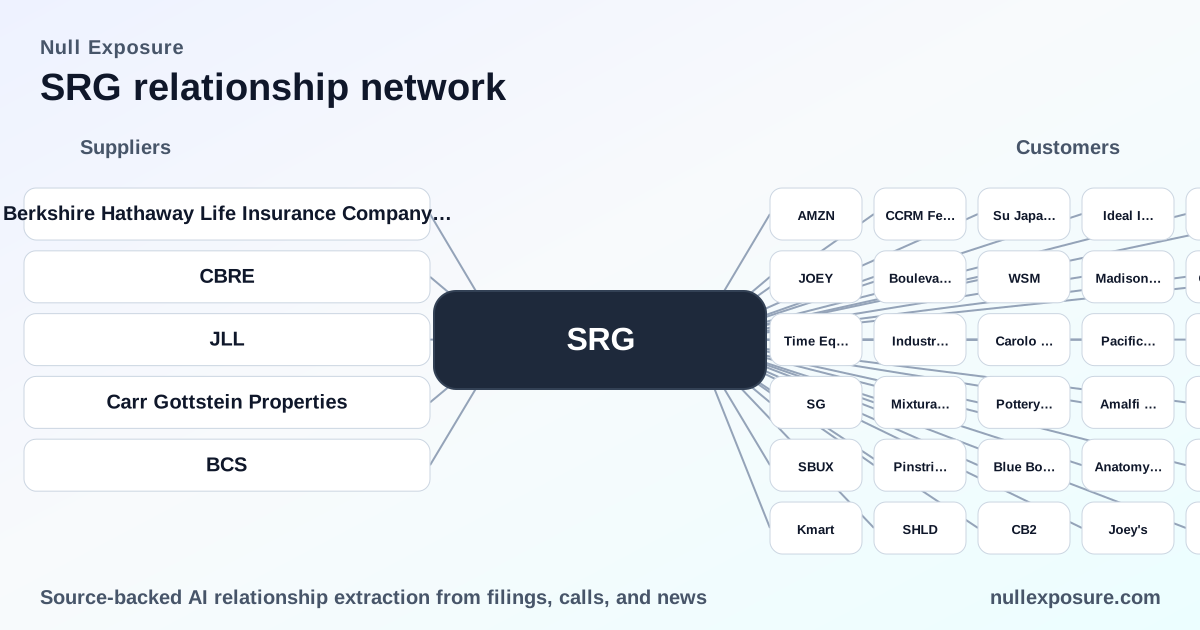
Seritage Growth Properties (SRG): Tenant roll-up and what the customer map tells investors
Seritage Growth Properties is a self-managed REIT that monetizes a portfolio of predominantly U.S. retail and mixed‑use properties through leasing, selective property sales and fee-based management services for unconsolidated affiliates. The company extracts value by redeveloping former Sears/Kmart parcels into higher-density retail, office and experiential uses, capturing cash flow from long‑term leases and one‑off disposition gains while also providing property-level services to joint ventures. Revenue drivers are rental income, asset sales and third‑party services; exposure is concentrated in the U.S. and skewed to a small set of higher-value tenants. For deeper relationship signals and historical coverage, see https://nullexposure.com/.
Portfolio snapshot: anchor tenants, restaurant clusters and active disposal partners
Seritage’s customer relationships fall into three practical buckets: large corporate occupiers that anchor redevelopments (notably Amazon), national retail and food-and-beverage tenants that populate centers (Williams Sonoma, Starbucks, Sweetgreen, etc.), and institutional buyers/partners that acquire finished assets (Boulevard Step Ventures, The Easton Group, Benderson). Below I summarize every named relationship surfaced in the referenced coverage.
-
Amazon / AMZN / Amazon.com, Inc. — Amazon signed a 123,000 sq ft lease at The Collection at UTC in La Jolla, taking the top two floors and committing to an office presence that Seritage says will house roughly 700 employees; reported by CityBiz and ConnectCRE in March 2026. (CityBiz, Mar 10, 2026 — https://www.citybiz.co/article/256315/seritage-growth-properties-signs-123000-square-foot-lease-with-amazon-at-the-collection-at-utc/; ConnectCRE, Mar 2026 — https://www.connectcre.com/stories/seritage-secures-lease-with-amazon-at-the-collection-in-la-jolla/)
-
Williams Sonoma / WSM — Williams Sonoma is listed among ground-level retail tenants at The Collection at UTC alongside other specialty brands, per CityBiz reporting detailing the mix below Amazon’s office floors. (CityBiz, Mar 10, 2026)
-
Pottery Barn Kids — Named by CityBiz as part of the ground-level retail mix at The Collection at UTC. (CityBiz, Mar 10, 2026)
-
Pacific Catch — Included in The Collection tenant roster that complements the Amazon lease. (CityBiz, Mar 10, 2026)
-
CB2 — Identified as one of the specialty retail tenants at The Collection at UTC. (CityBiz, Mar 10, 2026)
-
Blue Bottle Coffee — Listed among café and food concepts inside The Collection’s retail layer. (CityBiz, Mar 10, 2026)
-
Ideal Image — A service tenant cited as part of the retail composition at The Collection at UTC. (CityBiz, Mar 10, 2026)
-
Madison Reed — Named as a specialty retail tenant at The Collection at UTC. (CityBiz, Mar 10, 2026)
-
Blue‑chip food & beverage / quick‑service brands (Starbucks, Sweetgreen, Pura Vida) — These operators are documented as part of the tenant mix at Seritage’s Esplanade at Aventura and similar redevelopments, signaling health‑and‑dining demand in Seritage projects. (JLL newsroom, FY2025 — https://www.jll.com/en-us/newsroom/mixed-use-retail-center-esplanade-at-aventura-in-miami-sells)
-
STK / STKE — STK was listed among the Esplanade at Aventura food-and-beverage tenants that comprised the center’s opening mix before its sale. (JLL, FY2025)
-
Joey’s / JOEY — Restaurant operator that signed at Esplanade and is referenced among tenants in construction and sale coverage. (The Real Deal, FY2022; JLL, FY2025)
-
Amalfi Llama — Named as a food concept in Esplanade tenant lists in the JLL release on the asset sale. (JLL, FY2025)
-
North Italia — Part of the Esplanade tenant roster cited in the JLL sale notice. (JLL, FY2025)
-
One Medical — Cited as a health-and-wellness tenant at Esplanade. (JLL, FY2025)
-
LEGO (LEGO‑U) — Included among specialty retail tenants at Esplanade, per JLL’s description. (JLL, FY2025)
-
Anatomy Fitness — Documented as a fitness/health tenant at Esplanade. (JLL, FY2025)
-
Pure Barre — Listed in the Esplanade tenant composition. (JLL, FY2025)
-
Mixtura Market — Named among pre-construction tenants that signed for Esplanade at Aventura. (The Real Deal, FY2022)
-
Pinstripes — One of the early tenants signed at Esplanade prior to construction pauses. (The Real Deal, FY2022)
-
Su Japanese — Included among the original tenant commitments at Esplanade. (The Real Deal, FY2022)
-
CCRM Fertility — Signed a long‑term lease for an 18,179‑sq‑ft office space at Esplanade, per press coverage. (The Real Deal, FY2022)
-
Industrious — The flexible‑office operator occupies office space at Esplanade and is explicitly referenced in post‑sale marketing materials. (JLL, FY2025)
-
Dave & Buster’s / PLAY — A 34,000‑sq‑ft Dave & Buster’s entertainment center was fitted into a former Sears redevelopment, as reported in local coverage. (The Review, FY2019)
-
Petsmart (PETM) — Named as a replacement retailer on redeveloped Sears sites; cited in redevelopment coverage. (Herald Tribune, FY2016)
-
Dick’s Sporting Goods (DKS) — Identified as an anchor occupant in Sears-redevelopment plans. (Herald Tribune, FY2016)
-
Lucky’s Market — Cited in local redevelopment reporting as a planned occupant of redeveloped Sears sites. (Herald Tribune, FY2016)
-
Sears / Sears Holdings Corp. / SHLD / SHLWQ — Seritage’s heritage is a Sears spinoff and older filings and press note the historical leasebacks and the company’s subsequent reduction of Sears/Kmart exposure as it re‑tenanted properties. (StarAdvertiser, 2016; CNBC, 2022; REIT magazine, 2022)
-
Kmart — Former Kmart parcels are part of Seritage’s legacy portfolio; reporting over time documents disposition and re‑tenanting activity. (CNBC, 2022; The Real Deal, FY2022)
-
Time Equities, Inc. — Purchased Midtown Mall and a former Sears warehouse from Seritage for $44 million, showing institutional secondary-market demand for Seritage assets. (AKBizMag, FY2022)
-
Boulevard Step Ventures LLC — Entered into purchase agreements to acquire Seritage’s Esplanade properties in Aventura and is reported as the buyer in the JLL sale. (JLL, FY2025; Investing.com, FY2025)
-
The Easton Group — Acquired a former Sears building and parking from Seritage at Miami International Mall for $17M, according to regional deal listings. (Bisnow, FY2024)
-
Benderson Development Company, LLC — Acquired Clearwater Shoppes from Seritage for $28.5M, per transaction reporting. (MarketScreener, FY2024)
-
3911 McCain LLC — Identified as the buyer in a transaction that included properties sold by Seritage SRC Finance LLC, an affiliate, per local deal coverage. (Arkansas Business, FY2024)
-
Carolo Holdings — Sued Seritage in a lease dispute at Esplanade, an example of tenant litigation that arises from construction pauses and redevelopment timing. (The Real Deal, FY2022)
-
RVLV (Revolve Group) — Reporting on Revolve’s permanent store opening referenced in‑house brands including “SRG,” reflecting brand-level activity tied to the SRG name in fashion retail coverage. (MR‑Mag, FY2026)
This roll‑call covers every named relationship surfaced in the referenced coverage and highlights that Seritage is simultaneously a landlord, developer and occasional seller of stabilized or value‑add assets. Large corporate occupiers and active institutional buyers dominate the most material relationships.
Operating constraints and what they imply for customer exposure
Several company‑level signals extracted from filings and coverage explain Seritage’s commercial posture:
-
Contracting posture: The company recognizes base rent on a straight‑line basis over non‑cancelable, long‑term leases, and historically executed master leases (e.g., with Transform Holdco/ESL affiliates) — this indicates a bias toward durable cash flows in core holdings rather than short, churn‑heavy leasing.
-
Geographic concentration: All revenue and tangible assets are U.S.-based, so macro demand is tied to U.S. retail and office markets.
-
Counterparty mix: Seritage competes for tenants with REITs and large institutional owners but also deals with individual and large‑enterprise counterparties, reflecting a tenant base that spans national chains to independent restaurateurs.
-
Materiality: Management disclosed one tenant representing 12.5% of annualized base rent, making a small number of occupants relatively material to cash flow.
-
Business roles: Seritage functions as seller (frequent asset dispositions and gains) and service provider (management, leasing and construction services for unconsolidated affiliates), creating diversified margin streams but also operational complexity.
-
Relationship stage: Coverage and in‑place lease metrics indicate a meaningful share of the portfolio is active and leased, while the Plan of Sale and asset dispositions point to a transitionary strategy.
These constraints imply Seritage’s cash flow profile blends steady long‑term lease income with episodic sale gains; investors must track tenant concentration, redevelopment schedules and timing of asset sales.
Investment takeaway and next steps
Seritage’s customer map shows an operator monetizing land and retail density through strategic re‑tenanting and selective dispositions. Key investment variables are tenant concentration risk (one tenant >12% of ABR), U.S. market exposure, and execution on redevelopment-to-sale events. For analysts modeling future cash flow, prioritize the timeline for redevelopment completions, the confirmed leases for anchor office/tech users like Amazon, and the pipeline of institutional buyers.
If you want continual, signal‑level tracking of Seritage’s tenant and buyer relationships, visit https://nullexposure.com/ for the research interface and coverage tools.