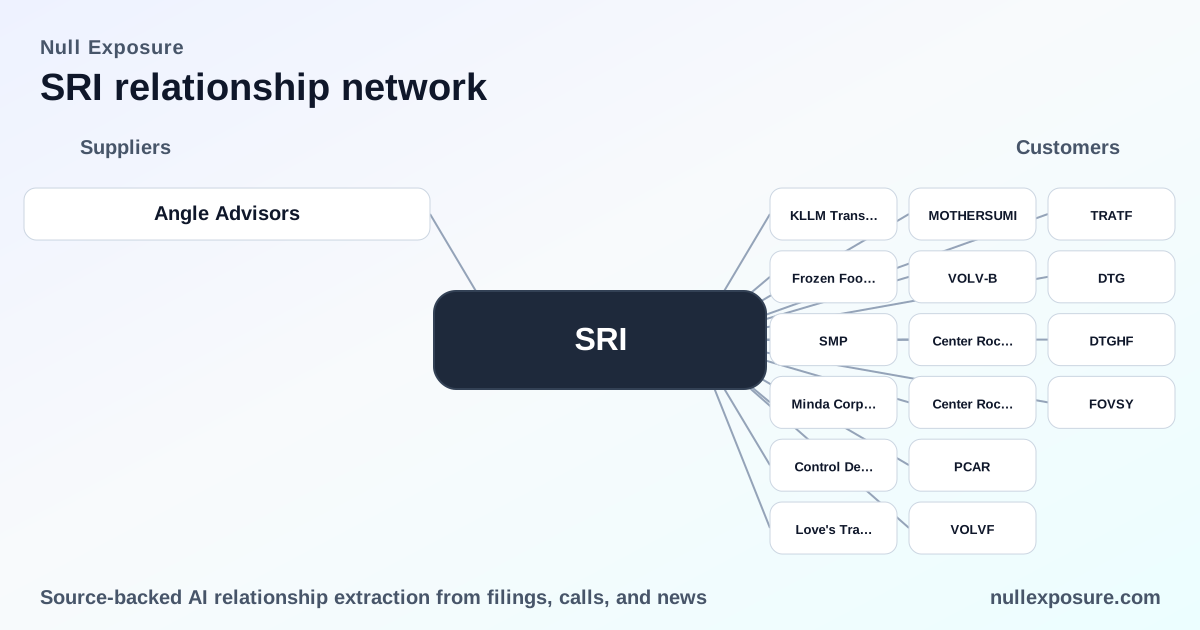
Stoneridge (SRI) — Customer Relationships That Define Revenue Visibility and Execution Risk
Stoneridge manufactures electrical and electronic components and systems for OEMs, fleets and aftermarket channels, monetizing through serial-production part sales, recurring monitoring services and selective aftermarket device retail. Revenue is concentrated in the commercial vehicle OEM channel, backed by multi-year model-life contracts, but supplemented by aftermarket and fleet specifications that provide episodic, higher-margin wins. For deeper customer-by-customer intelligence, see Null Exposure.
What investors need to know in one paragraph
Stoneridge’s business combines sole-source OEM supply agreements that run for the life of vehicle programs (typically one to seven years) with aftermarket distribution and monitoring-service revenues; this mix creates predictable base sales with episodic upside from new OEM program launches and aftermarket rollouts. The company’s recent portfolio rationalization—selling its Control Devices segment—changes the customer map and requires short-term manufacturing continuity arrangements to preserve supply to buyers of that business.
Full roster: each customer or counterparty mentioned in the coverage
Below I cover every relationship referenced in the source material, with a concise takeaway and the published source.
-
LNAI — LNAI made an initial payment of $600,000 to Stoneridge and committed to fund future HIV research with Stoneridge’s licensors, reflecting a specific sponsored-research style transaction rather than an OEM supply contract; this was recorded in LNAI’s FY2025 filing. According to LNAI’s FY2025 10‑K filing, the payment and funding agreement are documented in the company’s disclosures (FY2025 10‑K).
-
Standard Motor Products (SMP) — SMP acquired certain switch and connector product lines from Stoneridge, moving those SKUs and their aftermarket/aftermarket-adjacent revenue out of Stoneridge’s portfolio; the transaction was announced by Angle Advisors in March 2026. Angle Advisors reported that SMP completed the purchase of those product lines from Stoneridge (news release, March 2026).
-
Frozen Food Express (FFE) — FFE, together with KLLM Transport Services, incorporated Stoneridge’s MirrorEye camera-monitor system into equipment specifications with the target of about 1,000 installations in 2023, demonstrating fleet-level adoption of Stoneridge telematics/hardware offerings. TruckingInfo covered the fleets’ plan to specify MirrorEye on new vehicles (TruckingInfo, FY2023).
-
KLLM Transport Services — KLLM joined FFE in specifying MirrorEye for its new trucks, representing a material fleet-spec channel for MirrorEye installations and recurring product sales. The fleet specification and installation expectation were published on TruckingInfo (FY2023).
-
Control Devices (business/segment) — Stoneridge entered manufacturing agreements in Mexico and China to ensure continuity for Control Devices product supply after divestiture, indicating transitional supply arrangements to the buyer. TradingView reported the Mexico and China manufacturing agreements tied to the Control Devices sale (news, March 2026).
-
Center Rock Capital Partners / Center Rock Capital — An affiliate of Center Rock Capital Partners acquired Stoneridge’s Control Devices segment for a base purchase price of $59 million; the sale closed in early May 2026 and triggered a material stock-price reaction. Investing.com and MarketScreener covered the completion of the Control Devices sale and market reaction (press release coverage, May 4, 2026).
-
Minda Corporation (Spark Minda Group) — Minda bought back Stoneridge’s stake in the Minda‑Stoneridge JV, taking full control of the instrument cluster and sensors business; Stoneridge supported local engineering and compliance needs tied to EGT/EGRT sensor localization requirements. The Economic Times reported Minda’s buyback and related JV activity (news, FY2021).
-
Motherson Sumi Systems Ltd (MOTHERSUMI) — In 2014 Motherson completed the acquisition of Stoneridge’s wiring-harness business for $65.7 million, an example of Stoneridge divesting legacy harness assets to focus on electronics and systems. Economic Times archived coverage documents the transaction (news, FY2014).
-
Volvo Trucks North America / Volvo — Volvo has launched OEM programs in North America that offer Stoneridge’s MirrorEye system across several nameplates; management highlighted this as a material program development in its 2025 Q2 earnings call. Stoneridge’s Q2 2025 earnings call transcript references new program launches with Volvo (2025 Q2 earnings call).
-
Daimler / Daimler Truck North America (DTG/DTG variants) — Daimler Truck North America launched MirrorEye programs alongside Volvo, marking another multi-OEM adoption in North America that supports recurring systems revenue from mirror-replacement camera systems. Management cited the Daimler program in the 2025 Q2 earnings call and earnings coverage (2025 Q2 earnings call / earnings transcripts).
-
PACCAR (PCAR) — PACCAR is one of Stoneridge’s top five customers and accounted for 16% of net sales in 2024, illustrating substantial customer concentration within the top tier. Stoneridge’s 2024 Form 10‑K lists PACCAR as the largest customer by percent of net sales (FY2024 10‑K).
-
Traton — Traton comprised roughly 13% of net sales in 2024, placing it among the small number of OEMs that drive a meaningful portion of Stoneridge revenue. Stoneridge disclosed Traton’s share of net sales in the 2024 Form 10‑K (FY2024 10‑K).
-
Volvo (as a consolidated top‑five customer) — Volvo accounted for approximately 13% of net sales in 2024, reinforcing the OEM concentration in Stoneridge’s sales mix. The company’s 2024 10‑K lists Volvo among the top five customers (FY2024 10‑K).
-
Daimler Truck (as a consolidated top‑five customer) — Daimler Truck contributed about 7% of net sales in 2024, another key OEM relationship reflected in the company’s customer concentration disclosure. Stoneridge included Daimler Truck in its 2024 top-five customer listing (FY2024 10‑K).
-
Ford — Ford represented roughly 7% of net sales in 2024, completing the set of five customers that together account for a concentrated portion of revenue. The 2024 Form 10‑K quantifies Ford’s contribution to net sales (FY2024 10‑K).
-
Love’s Travel Stops and Country Stores — Stoneridge made its EZ‑ELD electronic logging device available at Love’s retail locations, representing a retail distribution channel for an aftermarket product and a route to broad driver-level adoption. PR Newswire covered the Love’s retail rollout for EZ‑ELD (news release, FY2017).
How these relationships shape the operating model and risk profile
-
Contracting posture and maturity: Stoneridge executes a mix of long-term OEM model-life contracts (commonly 3–7 years) and shorter requirements or spot transactions; this structure yields predictable base revenue from OEM programs and episodic upside from new launches. Several source excerpts describe master purchase agreements, award letters and program-life obligations as the core contracting framework (company 10‑K disclosures).
-
Concentration and criticality: The top five customers — PACCAR, Traton, Volvo, Daimler Truck and Ford — together accounted for approximately half of the company’s visibility into net sales (16%, 13%, 13%, 7%, 7% respectively in 2024), creating concentration risk but also negotiating leverage tied to sole‑source parts on many programs (2024 10‑K).
-
Geographic coverage and distribution roles: Stoneridge operates as a global supplier with NA, EMEA, APAC and LATAM footprints, selling both direct-to-OEM and through aftermarket distributors; the Brazil segment focuses on South American aftermarket and telematics sales, while APAC and EMEA serve OEM and aftermarket channels (company disclosures).
-
Revenue mix and criticality of continuity: Most serial production parts are recognized at shipment; monitoring services are recognized over time, providing recurring revenue. Divestitures (wiring harnesses, Control Devices) change the revenue composition; transitional manufacturing agreements were put in place to preserve supply to buyers post-sale, reducing short-term disruption risk (press releases and news coverage, 2026).
Investment implications and key takeaways
- Positive: OEM program wins with Volvo and Daimler in North America and fleet specifications (KLLM/FFE) for MirrorEye create scalable, higher-margin system revenue opportunities.
- Negative: High customer concentration and recent divestitures make revenue visibility sensitive to OEM program timing and the effectiveness of transitional manufacturing arrangements for sold segments.
- Action: Monitor OEM program ramp schedules, aftermarket device distribution pickup, and how proceeds and cost savings from disposals are redeployed into growth segments. For ongoing customer-intel needs and real‑time relationship tracking visit Null Exposure.
This analysis synthesizes public filings and press coverage to map the customer landscape that underpins Stoneridge’s top-line and execution risk profile.