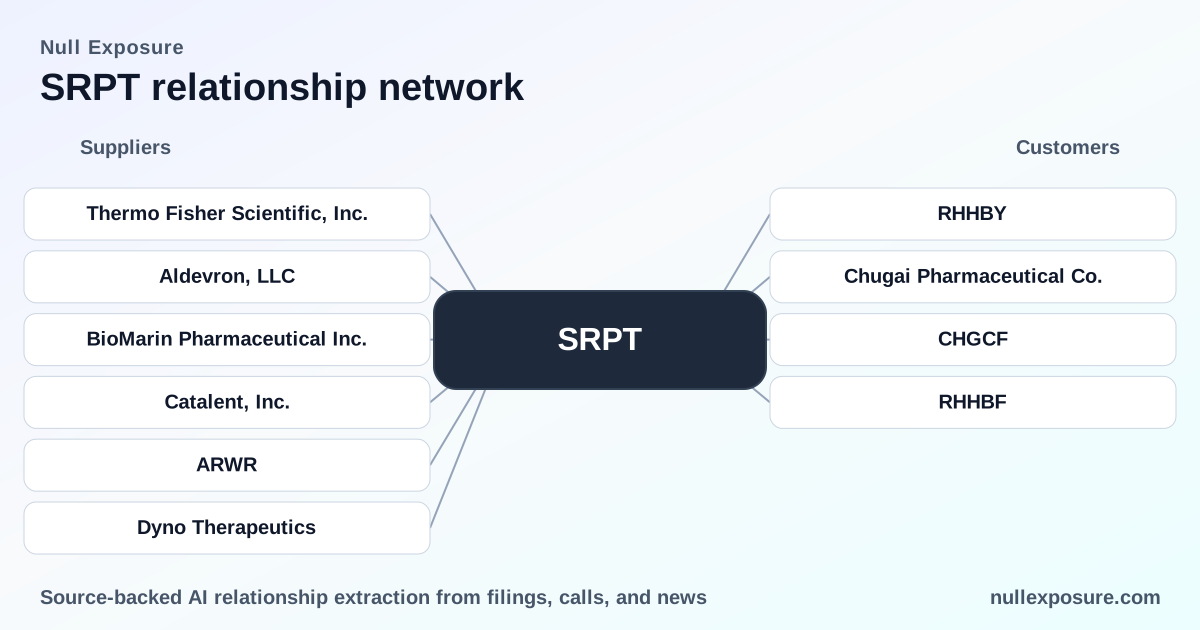
Sarepta Therapeutics: Customer Relationships Driving Gene‑Therapy Commercialization
Sarepta Therapeutics commercializes RNA‑targeted and gene therapies for rare diseases and monetizes through product sales, contracted manufacturing, and licensing collaborations with major pharmaceutical partners for ex‑U.S. commercialization and distribution. Contract manufacturing revenues and partner launches — particularly for ELEVIDYS — are material contributors to near‑term revenue and strategic optionality, while payor coverage and international pricing controls shape market access. For an operator or investor assessing counterparty risk, focus on supply agreements, partner exclusivity, and reimbursement exposure. Learn more at Null Exposure.
How these customer ties translate into cash and risk
Sarepta is a commercial‑stage biotech with trailing revenue of roughly $2.20 billion and negative operating margins, reflecting high R&D and commercialization costs. The company leverages partner licensing and supply relationships to scale global launches without building full international commercial infrastructure. That model converts large capital and operational fixed costs into variable, contract‑driven revenue through manufacturing and royalty/licensing mechanics.
Key business model characteristics to note:
- Contracting posture: Sarepta operates as both seller (direct U.S. distributor) and supplier to partners under negotiated supply agreements — contracts that shift manufacturing volume risk and revenue recognition timing to shipment events.
- Customer concentration: Roche and Chugai are primary external commercialization partners for ELEVIDYS outside the U.S., creating concentration risk around partner performance and regulatory approvals.
- Criticality: Manufacturing shipments of ELEVIDYS are critical revenue drivers; increased shipment volume directly raised collaboration and other revenues in FY2026.
- Maturity: Sarepta is commercial‑stage but still investing heavily in R&D and global commercialization; partnerships provide staged international rollout and risk sharing.
- Payor and geographic constraints: Government payors and national pricing/reimbursement rules across NA, EMEA, LATAM and APAC materially influence realized pricing and uptake.
Relationship ledger — source‑level briefs
Below are concise, plain‑English summaries of every customer relationship record surfaced in the coverage data, each with its source noted.
Roche — BioSpace press release (FY2026)
A Sarepta press release reported that collaboration and other revenues rose about $53.0 million in FY2026, primarily because contract manufacturing revenues increased by $45.6 million driven by higher shipments of ELEVIDYS to Roche. This ties direct manufacturing throughput to near‑term revenue swings. (Source: Sarepta press release on BioSpace, March 10, 2026.)
RHHBY (Roche) — duplicate BioSpace entry (FY2026)
The same BioSpace disclosure is also indexed under Roche’s ticker variant: Sarepta attributes most of the collaboration revenue lift to contract manufacturing volume for ELEVIDYS destined for Roche, reinforcing the single commercial driver across entries. (Source: Sarepta press release on BioSpace, March 10, 2026.)
Roche — TradingView / Zacks article (FY2026)
Financial coverage notes the 2019 licensing arrangement: Roche has exclusive rights to launch and market ELEVIDYS outside the United States under the licensing agreement entered in 2019, positioning Roche as Sarepta’s channel partner for international commercialization. (Source: Zacks summary on TradingView, May 4, 2026.)
Chugai Pharmaceutical Co. — BioSpace press release (FY2026)
Sarepta’s announcement highlighted that Chugai launched ELEVIDYS intravenous infusion in Japan in February 2026 — Japan’s first regenerative medical product for Duchenne muscular dystrophy — representing a formal market entry via a local partner. This launch extends ELEVIDYS access in a key APAC market through Chugai’s commercial infrastructure. (Source: Sarepta press release on BioSpace, March 10, 2026.)
CHGCF (Chugai) — SahmCapital commentary (FY2026)
Market commentary tied to Sarepta news observed that commercial launch of ELEVIDYS in Japan through Chugai, together with positive analyst commentary, is influencing expectations for Sarepta’s Duchenne franchise, signaling investor sentiment linkage between partner launches and equity re‑rating potential. (Source: SahmCapital analysis, March 6, 2026.)
Chugai — SahmCapital duplicate entry (FY2026)
A second indexing of the SahmCapital piece reiterates that Chugai’s Japan launch materially affects commercial expectations for Sarepta’s gene‑therapy franchise, underscoring the importance of that local launch to overall growth narratives. (Source: SahmCapital analysis, March 6, 2026.)
Roche — 2024 Form 10‑K (FY2024)
In its 2024 Form 10‑K, Sarepta disclosed that under the Roche Agreement the parties agreed to a Supply Agreement for Sarepta to provide Roche with clinical and commercial batches of ELEVIDYS, documenting the contractual foundation for manufacturing shipments to Roche. (Source: Sarepta Form 10‑K for fiscal 2024.)
RHHBF (Roche) — 2024 Form 10‑K duplicate (FY2024)
The same 10‑K language appears indexed under a ticker variant, confirming that formal supply commitments to Roche are embedded in Sarepta’s 10‑K disclosures, which codify the supply relationship underpinning collaboration revenue. (Source: Sarepta Form 10‑K for fiscal 2024.)
What investors and operators should extract
- Revenue linkage to partner shipments is explicit. The FY2026 press disclosures show a near‑term, quantifiable revenue uplift driven by contract manufacturing for Roche. That creates a predictable lever for revenue growth — but it also concentrates risk if shipments slow.
- International commercialization is outsourced and partner‑dependent. Roche and Chugai hold ex‑U.S. launch and distribution rights for ELEVIDYS, meaning Sarepta’s international uptake depends on partner execution and local reimbursement dynamics.
- Payor and geographic sensitivity is a company‑level constraint. Government pricing controls and third‑party reimbursement regimes across NA, EMEA, LATAM and APAC are material determinants of realized revenue and should be tracked alongside partner rollout schedules.
- Operational posture favors supply contracting over building global commercial footprint. That reduces fixed commercial overhead but increases dependency on manufacturing capacity, quality control, and timely deliveries to partners.
Key considerations for due diligence:
- Monitor quarterly shipment cadence to Roche and commercial uptake in Japan through Chugai for revenue momentum signals.
- Track regulatory and reimbursement developments in major markets because they will directly affect partner rollouts and pricing realization.
- Evaluate manufacturing capacity and quality metrics since contract manufacturing is a direct revenue driver and operational bottleneck.
Bottom line
Sarepta’s customer relationships — particularly with Roche and Chugai — are core to the company’s near‑term revenue profile and international commercial strategy. Manufacturing shipments to Roche and Chugai’s Japan launch of ELEVIDYS are tangible value inflection points; they also introduce partner concentration and payor dependency as principal risks. For investors and operators, focus on partner execution, shipment trends, and reimbursement outcomes as the primary lenses through which to assess SRPT’s commercial trajectory.
For a deeper view of counterparty exposure modeling and partner‑level event monitoring, visit Null Exposure.