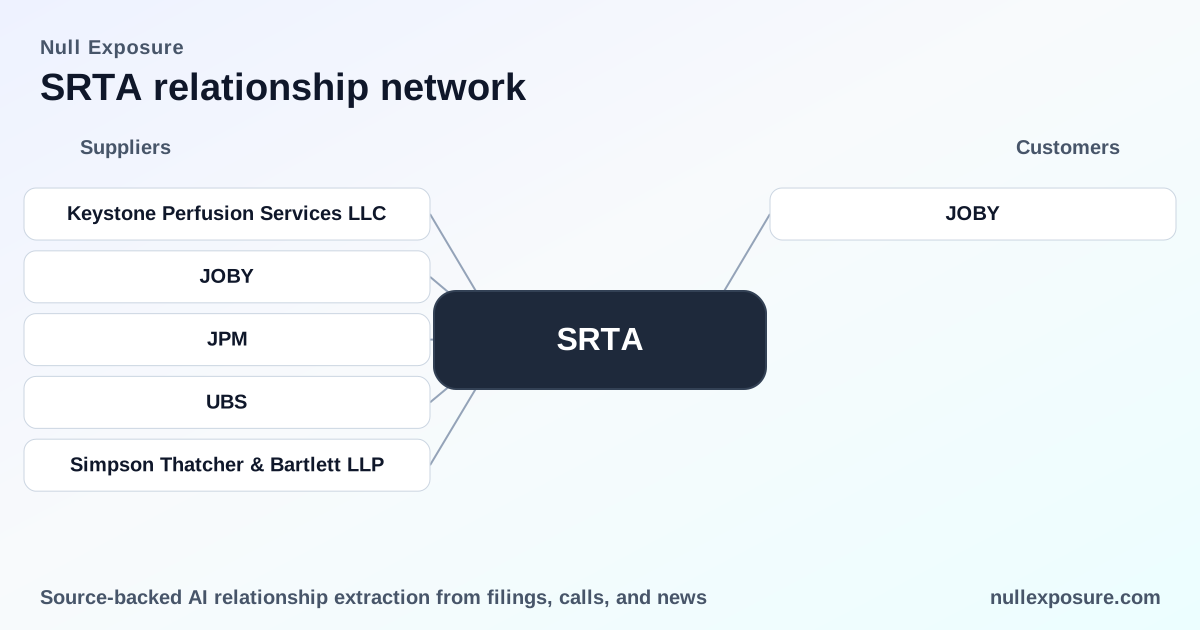
Strata Critical Medical (SRTA): Customer relationships and the post‑divestiture commercial footprint
Strata Critical Medical monetizes a time‑critical logistics and specialized medical services platform built around organ transport and hospital logistics; revenue derives from service contracts with transplant centers, organ procurement organizations and hospitals, combined with spot and subscription style bookings for short‑distance air transport. The company completed a strategic divestiture of its legacy passenger business in August 2025 and now positions its balance sheet and growth strategy around medical logistics, recurring service flows, and earn‑out contingent payments tied to that sale. For a compact, structured view of SRTA relationships, see Null Exposure’s relationship pages: https://nullexposure.com/
What changed in August 2025 and why it matters
Strata executed a definitive strategic pivot by selling its Passenger business to Joby Aviation on August 29, 2025. That transaction transforms SRTA into a focused medical‑logistics operator, shifting revenue mix and counterparty patterns away from consumer mobility toward institutional healthcare customers. The sale generated consideration that included Joby securities and potential earn‑out payments up to $45 million, both of which affect near‑term cash flow volatility and the company’s reported realized gains or losses on the divestiture.
A concise investor action: review the company’s post‑divestiture financials and earn‑out disclosures at Null Exposure for forward cash‑flow sensitivity analysis: https://nullexposure.com/
How Strata operates today: contracting posture and customer dynamics
Strata runs a service‑heavy model with two observable contracting modes: spot, on a by‑seat or charter basis for short flights (10–100 miles), and subscription/bulk purchasing constructs such as commuter passes that increase utilization. The firm is a buyer of operator services in some markets (contracting third‑party operators to fly and maintain aircraft) while acting as the service provider to hospitals and nonprofit organ procurement organizations. Geography is concentrated in North America with supplemental activity in Europe (Southern Europe historically), and the medical business is core and mission‑critical to transplant customers. These characteristics produce a revenue base that is concentrated, contractual with both spot and recurring components, and operationally critical to customers—factors that support higher switching costs and defensibility, but also concentrate execution risk.
Line‑by‑line relationship roll call
Below are every relationship result returned in the review set with a plain‑English summary and the source.
Joby Aero, Inc. — TradingView / SEC note
On August 29, 2025 Strata sold its Passenger business to Joby Aero, allowing Strata to focus exclusively on medical and logistics services; TradingView summarized that disclosure tied to the company’s SEC 10‑Q reporting. (TradingView summary of Strata SEC 10‑Q, first reported March 10, 2026)
JOBY — GlobeNewswire press release (Aug 29, 2025)
Strata announced the successful closing of the divestiture of its Passenger business to Joby Aviation in a GlobeNewswire release on August 29, 2025, formalizing the change in corporate scope and the company’s intended pivot to critical medical services. (GlobeNewswire press release, Aug 29, 2025)
Joby Aviation, Inc. — GlobeNewswire duplicate (Aug 29, 2025)
The same GlobeNewswire release is filed under Joby Aviation naming conventions; it confirms Joby as the purchaser and reiterates the operational transfer of the passenger unit. (GlobeNewswire press release, Aug 29, 2025)
JOBY — GlobeNewswire Q3 2025 results (Nov 10, 2025)
In its Q3 2025 results release, Strata recorded the completed sale of the Passenger business to Joby Aviation, reflecting the transaction’s impact on period results. (GlobeNewswire, Nov 10, 2025)
Joby Aviation — GlobeNewswire Q3 2025 results (Nov 10, 2025)
The company’s Q3 results release also referenced Joby Aviation as counterparty to the divestiture, confirming recognition of the transaction in third‑quarter reporting. (GlobeNewswire, Nov 10, 2025)
JOBY — TradingView duplicate (SEC 10‑Q summary)
TradingView repeated the August 29, 2025 disclosure in its coverage, noting the strategic refocus enabled by the sale. (TradingView summary of Strata SEC 10‑Q, reported March 10, 2026)
Joby Aviation — Investing.com analyst note (May 4, 2026)
An analyst coverage note (B. Riley initiation reported on Investing.com) restated that Strata sold its legacy passenger business to Joby Aviation in August 2025, a cornerstone fact behind the initiation rationale. (Investing.com, May 4, 2026)
Joby Aviation — GlobeNewswire Q4 2025 results (Mar 3, 2026)
Strata’s Q4 2025 release disclosed a realized loss on the sale of Joby Aviation securities that were received as part of the divestiture consideration, signaling mark‑to‑market impacts tied to the purchaser’s stock. (GlobeNewswire, Mar 3, 2026)
Joby Aviation — Globe and Mail earnings call coverage (Mar 2026)
During earnings commentary covered by The Globe and Mail, management flagged expected earn‑out payments of up to $45 million from Joby related to the Blade sale, indicating contingent cash inflows tied to performance triggers. (The Globe and Mail coverage of Strata earnings call, March 2026)
Joby Aviation — Globe and Mail duplicate (Mar 2026)
The Globe and Mail reporting reiterated the earn‑out expectation and its role in supporting acquisition strategy. (The Globe and Mail, March 2026)
RUBI (Rubicon Project) — Yahoo/SG Finance historical note (FY2017)
A 2017 industry note referenced a strategic partnership arrangement that included Strata among partners; this is a historical reference to a 2017 buy‑side partnership approach involving Rubicon and Strata, not a current core medical relationship. (SG.Finance/Yahoo coverage of Rubicon Project, reporting historical FY2017 partnership)
Constraints and what they imply for SRTA’s commercial risks and strengths
Treat these constraints as company‑level operating signals rather than relationship‑specific attributes:
- Contract mix: Strata operates with both spot bookings for short flights and subscription/bulk contractual constructs such as commuter passes, producing both transactional and recurring revenue streams. This split supports revenue diversification but creates forecasting complexity.
- Counterparty profile: A meaningful portion of the medical business deals with nonprofit organ procurement organizations (OPOs) and transplant centers, making revenue critical to patient outcomes and less price‑sensitive, but also exposing Strata to reimbursement and procurement cycles.
- Geographic concentration: North America is the dominant revenue market, with historical operations in Southern Europe; concentration in a single region amplifies regulatory and demand‑cycle risk but also concentrates the firm’s operational expertise.
- Relationship roles and maturity: Strata acts both as buyer (contracting operator partners) and service provider to medical customers, indicating a two‑sided operational posture that requires vendor management and strong service delivery controls.
- Segment focus: The company’s revenue base is service‑centric, with MediMobility organ transport as a core, mission‑critical line—this supports stickiness but requires high operational reliability.
Investment implications: what to watch next
- Cash‑flow sensitivity to Joby securities and earn‑outs. The divestiture generated consideration in Joby equity and an earn‑out of up to $45 million; investors must model both mark‑to‑market fluctuations and the probability/timing of earn‑out payments. GlobeNewswire and The Globe and Mail coverage document both the securities consideration and the earn‑out.
- Concentration and counterparty criticality. North American concentration and reliance on OPOs and hospitals create high revenue defensibility but also operational concentration risk—loss of a major institutional contract would be material.
- Contracting mix complicates revenue visibility. The coexistence of spot and subscription flows requires granular tracking of utilization trends and contractual renewals to forecast growth accurately.
- Operational execution is the valuation driver. With the passenger unit divested, growth and margin improvement depend on scaling organ logistics, tightening unit economics, and converting institutional relationships into predictable recurring revenue.
For investors evaluating counterparties, contracts, and contingent consideration, the consolidated relationship view and time‑series disclosures hosted at Null Exposure provide a practical starting point: https://nullexposure.com/
Bottom line
Strata’s pivot to a pure‑play medical logistics operator is a decisive repositioning that concentrates cash‑flow exposure in a high‑value, mission‑critical segment while introducing near‑term volatility from consideration received in Joby securities and contingent earn‑outs. Success hinges on scaling institutional contracts, converting spot flows into repeatable revenue, and managing the balance‑sheet implications of the divestiture consideration.