SRx Health Solutions (SRXH): Customer Relationships and Commercial Posture
SRx Health Solutions operates a branded pet health and wellness business (the Halo line) and monetizes primarily by selling consumer pet products through third‑party retail and e‑commerce partners rather than direct‑to‑consumer storefronts. Revenue is recognized through digital channels (sales to online retailers) and wholesale relationships; the company has deliberately shifted away from its own DTC channel and now directs consumers to retail partners for purchases. For a consolidated view of relationship intelligence and comparable coverage, visit https://nullexposure.com/.
The business model in one line: branded products sold through resellers and e‑commerce partners
SRx’s continuing operations center on the Halo pet health and wellness portfolio—premium foods, treats, supplements and related products. The FY2025 10‑K classifies revenue channels into three categories and explicitly identifies Digital as sales to online retailers such as Amazon and Chewy, indicating that SRx functions as a supplier to platform resellers rather than a vertically integrated retailer. The company also disclosed the strategic exit of direct retail store placements (Petco and Pet Supplies Plus locations) while maintaining online availability through those same retail platforms. These disclosures point to a reseller‑centric commercial posture with the company relying on partner platforms to reach end customers.
Where SRx distributes Halo products (customer list and takeaways)
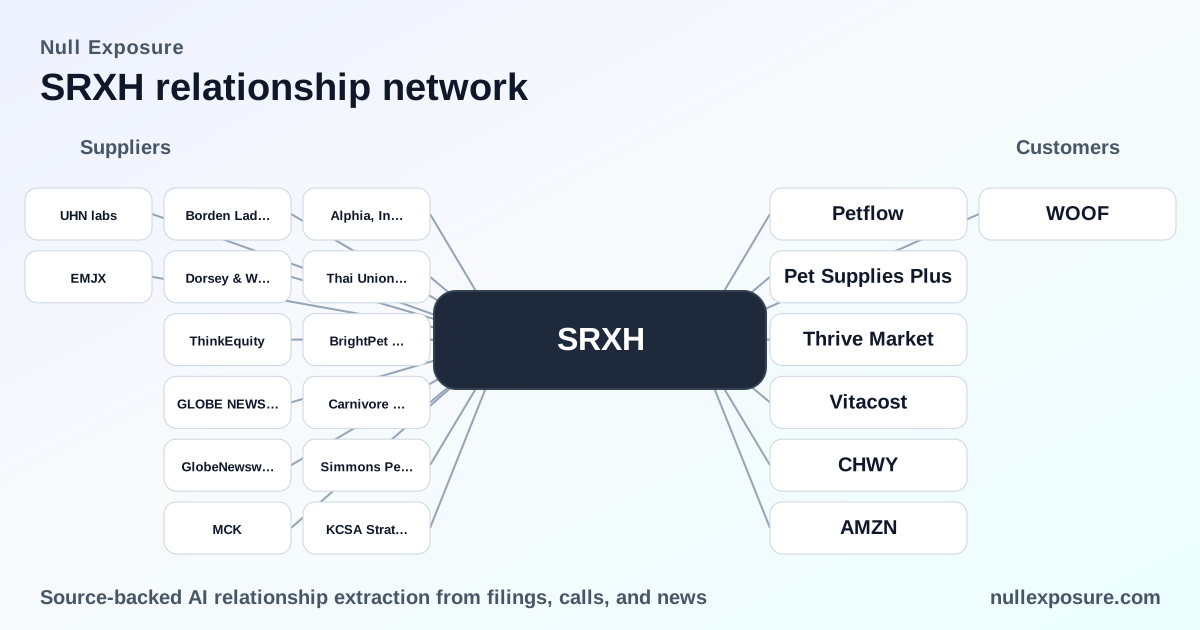
Below are every customer relationship cited in the FY2025 10‑K, each summarized in plain English with the filing as the source.
-
Chewy (CHWY) — Chewy is named explicitly as an online retailer in SRx’s Digital revenue channel, indicating Chewy purchases Halo product inventory for resale on its platform. According to the FY2025 10‑K, Digital includes sales to online retailers such as Amazon and Chewy.
Source: FY2025 10‑K (SRx Health Solutions), revenue channel description. -
Amazon (AMZN) — Amazon is listed as an e‑commerce partner and part of the Digital revenue bucket; SRx sells product to Amazon for online resale. The FY2025 10‑K lists Amazon among the company’s e‑commerce partners.
Source: FY2025 10‑K (SRx Health Solutions), e‑commerce partner list. -
Petflow — Petflow is identified among SRx’s e‑commerce partner websites, marking it as a reseller channel for Halo product sales. The FY2025 10‑K lists Petflow alongside other online partners.
Source: FY2025 10‑K (SRx Health Solutions), e‑commerce partner list. -
Thrive Market — Thrive Market is included in the company’s list of e‑commerce partners, indicating SRx distributes product to Thrive for online resale. The FY2025 10‑K names Thrive Market in the partner roster.
Source: FY2025 10‑K (SRx Health Solutions), e‑commerce partner list. -
Vitacost — Vitacost appears in the same e‑commerce partner list; SRx supplies product to Vitacost as an online retail channel for Halo products. The FY2025 10‑K includes Vitacost among e‑commerce partners.
Source: FY2025 10‑K (SRx Health Solutions), e‑commerce partner list. -
Pet Supplies Plus — SRx notes a strategic exit of Pet Supplies Plus physical store placements while continuing sales through Pet Supplies Plus’s online platform, signaling a move away from in‑store shelf space but retention of the partner’s digital channel. The FY2025 10‑K specifically states the company “strategically exited Petco and Pet Supplies Plus stores while continuing online sales via those platforms.”
Source: FY2025 10‑K (SRx Health Solutions), channel strategy disclosure. -
Petco (WOOF) — Petco is mentioned in the same disclosure: SRx exited Petco stores but continues to make Halo available on Petco’s online marketplace, preserving digital distribution even as brick‑and‑mortar placements were reduced. The FY2025 10‑K contains this channel exit statement.
Source: FY2025 10‑K (SRx Health Solutions), channel strategy disclosure.
What the company‑level constraints say about SRx’s operating model
The filings and extracted constraints generate a clear corporate signal set that informs risk and go‑to‑market posture:
-
Geographic focus is North America with limited APAC activity. The company’s operations concentrate on the U.S. and Canada; select Asian markets are referenced, but international sales are a smaller portion of net revenue. This is a company‑level geographic profile from the FY2025 filing.
-
High customer concentration is a material risk. SRx disclosed that accounts receivable from three customers represented 98% of accounts receivable as of September 30, 2025, and three customers accounted for 88% of gross sales in FY2025. This level of concentration makes revenue highly dependent on a handful of reseller relationships.
-
Contracting posture is reseller‑centric and platform‑dependent. The company groups revenue into a Digital channel comprised of online retailers, and it has moved away from direct‑to‑consumer channels, indicating reliance on partner platform terms and distribution mechanics rather than proprietary retail control.
-
Relationship roles span seller and reseller functions. The company is the product seller to partners who act as resellers; the FY2025 materials explicitly describe revenue attribution by geography and the role of e‑commerce partner websites in generating the majority of continuing net sales.
-
Channel maturity and stage mix: active partners and terminated DTC. The Halo business is the company’s continuing core product line, with active online partnerships generating net sales in FY2025; the direct‑to‑consumer channel (halopets.com) was exited in June 2024 and consumers are now directed to retail partners for purchase.
Investment implications: concentrated risk, clear operating leverage
Investors should take away three direct points:
-
Concentration amplifies execution risk. When three customers account for the bulk of receivables and gross sales, any channel disruption, contract renegotiation or delisting by a major partner can produce meaningful top‑line volatility and working capital stress. The FY2025 10‑K explicitly quantifies this concentration.
-
The company is not a retailer; it is a brand supplier. SRx has ceded direct consumer checkout to partners, which reduces marketing and fulfillment overhead but increases exposure to partner economics and marketplace competition. The FY2025 filing’s Digital revenue classification and DTC exit confirm this strategic posture.
-
Product strength is complemented by scale constraints. The Halo portfolio is described as core product and generating repeat purchases, but total net sales for continuing operations were modest (net sales for 2025 were reported at $6.5 million in the FY2025 filing), and profitability metrics show operating losses. Investors should weigh brand loyalty against limited scale and concentrated counterparty exposure.
For research teams requiring a compact view of SRx’s partner map and commercial constraints, NullExposure maintains curated relationship intelligence tailored to investor diligence—see https://nullexposure.com/ for enterprise coverage.
Bottom line
SRx Health Solutions runs a reseller‑driven, digital‑first distribution model for its Halo pet products, with the company depending on a small set of online retail partners for the majority of its sales. Concentration and platform dependence are the dominant commercial risks; conversely, the company’s deliberate move away from DTC and focus on partner channels clarifies the revenue model and cost structure. Investors evaluating SRXH should prioritize counterparty stability, contract terms with major online retailers, and any evidence of channel diversification before committing capital.