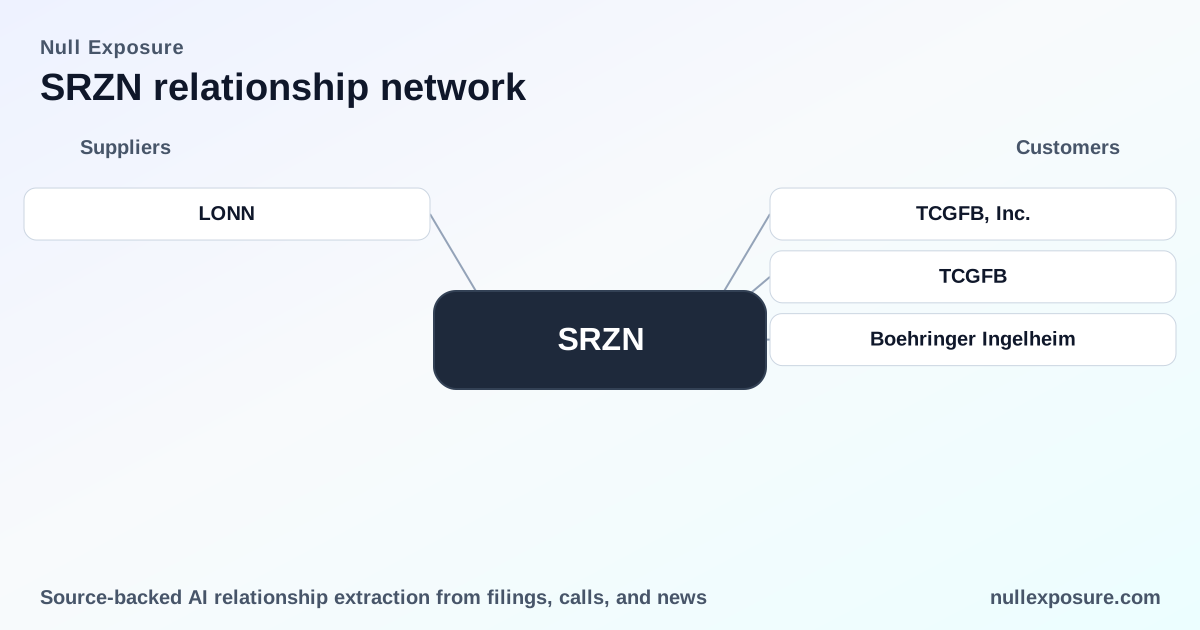
SRZN: Partnership-driven funding with concentrated milestone risk
Surrozen (SRZN) is a clinical‑stage biopharma that converts preclinical assets into non‑dilutive cash through research collaborations, licensing deals and milestone payments, while also deriving modest service and sublease income. The company’s commercial model monetizes discovery-stage programs (core Wnt pathway assets) largely by partnering with larger pharma for development and by delivering research services tied to short-term contracts and related‑party arrangements. For additional customer-level intelligence, see https://nullexposure.com/.
How Surrozen turns science into near‑term cash
Surrozen’s revenue profile is partnership‑centric rather than product sales: the business earns licensing and research collaboration fees, milestone receipts and, in time, royalties if partnered assets reach the market. That structure creates three operational characteristics investors must track:
- Contracting posture: revenue is a mix of short‑term research services and longer‑dated, milestone‑based licensing arrangements; this produces lumpy cash inflows driven by discrete study outcomes. Company filings show direct research service revenue and month‑to‑month sublease receipts alongside licensing income.
- Concentration and criticality: a small number of partners provide the majority of near‑term proceeds, making each milestone payment highly material to reported revenue given Surrozen’s modest revenue base (Revenue TTM ~$3.48M).
- Maturity and risk: programs remain preclinical and early clinical, so value realization depends on partners advancing IND‑enabling studies and hitting technical milestones rather than on commercial sales today.
These dynamics make Surrozen a capital‑efficient, partner‑funded developer — attractive for upside but sensitive to partner decisions and milestone timing. If you evaluate customer risk or counterparty exposure, this is fundamentally a partnerships play rather than a recurring revenue business for now.
Relationship map — what every partner contributes
Boehringer Ingelheim
Surrozen has a multi‑asset collaboration with Boehringer Ingelheim that has been a primary source of non‑dilutive funding; Boehringer provided $22.5 million in aggregate proceeds to date and the collaboration structure includes future success‑based development and commercial milestones plus royalties. According to Surrozen’s corporate filings and company updates (GlobeNewswire, March–April 2026), a research milestone for SZN‑413 triggered a $5.0 million payment after a successful IND‑enabling GLP toxicology study. Market commentary (Guggenheim/MarketBeat coverage, early May 2026) reiterates the significance of that milestone payment to the company’s near‑term cash position.
TCGFB, Inc.
Surrozen executed a collaboration with TCGFB, Inc. to develop TGF‑β‑targeting antibodies and was contracted to provide research services in exchange for up to $6.0 million plus third‑party costs, and a warrant structure tied to performance. Company reporting for FY2025–FY2026 notes that research service revenue from the TCGFB collaboration contributed materially to reported contract revenue ($0.5M for the quarter and $3.5M for the year ended Dec 31, 2025). (See FierceBiotech reporting and Surrozen’s FY2025 press release on GlobeNewswire and Investing News, March–May 2026.)
TCGFB
Separate press coverage uses the shorthand “TCGFB” and confirms the commercial terms: the partner committed up to $6 million for antibody work targeting idiopathic pulmonary fibrosis and related indications, and Surrozen provided research services under that agreement prior to a termination notice. A March 2026 MarketScreener update and TradingView summaries record that TCGFB issued a termination notice to end the collaboration, which is a direct operational development for Surrozen’s research revenue cadence. (Sources: FierceBiotech, MarketScreener, TradingView, March–May 2026.)
Operational constraints and company‑level risk signals
Surrozen’s public disclosures and filings surface several constraints that shape partner economics and execution risk:
- Short‑term leasing and seller activity: a sublease arrangement is on a month‑to‑month basis with monthly base rent of approximately $35,000, escalating at 3% annually — a modest but flexible cash inflow and a sign of asset monetization outside core R&D. Company SEC filings describe this sublease arrangement and the related party aspects.
- Licensing and collaboration revenue as the core segment: management states that the company’s single reportable segment derives revenue from licensing and research collaborations, confirming the partnership‑funded business model rather than product sales.
- Geographic footprint: public excerpts reference revenue generation in North America and relationships with entities domiciled in Europe (evidence excerpts note a counterparty domiciled in Germany), indicating cross‑border contractual and operational exposure that creates regulatory and execution variables.
- Core product focus: Surrozen operates a single R&D segment centered on Wnt pathway modulation for tissue repair, which concentrates technical and commercial risk around a narrow scientific platform.
These constraints imply a company that is lean and partnership‑dependent: capital needs and valuation catalysts are driven by a small number of milestones and by the timing of partner decisions.
For a rapid, structured view of the partner landscape and how each customer contributes to revenue and milestone timing, explore https://nullexposure.com/.
Practical investor takeaways
- Boehringer Ingelheim is the material counterparty: its milestone payments (most recently $5.0M) and prior $22.5M of funding are the primary non‑dilutive capital source and a key driver of Surrozen’s near‑term runway. (GlobeNewswire; MarketBeat; March–May 2026.)
- TCGFB collaborations were a meaningful but now‑disrupted revenue stream: the TCGFB program committed up to $6M, contributed several million in research fees through 2025, and was the subject of a termination notice in March 2026 — a change that reduces one source of predictable research revenue. (FierceBiotech; MarketScreener; TradingView; March 2026.)
- Revenue is lumpy and milestone‑dependent: with TTM revenue under $4M, individual milestone receipts materially shift reported results and cash runway — monitor partnership announcements and IND‑enabling study outcomes as the primary valuation catalysts.
- Operational diversification is limited: the company’s single‑segment, platform‑centric model concentrates scientific and commercial risk around Wnt pathway programs; licensing deals are the lever for de‑risking clinical development and creating eventual royalty streams.
Surrozen is positioned as a high‑upside, partnership‑funded developer: upside comes from successful partner advancement of SZN‑413 and related programs, while the key near‑term risk is milestone timing and partner decisions (including contract terminations). For deeper partner intelligence and to track these relationships dynamically, visit https://nullexposure.com/.