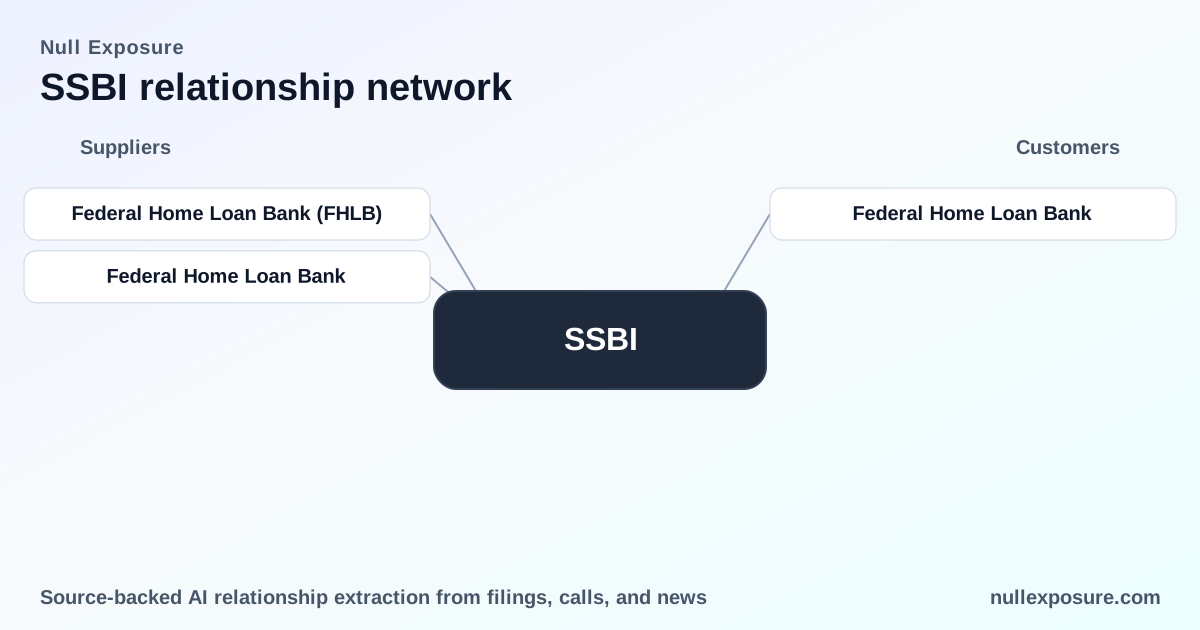
Summit State Bank (SSBI) — Customer Relationships and Operational Signals
Summit State Bank operates as a regional community bank headquartered in Santa Rosa, California, monetizing through net interest income on a locally focused loan portfolio, fee income from deposit services, and balance-sheet management. Revenue drivers are core banking spreads and localized commercial lending; capital access and liquidity management are the critical operational levers. For a concise hub of related research and relationship signals, visit https://nullexposure.com/.
How this bank makes money and why relationships matter
Summit State Bank’s business model centers on relationship-driven deposit gathering and commercial lending in Sonoma County, translating local market knowledge into credit spreads and fee income. The bank’s operating performance is sensitive to liquidity access, deposit stickiness, and the cost of funding, which elevates the significance of any named counterparty or institutional funding source. According to public company profile and filings through the quarter ended 2026-03-31, Summit State Bank reports modest profitability metrics consistent with a small regional bank and a concentrated geographic footprint.
What we searched for and found in customer relationships
The records reviewed returned a single explicit counterparty relationship in the customer scope. Below I cover that relationship verbatim, its practical implication for SSBI’s operating model, and how investors should read it.
Federal Home Loan Bank — liquidity counterparty, evident advances
Federal Home Loan Bank advances are recorded as a customer relationship in the reviewed news item, noting an advance amount of 5,500 (as reported in the source). This indicates a direct funding relationship with the Federal Home Loan Bank system — a standard liquidity channel for regional banks that provides secured advances against eligible collateral. The mention was captured in a 2026 news summary of Summit State Bank’s FY2025 results; the item was first seen on 2026-03-10 and published via Quiver Quantitative’s news aggregation. Source: a Quiver Quantitative news item summarizing Summit State Bank’s Q3 2025 results and related disclosures (published 2026-03-10).
Why a Federal Home Loan Bank relationship matters to investors
- Liquidity and contingent funding: An FHLB advance confirms an operational funding backstop that can be tapped to manage short-term liquidity mismatches or to supplement deposit funding during seasonal or stress periods.
- Collateral and balance-sheet mechanics: Using FHLB advances requires eligible collateral and affects asset-liability management — this is a standard channel but one that increases sensitivity to collateral valuation and regulatory haircuts.
- Not a concentration alarm by itself: A single reported FHLB advance is a routine facility for a regional bank; the presence of the advance signals prudent access to secured funding while underscoring the importance of monitoring the total outstanding advances over time.
Operating constraints and company-level signals
The review of available relationship and constraints records returned no formal constraints entries. At the company level this is a signal of low public disclosure of contractual restrictions or vendor/customer-specific covenants in the sources reviewed. Combine that absence with the bank’s profile — a localized franchise focused on Sonoma County — and the operating model characteristics are clear:
- Contracting posture: Predominantly bilateral, relationship-rich commercial and consumer banking arrangements; no public evidence of complex outsourced contracts or material third-party dependency disclosures in the reviewed records.
- Concentration: Geographic concentration in Sonoma County is an implicit concentration risk for earnings and credit performance; contract-level concentration flags were not reported.
- Criticality: Operational criticality is driven by deposit flows and short-term liquidity sources (including secured advances), rather than dependence on any single commercial customer disclosed in the reviewed set.
- Maturity: The bank’s franchise is established at the regional level with balance-sheet and funding practices typical of community banks; public filings through early 2026 show a bank operating within standard regulatory and market mechanics for its peer group.
Financial context that frames these relationships
Summit State Bank’s reported metrics through the latest quarter (2026-03-31) show limited scale — market capitalization near $90.6 million and revenue in the low tens of millions — and profitability consistent with a small regional bank. These figures underline why access to institutional liquidity (such as FHLB advances) and deposit stability are material to capital adequacy and earnings volatility. Source: company public profile and reported quarter data through 2026-03-31.
Investment implications and risk checklist
- Positive: The FHLB relationship is a standard and stabilizing funding source that supports earnings continuity in funding-stressed environments. Access to FHLB advances reduces the bank’s immediate liquidity tail risk.
- Watchlist: Monitor the trend in outstanding advances, collateral composition, and any future disclosures that would quantify dependence on secured borrowings. Absent broader disclosure of constraints, investors must track quarterly filings and regulatory reports for changes in contractual or funding concentration.
- Valuation lens: Given limited scale and geographic concentration, valuation is sensitive to local economic cycles and credit performance in commercial real estate and small-business lending.
Practical next steps for analysis
- Review upcoming quarterly filings and the management discussion section for explicit disclosure of total FHLB advances and collateral schedules.
- Track deposit trends and local economic indicators in Sonoma County to assess loan performance and deposit stability.
- For an ongoing feed of relationship and exposure signals, see our research hub at https://nullexposure.com/.
Bold takeaways: Summit State Bank operates a traditional regional banking model where liquidity access via institutions such as the Federal Home Loan Bank is a core operational pillar; public records reviewed show routine use of secured advances but lack broader contract-level constraints disclosures, placing a premium on forward-looking filings to assess funding concentration and collateral risk.