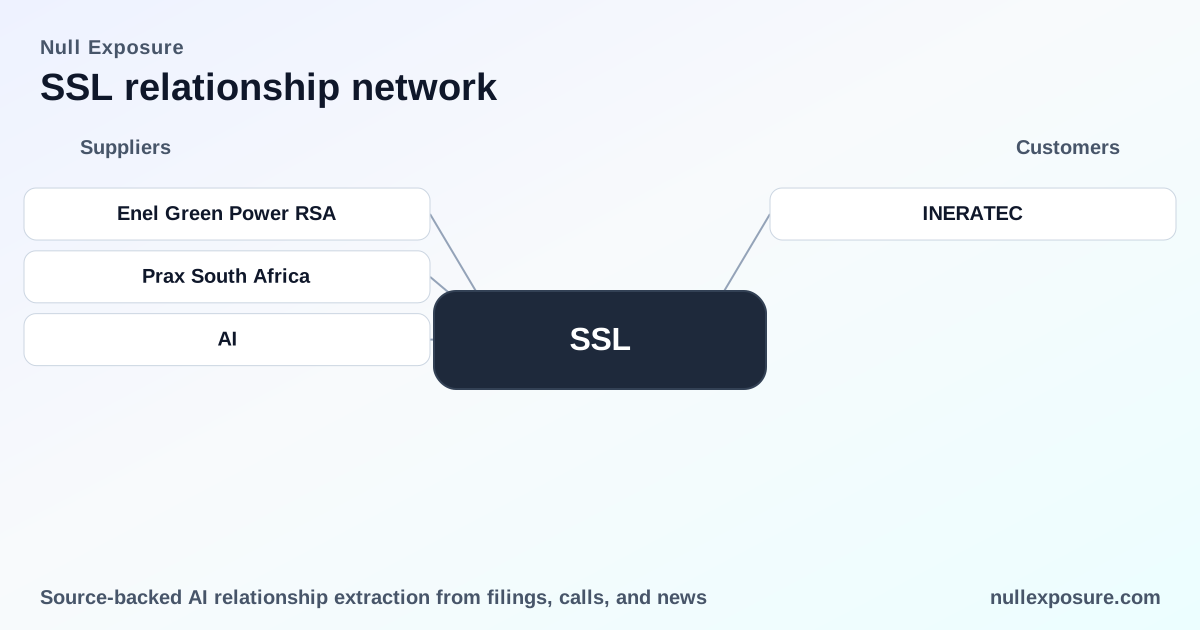
Sasol Ltd (SSL): Customer Relationships — Spotlight on INERATEC
Sasol is an integrated energy and specialty-chemicals company that converts hydrocarbons into fuels, chemicals and catalysts and sells those finished products and intermediate inputs to industrial and energy customers worldwide. The company monetizes through large-scale upstream and downstream operations—fuel and chemical sales, catalyst and technology licensing, and industrial services—anchored by a sizeable revenue base (approximately $249.4 billion TTM) and operating margins that support capital-intensive projects. For investors evaluating customer relationships, the critical lens is how those relationships translate into supply contracts, technology commercialization, and recurring revenue streams. For more on the platform that monitors these customer ties, visit https://nullexposure.com/.
Investment thesis up front
Sasol’s scale and vertical integration give it pricing and delivery leverage in chemicals and fuels, while new technology partnerships introduce optionality in higher-margin catalyst and e‑fuel segments. The company’s valuation metrics (forward P/E ~4.2, EV/EBITDA ~7.3) reflect a transition profile: legacy commodity exposure balanced against higher-margin specialty and technology-led opportunities. Key investor questions: will emerging technology partnerships convert to recurring, contract-backed revenue, and how concentrated are Sasol’s commercial exposures?
What the INERATEC letter-of-intent means commercially
The only customer relationship surfaced in the review is a Letter of Intent between Sasol Chemicals and German startup INERATEC for supply of Sasol’s next-generation catalyst once development completes in 2026. This is a commercial footing rather than a final purchase contract: an LoI signals intent and pathway to transact but stops short of binding long-term supply terms or committed volumes. According to an AlchemPro news item published March 10, 2026, Sasol and INERATEC signed the LoI outlining commitment to supply the catalyst after development wraps in 2026 (source: AlchemPro, March 10, 2026; https://www.alchempro.com/news/chemicals-news/germany-s-ineratec-sasol-to-boost-e-fuel-yields-with-new-catalyst-304158-newsdetails.htm).
Takeaway: the INERATEC LoI is a near-term commercialization signal for higher-value catalyst sales, but investors should watch for binding supply agreements, pricing structure, and volume commitments that convert LoI intent into measurable revenue.
Relationship catalog — what the data shows
- INERATEC — Sasol Chemicals signed a Letter of Intent to supply its next-generation catalyst once development is completed in 2026; the LoI frames an expected supplier-customer relationship for e‑fuel applications (AlchemPro, March 10, 2026).
This entry is the full set of customer relationships surfaced in the provided results. The single LoI indicates targeted, technology-led customer engagement rather than broad retail or commodity contracts revealed by the data.
Company-level operating model and business-model signals
With no explicit constraints provided in the relationship results, the following characteristics surface as company-level signals that shape how customer relationships behave:
- Contracting posture: Sasol operates in capital-heavy, industrial markets where long-term supply, tolling, and licensing contracts are common. Expect customer relationships to transition from exploratory LoIs and pilot agreements into multi-year supply or licensing contracts once technical validation and scale-up milestones are passed.
- Concentration: The company’s integrated model suggests revenue exposure across fuels, chemicals and technology licensing rather than dependence on a single counterparty; however, the dataset does not provide counterparty-level concentration metrics. Investors should treat the INERATEC relationship as a low-concentration, high-optionality partnership at this stage.
- Criticality: Catalysts and technology can be strategic differentiators for e‑fuel production; a catalyst supply arrangement is operationally critical for customers that adopt Sasol’s process, elevating the commercial importance if and when supply contracts are formalized.
- Maturity: The relationship is early-stage—an LoI tied to a 2026 completion date for development—so revenue recognition and contract enforcement remain contingent on technical completion and subsequent commercial agreements.
These operating-model signals imply that commercial outcomes will depend on technology validation, the structure of follow-on contracts, and how Sasol prices and protects intellectual property in catalyst sales and licensing.
Financial and strategic implications for investors
- Upside: If Sasol converts LoIs like INERATEC into binding long-term supply agreements, the company gains higher-margin, differentiated revenue streams that improve returns on capital relative to commodity cycles.
- Near-term uncertainty: The current status is non-binding; investors should not assume immediate revenue uplift until formal contracts and delivery schedules are announced.
- Execution risk: Technology partnerships introduce integration and scale-up risk—technical performance, supply-chain readiness and IP protection determine commercial viability.
- Valuation context: Given Sasol’s low forward P/E and moderate EV/EBITDA, successful commercialization of catalyst technology could materially re-rate parts of the business toward specialty-chemical multiples.
Monitoring checklist for operators and investors
- Track public filings and press releases for a formal supply contract or licensing agreement with INERATEC that includes committed volumes, pricing, and contract tenure.
- Confirm milestone schedule and proof-of-performance metrics tied to the 2026 development completion date cited in the LoI.
- Evaluate whether the catalyst program is accompanied by offtake or tolling agreements that create recurring revenue rather than one-off sales.
- Assess counterparty risk and concentration by observing whether Sasol signs multiple technology partners or relies on single strategic buyers for rollout.
Final read and next steps
The INERATEC LoI is a strategic signal: Sasol is actively positioning its catalyst IP into commercial e‑fuel workflows, which fits a broader strategic pivot toward higher-value chemical technologies. For investors and operators, the priority is watching the conversion from intent to enforceable contracts and understanding how those contracts affect margin profiles and revenue visibility. For a consolidated view of Sasol’s customer relationships and to track updates as ties convert from LoIs to binding deals, visit https://nullexposure.com/.
Bold takeaway: LoIs signal directionality; binding supply contracts and milestone-linked revenue definitions determine value.