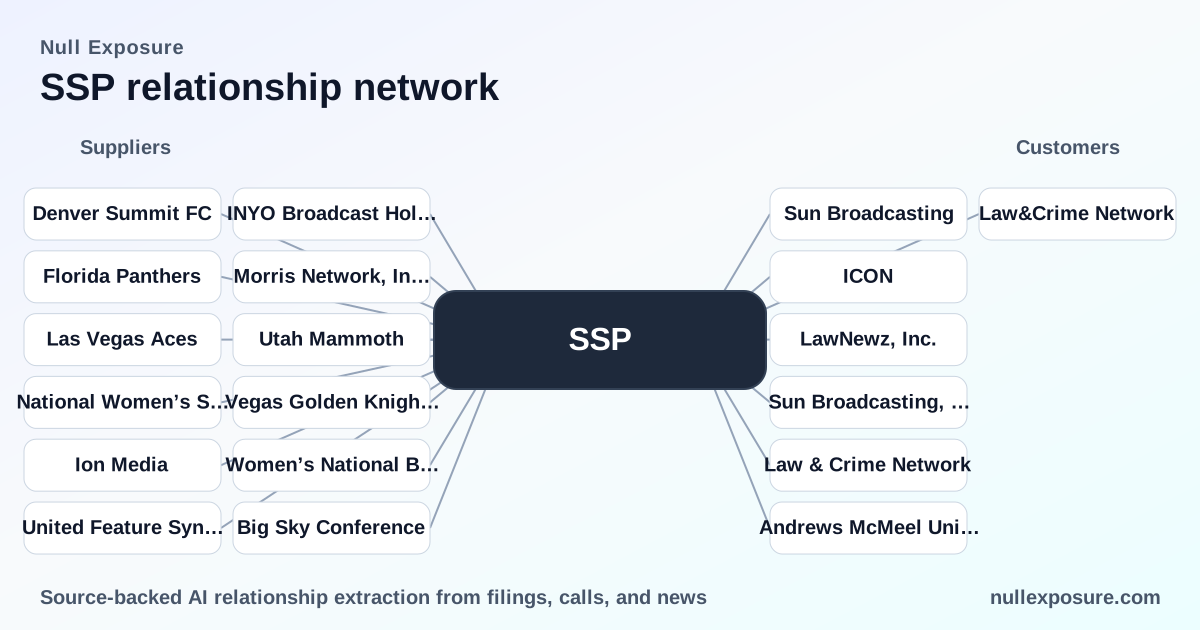
E.W. Scripps (SSP): Customer Relationships That Drive Cash and Strategic Repositioning
E.W. Scripps operates a portfolio of local broadcast stations and national cable/networks and monetizes through advertising sales (core revenue), distribution and retransmission licensing fees, and occasional asset sales. Recent activity shows the company actively monetizing station assets while expanding sports and niche-network partnerships to stabilize advertising yield and diversify distribution. For a concise view of counterparties and deal flow, see Null Exposure’s coverage at https://nullexposure.com/.
How Scripps’ commercial model actually works — the investor view
Scripps’ economics combine two contract postures: multi-year licensing and distribution agreements with MVPDs and digital distributors for retransmission fees, alongside short-term, transaction-based advertising sales to national and local advertisers. The company reports that roughly 67% of operating revenues come from advertising, making ad sales the critical revenue driver, while distribution and licensing provide recurring cash and negotiating leverage. Geographically, the business is U.S.-centric and benefits from national network reach through brands such as Court TV and ION and local station footprints that remain attractive to buyers. The company therefore balances predictable distribution receipts with a cyclical ad book — and it uses asset sales to de-lever and reallocate capital.
Bold takeaways:
- Advertising is the single most critical revenue source.
- Contract mix is bifurcated: multi-year distributor/licensing deals versus short-term ad agreements.
- Scripps is actively monetizing local TV assets to strengthen the balance sheet.
If you want ongoing tracking and analytics around these counterparties, visit https://nullexposure.com/ for our investor briefs.
The counterparties: one-by-one commercial summaries
Below are every customer, acquirer, partner, or counterparty mentioned in public reporting about Scripps in the covered period. Each entry is a plain-English summary followed by the source.
Station buyers and swap partners
-
Sun Broadcasting — Scripps sold WFTX, its Fox-affiliated station in Fort Myers-Naples, for $40 million; proceeds were earmarked for debt reduction. Source: Scripps press release and GlobeNewswire announcing the transaction (Nov 2025 / Mar 2026 press communications).
-
Circle City Broadcasting — Scripps closed the sale of WRTV in Indianapolis to Circle City Broadcasting for $83 million; that transaction is presented as part of Scripps’ broader asset monetization. Source: SahmCapital news release covering the WRTV close (Mar 31, 2026).
-
GTN-A — In a market-structure move, Gray Media’s swap will result in Gray acquiring Scripps’ WSYM (Fox) in Lansing and KATC (ABC) in Lafayette, reflecting station portfolio optimization and regulatory-driven swaps. Source: QuiverQuant news on the Gray/Scripps station swap (May 3, 2026).
-
INYO Broadcast Holdings — Scripps is exercising options related to formerly divested ION-affiliated stations that had been transferred to INYO as part of the ION acquisition process, signaling portfolio re-alignment on affiliate footprint. Source: Scripps Q4 2025 financial reporting summarized by SahmCapital (Feb 26, 2026).
Network buyers and content acquirers
-
Law&Crime (Law & Crime Network) — Scripps agreed to sell Court TV to Law&Crime, a move that crystallizes value in a branded legal-news channel and reduces network ownership complexity. Source: MarketScreener and Finviz reporting on the Court TV sale (Mar 2026).
-
LawNewz, Inc. — MarketScreener coverage notes LawNewz, Inc. entered an agreement to acquire Court TV Media LLC from Scripps, underlining competing or parallel buyers in the legal-television niche. Source: MarketScreener transaction coverage (Mar 2026).
Legacy syndication and brand licensing counterparties
-
Iconix Brand Group / ICON — Historical note: Scripps sold United Media Licensing (United Feature Syndicate) to Iconix Brand Group in 2010 for $175 million; that legacy transaction remains part of Scripps’ intellectual-property footprint and monetization history. Source: Britannica company history entry (archival).
-
Andrews McMeel Universal — Scripps transferred remaining syndication operations, including United Feature Syndicate and Newspaper Enterprise Association, to Andrews McMeel Universal in historic syndication consolidation. Source: Britannica company history entry (archival).
Sports and content partnerships (Scripps Sports)
Scripps Sports lists a wide roster of league and team partnerships used to strengthen live-content advertising inventory and national network distribution:
-
Women’s National Basketball Association (WNBA) — Partnership supports national broadcast and sponsorship collaboration. Source: SahmCapital report on Scripps Sports partnerships (Apr 16, 2026).
-
National Women’s Soccer League (NWSL) and Denver Summit FC — Scripps Sports has rights/partnerships that include NWSL teams such as Denver Summit FC for broadcast and promotional activity. Source: SahmCapital (Apr 16, 2026).
-
Professional Women’s Hockey League (PWHL) — Scripps Sports lists the PWHL among multi-year partnerships to deliver live telecasts and event coverage. Source: QuantisNow reporting on an Ally-presented PWHL broadcast and SahmCapital partnership summary (May/Apr 2026).
-
Major League Volleyball (MLV) — Scripps Sports has a multi-year tie-up to carry MLV content and monetize inventory. Source: SahmCapital (Apr 16, 2026).
-
Pro Cheer League (PCL) — Partnership reported as part of Scripps’ portfolio of alternative sports content. Source: SahmCapital (Apr 16, 2026).
-
ATHLOS track-and-field — Listed as a Scripps Sports partner in the company’s multi-year sports slate. Source: SahmCapital (Apr 16, 2026).
-
Tampa Bay Lightning, Florida Panthers, Vegas Golden Knights, Utah Mammoth — Scripps Sports lists partnerships with major and regional pro franchises to secure localized and national rights opportunities. Source: SahmCapital (Apr 16, 2026).
-
Las Vegas Aces — Scripps Sports holds partnerships enabling coverage and sponsorship inventory for WNBA assets like the Aces. Source: SahmCapital (Apr 16, 2026).
-
NCAA’s Big Sky Conference — Scripps Sports includes college conference relationships to bolster regional and national sports programming. Source: SahmCapital (Apr 16, 2026).
-
Pro Cheer League (listed again in reporting) — Included in the Scripps Sports partner roster for content and sponsorship. Source: SahmCapital (Apr 16, 2026).
-
Ally Financial — Ally is the presenting sponsor for a historic PWHL telecast and related events delivered through Scripps Sports, illustrating advertiser demand for women’s sports inventory. Source: QuantisNow news on the Ally–Scripps PWHL presentation (May 4, 2026).
What the relationship map implies for investors
Scripps is actively converting station ownership into liquidity while retaining and expanding network-level and sports distribution that support higher-yield ad inventory. The company’s contract mix — multi-year distributor/licensing agreements versus short-term ad contracts — creates a revenue base that is predictable on distribution receipts but cyclical on ad dollars. That structure forces a capital-allocation approach focused on:
- Reducing leverage with station sale proceeds (documented WFTX and WRTV transactions).
- Investing in scalable network and sports partnerships where sponsorships (e.g., Ally) can deliver long-term CPM uplift.
- Managing regulatory and transactional timing risk (FCC approvals and swap closings).
Key investment risks: ad-revenue cyclicality given the 67% advertising dependence, concentration of U.S.-only reach, and execution risk on monetizing network and sports rights without inflating costs.
Bottom line
Scripps is repositioning from a local-station owner/operator to a national network and sports-rights platform while using targeted asset sales to stabilize the balance sheet. For investors evaluating SSP customer exposure, the critical signals are the dominance of advertising revenue, the mixed contract tenure profile, and the ongoing use of asset sales to manage leverage. For deeper counterparty analytics and ongoing alerts, consult our investor briefing at https://nullexposure.com/.