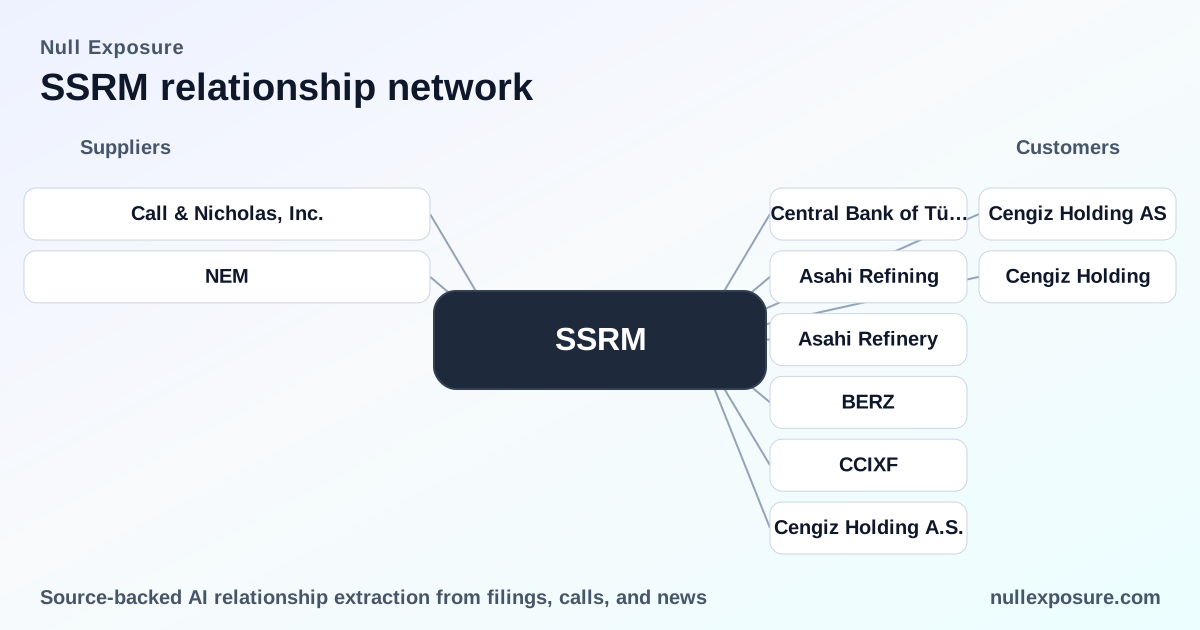
SSR Mining (SSRM): Customer relationships that drive cash flow and strategic optionality
SSR Mining operates and monetizes by producing and selling precious and base metals—primarily gold doré and metal concentrates—from four producing assets across North America, Türkiye and Argentina. The company sells doré and concentrates on short-term and spot-linked terms to banks, refiners and exchanges, and it extracts optionality from asset disposals and joint-venture arrangements to reallocate capital; recent transactions (notably the Çöpler sale) materially reshape revenue mix and liquidity. For investors, the combination of high-revenue concentration in doré sales and transactional, spot-linked contracting creates both predictable price exposure and counterparty concentration risk. Learn more about the data that underpins relationship intelligence at the company homepage: https://nullexposure.com/.
Why customers matter for a mining valuation
Mining companies are commodity producers, not recurring-subscription businesses; valuation sensitivity comes from realized metal prices, production volumes, and who takes delivery. SSRM’s revenues are dominated by physical doré sales and concentrate shipments, which are transacted on short settlement cycles and often priced to prevailing LBMA/spot benchmarks. That structure delivers immediate price exposure and cash generation, but it also concentrates counterparty risk—a material share of 2024 revenue flowed through a small number of refiners and banks. Investors should treat SSRM’s customer map as both a revenue roadmap and a concentration risk profile.
Customer relationships: who buys SSRM’s metals (plain-English summaries)
Central Bank of Türkiye
SSR Mining sells gold doré produced at Çöpler to the Central Bank of the Republic of Türkiye; Türkiye legislation gives the Bank first right of refusal for gold produced domestically, and Çöpler doré is sold primarily on the Istanbul Gold Exchange. Source: SSR Mining 2024 Form 10‑K (FY2024).
Canadian Imperial Bank of Commerce (CIBC) — referenced as CCIXF
CIBC accounted for ~30% of SSRM’s consolidated revenue in 2024 through purchases of gold doré tied to the Marigold and Seabee segments, making the bank a material buyer of SSRM’s product. Source: SSR Mining 2024 Form 10‑K (FY2024).
Asahi Refining
Asahi Refining purchased roughly 13% of SSRM’s 2024 revenues, acting as a major refiner counterparty for doré sales—a meaningful share that concentrates refining counterparty exposure. Source: SSR Mining 2024 Form 10‑K (FY2024).
Bank of Montreal (BERZ)
Bank of Montreal received a single-digit-to-teen percentage share of doré sales in prior periods (16% noted in 2022 disclosures), with its purchases included in the Seabee segment; the bank is a repeat counterparty for Canadian-produced doré. Source: SSR Mining 2024 Form 10‑K (FY2024).
Cengiz Holding A.S.
SSR Mining signed a definitive agreement (announced in early 2026) to sell its 80% interest in the Çöpler mine and related Turkish assets to Cengiz Holding A.S. for $1.5 billion in cash, a transaction that extracts asset value and reduces future doré supply to Türkiye counterparties. Source: multiple March–May 2026 press reports, including CityBiz and Investing.com (March–May 2026).
Aftermath Silver Ltd.
Aftermath Silver completed the acquisition of the Berenguela silver–copper project from SSR Mining, representing a divestiture of a non-core asset and a transfer of future production rights rather than a physical-sales counterparty relationship. Source: SimplyWallSt reporting (May 2026).
Royal Gold (RGLD)
Royal Gold’s 30% interest in the Hod Maden joint venture is referenced in SSRM commentary regarding a strategic review and delayed conversion to a royalty structure; Royal Gold is therefore a stakeholder in a joint-venture asset tied to SSRM’s development optionality. Source: Tikr commentary referencing SSRM strategic review (May 2026).
What the relationship constraints tell investors about revenue quality
-
Contracting posture: short-term and spot-dominant. SSRM prices doré using LBMA/spot benchmarks and settles metal sales within a 30–120 day invoicing/settlement window; concentrates are sold under annual or spot-updated supply contracts. This structure delivers direct commodity-price exposure and fast revenue recognition, not multi-year fixed-price contracts. Evidence: SSRM 2024 Form 10‑K (settlement windows and spot pricing).
-
Counterparty mix: governments plus large enterprises. The Central Bank of Türkiye is an explicit government counterparty under Türkiye law with first right of refusal for domestic gold; most doré outside Türkiye is sold to large commercial banks and refiners (CIBC, Asahi, Bank of Montreal). This produces a mix of sovereign and large-enterprise counterparty exposure that is operationally robust but concentration-prone. Evidence: SSRM 2024 Form 10‑K.
-
Concentration and criticality: doré sales are material. Gold doré comprised 67% of 2024 revenue, with 30% of total revenue flowing to CIBC and 13% to Asahi Refining—a concentrated revenue base where a small number of refiners and banks account for the majority of receipts. For investors, that is a central risk lever for cash-flow volatility. Evidence: SSRM 2024 Form 10‑K (FY2024).
-
Geographic footprint: EMEA/APAC exposure and global production. Production and sales are geographically diversified across North America, Türkiye and Argentina, but concentrate and doré flows route through regional hubs—Çöpler doré via Istanbul and concentrates to smelters/traders in Asia and Europe—exposing the company to regional logistics and regulatory risk. Evidence: SSRM 2024 Form 10‑K.
-
Relationship maturity and role: transactional seller of core product. SSRM’s role is the producer/seller of core products (gold doré and concentrates); most relationships are transactional and active, not franchise contracts, with the company retaining operational ownership of production. Evidence: SSRM 2024 Form 10‑K.
If you want a systematic breakdown of active counterparty concentration and contract tenor across SSRM’s buyers, visit https://nullexposure.com/ for structured relationship intelligence.
Near-term implications and investor takeaways
-
Liquidity and capital redeployment: The $1.5 billion cash sale of the Çöpler 80% stake to Cengiz Holding accelerates liquidity and reduces SSRM’s exposure to Turkish doré sales; press coverage in March 2026 confirmed the transaction terms and market reception. This event materially changes the company’s future revenue map and funds capital returns and reinvestment. Source: CityBiz/Investing.com/E&MJ reporting (March 2026).
-
Revenue concentration remains a valuation lever. Even after disposals, a small set of banks and refiners account for a disproportionate share of receipts, so margin or counterparty disruptions at those buyers would transmit quickly to SSRM’s cash flow. Source: SSRM 2024 Form 10‑K.
-
Asset monetizations normalize strategic optionality. The Berenguela sale to Aftermath and the Çöpler divestiture demonstrate SSRM’s willingness to monetize non-core or regionally complex assets to improve balance-sheet flexibility and focus on core production hubs. Source: SimplyWallSt (Aftermath Berenguela acquisition) and multiple March 2026 press reports (Çöpler sale).
-
JV and royalty dynamics influence upside. The Hod Maden JV and discussion of royalty conversion (Royal Gold) are value-creation levers under strategic review; delays or conversion decisions will affect SSRM’s risk/return profile for that asset. Source: Tikr commentary (May 2026).
Bottom line
SSR Mining is a physically focused precious‑metals producer that generates the majority of its revenue from spot‑priced doré and concentrate sales to a small set of banks and refiners; that model delivers immediate price exposure and cash but concentrates counterparty and geographic risk. Recent asset sales (Çöpler to Cengiz Holding and Berenguela to Aftermath) materially change the company’s revenue composition and liquidity position, increasing optionality for capital returns and growth. For investors assessing SSRM, the two central axes are price/production sensitivity and counterparty concentration—both critical to forecasting near‑term cash flow and long‑term strategic optionality.
For more detailed counterparty maps and document-level evidence to support investment decisions, explore our research hub: https://nullexposure.com/.