SuRo Capital (SSSS): What the 2025Q3 Call Reveals About Customer and partner exposure
SuRo Capital operates as a closed‑end investment firm that builds value by taking equity positions in growth‑stage technology companies and realizing returns through exits and value accretion in its portfolio. The company monetizes through investment gains and capital management of those holdings while providing public market investors targeted exposure to disruptive tech opportunities. For investors evaluating SuRo’s counterparties and customer context, the 2025 Q3 earnings call highlights market relationships and ecosystem dependencies that matter for portfolio company trajectories. For more context on how we compile relationship signals, visit https://nullexposure.com/.
Management’s headline: CoreWeave and hyperscaler partnerships set the context
On the 2025 Q3 earnings call SuRo referenced CoreWeave as one of the fastest‑growing infrastructure providers, driven by surging GPU demand and strategic partnerships with major AI platform players. Management used this observation to underline growth dynamics in the AI infrastructure market that influence multiple portfolio companies’ go‑to‑market and vendor risk profiles. According to the earnings call transcript (filed as the 2025Q3 call, March 2026), CoreWeave’s partner set includes Google, Microsoft, and OpenAI — a trio that shapes demand and capital intensity in the segment.
The relationships called out on the call — line by line
-
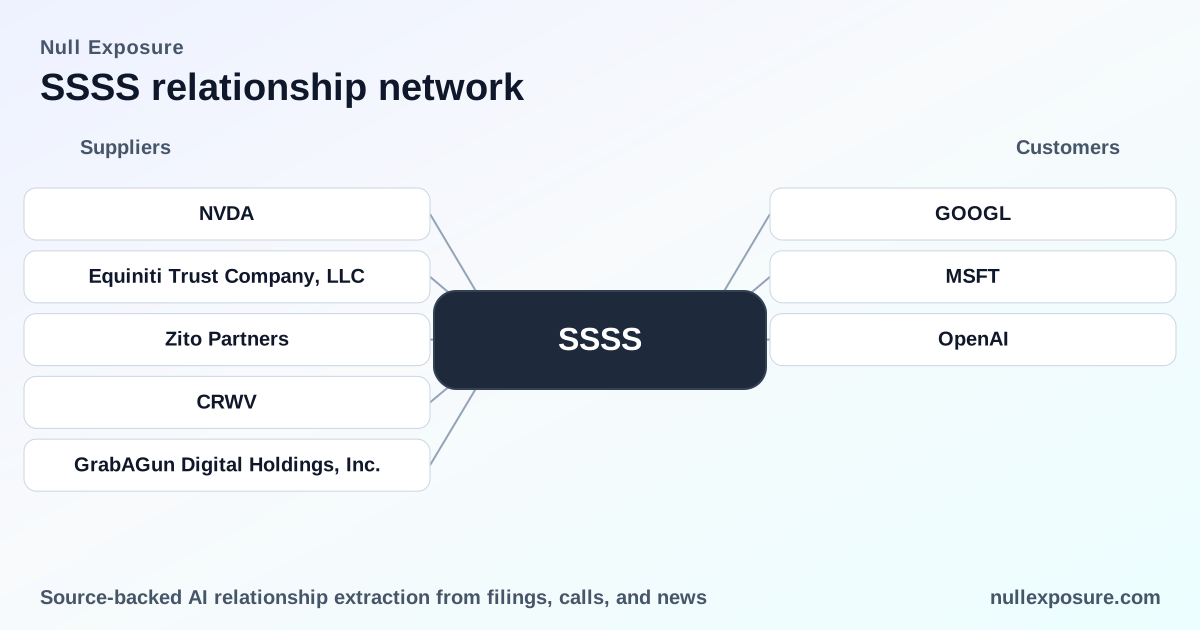
Google (GOOGL) — SuRo explicitly named Google as one of the strategic partners driving CoreWeave’s scale, linking Google’s AI infrastructure demand to CoreWeave’s rapid growth. According to the 2025 Q3 earnings call transcript (file: ssss-2025q3-earnings-call, referenced March 2026), management highlighted Google’s role in the record GPU demand supporting infrastructure providers.
-
Microsoft (MSFT) — Management identified Microsoft as a central customer/partner for CoreWeave, indicating Microsoft’s platform relationships contribute meaningfully to infrastructure expansion. The detail comes from SuRo Capital’s 2025 Q3 earnings call transcript (ssss-2025q3-earnings-call, March 2026).
-
MSFT (duplicate mention) — The call records include a duplicated reference to Microsoft under the ticker form “MSFT,” reinforcing that Microsoft was a clear, repeated datapoint in the company’s commentary about infrastructure market dynamics. This duplicate is recorded in the same 2025 Q3 earnings call transcript (ssss-2025q3-earnings-call, March 2026).
-
OpenAI (no ticker) — SuRo named OpenAI among the partnerships fueling CoreWeave’s growth, tying the provider’s expansion to AI model training and inference workloads from advanced AI developers. This mention is recorded in the 2025 Q3 earnings call transcript (ssss-2025q3-earnings-call, March 2026).
Each of the four entries above is documented in SuRo’s 2025 Q3 call, which management used to situate portfolio exposure to the AI infrastructure cycle.
What those relationship mentions imply for SuRo’s operating and business model
SuRo’s remarks about CoreWeave and hyperscaler/AI platform partners are not transactional customer disclosures; they serve as market context that signals the footprint and dependencies of asset holdings. From a company‑level perspective, the call and public metrics point to several operating characteristics investors should monitor:
-
Contracting posture: SuRo’s business is equity ownership rather than vendor contracting; that results in longer investment horizons and capital‑rather‑than‑service relationships with portfolio companies. Portfolio companies’ contracts with hyperscalers (like Google or Microsoft) are a downstream risk to SuRo’s realizable value, not a direct contractual exposure for SuRo itself.
-
Concentration: Public metrics show modest institutional ownership (approximately 22%) and material insider stake (about 8%), supporting a governance posture where concentrated decision making can influence exit timing and strategic direction. Portfolio concentration risk, however, is driven by individual portfolio company exposure to a small set of large cloud and AI customers.
-
Criticality of counterparties: The call highlights that several portfolio companies or their vendors are economically dependent on a handful of hyperscalers and AI platform providers, elevating counterparty criticality in the value chain and making revenue realization sensitive to those relationships.
-
Maturity and growth stage: SuRo’s target set is growth‑stage technology companies; that implies higher revenue volatility and greater sensitivity to market cycles, with valuation outcomes tied to successful business development and the robustness of partner relationships (for example, infrastructure providers securing major cloud or AI customers).
These are company‑level signals derived from the call and SuRo’s public profile; they should guide diligence rather than substitute for deal‑level contract review.
Risk and opportunity takeaways for investors
-
Opportunity: The mention of CoreWeave and its partnerships with Google, Microsoft, and OpenAI is a positive signal for portfolio companies exposed to AI infrastructure demand; accelerating GPU consumption underwrites higher valuation potential for the right assets.
-
Risk: Heavy reliance by portfolio assets on a narrow set of hyperscalers introduces concentration and counterparty risks that can amplify downside in a contracting environment or if pricing/contract terms shift unfavorably.
-
Liquidity and exit dynamics: As a closed‑end investment vehicle, SuRo’s path to realization depends on market appetite for growth‑stage exits; hyperscaler adoption rates and AI spend cycles are direct drivers of exit timing and multiple compression/expansion.
-
Governance and alignment: With notable insider ownership and modest institutional ownership, management’s strategic choices and timing of exits should be monitored closely for alignment with public‑market investors.
For investors who want continued monitoring of how SuRo’s portfolio reacts to hyperscaler and AI platform dynamics, check ongoing signal updates at https://nullexposure.com/.
Bottom line
SuRo’s 2025 Q3 commentary places AI infrastructure growth and hyperscaler partnerships at the center of near‑term valuation narratives for certain portfolio holdings. The earnings call explicitly connects CoreWeave’s rapid growth to partnerships with Google, Microsoft, and OpenAI, and that relationship map translates into both upside (accelerating demand) and concentrated counterparty exposure (dependency on a few large platform players). Investors should weigh those dynamics against SuRo’s closed‑end structure, insider/institutional ownership mix, and the growth‑stage risk profile when sizing exposure.