System1 (SST): Google as a Core Acquisition Channel — What investors need to know
System1 operates a proprietary responsive acquisition marketing platform called RAMP that buys, tests and optimizes online customer acquisition across large advertising networks, then monetizes those acquired users through third‑party advertisers and advertising networks. The company’s economics hinge on high‑frequency ad buys, algorithmic optimization, and a small set of major advertising partners that supply the lion’s share of traffic and distribution. For more granular counterparty and customer signals, visit https://nullexposure.com/.
The short investor thesis: platform economics with concentrated distribution
System1 captures users at scale through paid acquisition, feeds that user flow into monetization partnerships, and earns revenue from advertiser relationships that place ads against the acquired audiences. RAMP is the engine — acquisition volume plus daily optimization drive incremental returns — but the model is distribution‑dependent, not subscription‑based. That coupling of advanced data science and high dependency on a handful of ad networks produces a distinct risk‑return profile: operational leverage when campaigns scale efficiently, and meaningful concentration risk when distribution terms change.
How System1 actually monetizes and operates
System1 purchases traffic across major ad channels, applies RAMP’s signal testing and automated bidding to improve conversion rates, and then monetizes the resulting audiences through advertising partners and network placements. Revenue is transactionally tied to campaign performance and network access rather than recurring fees. Key economic levers are cost per acquisition, conversion yield on monetized traffic, and the company’s ability to sustain short payment cycles while funding ongoing ad spend.
Operating constraints that drive investor conclusions
Investors should treat the following as company‑level operating signals rather than relationship‑specific facts unless otherwise noted.
- Contracting posture — short payment terms. System1 reports that payment terms with Advertising Partners are typically 30 days, which implies rapid cash conversion on the revenue side but also creates working capital pressure to finance ongoing ad purchases and campaign tests.
- Counterparty profile — large enterprise partners. The company operates “seamlessly across major advertising networks and advertising category verticals,” signaling that its counterparties are predominantly large advertising platforms and networks rather than long‑tail publishers.
- Role and delivery model — service provider. System1 positions itself as a platform and service provider through RAMP; it buys and optimizes traffic on behalf of monetization partners rather than acting solely as an ad reseller.
- Relationship maturity and activity — live, high‑frequency operations. System1 processes daily campaign optimizations and reported ingesting over 12 billion rows of data daily across about 40 advertising verticals as of December 31, 2024, indicating an operationally mature, data‑intensive business that runs continuous experimentation and bidding.
- Concentration and criticality — revenue dependence named. The company’s filings explicitly identify two key Advertising Partners as material to revenue, naming Google and Microsoft; that elevates distribution concentration from a theoretical risk to a documented financial dependency.
Why the short payment cycle and high data throughput matter
Short payment terms reduce counterparty credit risk but increase the need for tight cash management; System1’s model requires continuous outlay for traffic acquisition ahead of advertiser settlement. The reported 12+ billion rows of daily data ingestion is not mere marketing copy — it underpins the adaptive bidding that drives marginal improvements in CPA and revenue yield, which are the only levers that offset distribution concentration.
For investors assessing counterparty exposures, that means the company’s durability depends both on its algorithmic advantage and on stable commercial access to the same large advertising networks that supply traffic.
Customer relationship detail: Google
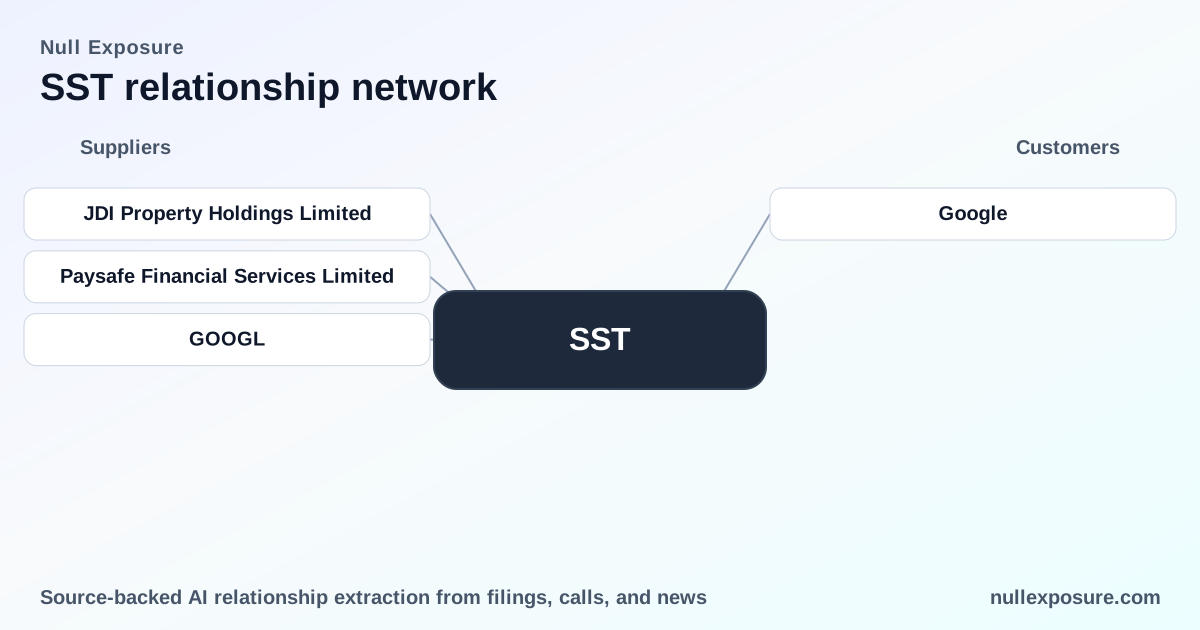
Google is listed in System1’s FY2024 disclosure as one of the large‑scale acquisition marketing channels the company relies on for a significant portion of its consumer Internet traffic; the 10‑K also names Google as one of two Advertising Partners on which revenue is dependent. Google is therefore a material distribution partner and a core operating input for System1’s acquisition and monetization workflow. According to System1’s FY2024 Form 10‑K, the company relies on large‑scale channels such as Google for a significant portion of consumer Internet traffic and explicitly identifies Google (along with Microsoft) among two key Advertising Partners that the business depends on.
Other channels mentioned by management
System1’s filings list other major channels — Meta, Outbrain, TikTok and Network Partners — as part of the acquisition mix that supports RAMP’s testing and scaling. Those channels are cited as sources of traffic in the FY2024 10‑K, but the filing singles out Google and Microsoft when it addresses customer concentration. The broader channel set reduces single‑channel dependency in theory, but the explicit naming of Google and Microsoft creates a concentrated counterparty footprint in practice.
For deeper customer‑level and concentration analytics, visit https://nullexposure.com/.
Investment implications: upside drivers and downside risks
- Upside: If RAMP continues to deliver step improvements in conversion efficiency, System1 realizes operating leverage because incremental revenue from better monetization falls largely to the bottom line. Cost structure and the platform’s learning loop provide a plausible path to margin expansion.
- Downside: Commercial dependence on a very small set of advertising platforms is the primary idiosyncratic risk. Any adverse change in ad platform policies, algorithmic throttling, or commercial terms with Google and Microsoft could materially compress revenue and raise acquisition costs.
- Capital and liquidity: short payment cycles and continuous ad spend mean cash management is critical; the firm’s negative EPS and negative operating margins as reported for trailing periods increase sensitivity to sudden distribution shocks.
- Valuation context: the company trades at low multiples to sales and has a small market capitalization and concentrated insider ownership, amplifying both volatility and the potential for outsized returns if operational trends reverse positively.
Bottom line
System1 is a data‑driven customer‑acquisition platform whose economics are powerful when acquisition efficiency rises but fragile when distribution relationships harden or change. Google functions as a core distribution partner and is explicitly named as materially important to revenue; investors should prioritize monitoring platform contract terms, traffic share trends, and any regulatory or product changes at Google and other major ad networks. For ongoing, structured counterparty signal tracking and relationship-level detail, see https://nullexposure.com/.