ShotSpotter’s customer map: concentration, contracts, and what investors should price in
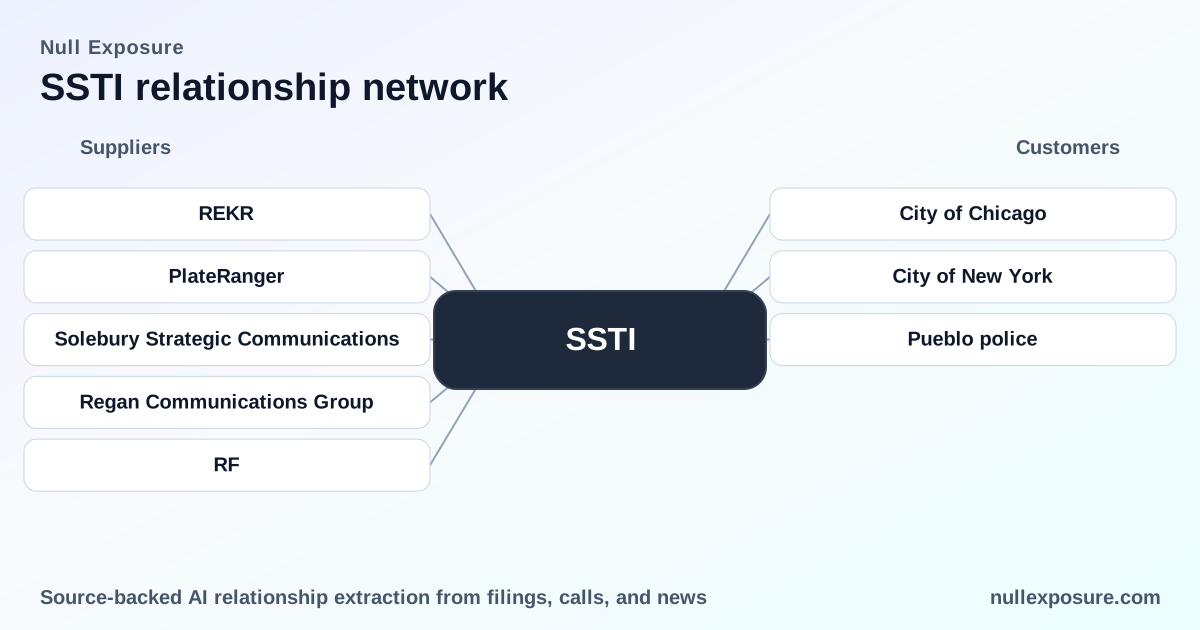
ShotSpotter (SSTI) sells cloud-hosted gunshot detection and investigative tools to public safety agencies and a small set of international customers; the company monetizes primarily through annual software-as-a-service subscriptions and support/maintenance fees, supplemented by professional services and a legacy software licensing channel. The business has meaningful revenue concentration (the City of New York accounted for 23% and the City of Chicago 10% of 2024 revenue per the company’s 2024 Form 10-K) and a customer base that is highly government-centric and renewal-driven, creating a profile of predictable recurring revenue but material single-customer risk. For a concise view of ShotSpotter’s customer signals, visit https://nullexposure.com/.
How ShotSpotter actually sells — the operating model investors need to track
ShotSpotter runs a classic public-safety SaaS model with shorter contract cadence and a government counterparty footprint. The company invoices renewals up front and recognizes revenue ratably over contract terms that are typically one year, which creates near-term cash collection visibility but also makes top-line retention a constant operational focus. The majority of revenue is generated from subscription, maintenance and support services; professional services are a small adjunct.
- Contracting posture: Renewals are mostly annual, invoiced at renewal execution, which makes FY revenue sensitive to procurement timing and municipal budget cycles.
- Counterparty concentration and criticality: Substantially all revenues come from local governments and law enforcement agencies, a compact and politically exposed buyer set. Two municipal customers alone represented 33% of 2024 revenue — a material concentration that investors must model explicitly.
- Geography and scale: The company reports coverage in 177 cities and 20 universities and corporations spanning the United States and select international markets (South Africa, Uruguay, Brazil, Bahamas), but most revenue is U.S.-based, reinforcing regulatory, procurement and local-politics risk as primary drivers of customer churn or expansion.
- Product mix and margin dynamics: The revenue base is dominated by subscription services (monthly subscription, maintenance and support), with software/professional services an incremental line; this supports steady gross margins but compresses operating leverage if customer renewals falter.
- Sales and renewal dynamics: ShotSpotter sells directly and customizes pricing in some modules to city size (for certain products pricing ties to the number of sworn officers), implying sales cycles that are relationship- and procurement-driven rather than purely transactional.
These operating characteristics are company-level signals drawn from the firm’s filings and public commentary; they define where execution risk sits and what metrics — renewal rates, budget timing, and municipal concentration — will move the stock.
The customer relationships you must know (short, sourced summaries)
City of New York
The City of New York was ShotSpotter’s largest single customer in 2024, representing 23% of total revenue, a revenue concentration disclosed in the company’s 2024 Form 10-K. According to the same filing, this level of concentration is material to revenue risk and investor calculus for the company.
City of Chicago
Chicago was the second-largest municipal customer in 2024, accounting for 10% of total revenue, per ShotSpotter’s 2024 Form 10-K; this reinforces that a small number of large municipal contracts dominate the top line and amplify event-driven revenue volatility.
Pueblo police
Local reporting in March 2026 covered the deployment and operational use of SoundThinking’s (ShotSpotter) gunshot detection system by the Pueblo police, stating the technology has been “instrumental in supporting the Pueblo police in effectively managing and solving cases involving gunfire.” This illustrates continued municipal adoption and case-level utility being cited in public safety press.
City of Little Rock
In May 2026, local news reported the Little Rock board voted to extend the city’s ShotSpotter contract, noting the program has been controversial; the renewal vote underscores the political dimension of municipal contracts and the potential for public debate to influence renewal outcomes.
Little Rock Police Department (LRPD)
Coverage from the Little Rock story also notes the LRPD has used ShotSpotter since 2018, indicating a multi-year operational relationship and a renewal decision cycle that rests in part on local political and public-safety evaluations.
What these relationships imply for revenue modeling and risk
The five relationships above show a clear pattern: public-safety agencies form the backbone of revenue, with a handful of large city contracts driving material share. That reality demands a modeling approach that treats renewal probability as a central input rather than a secondary assumption.
- Concentration risk: With two customers at one-third of revenue, a single non-renewal materially impacts margins and EPS. Investors must stress-test scenarios where either NYC or Chicago reduces scope or delays renewal.
- Renewal timing sensitivity: Annual contract terms and up-front invoicing mean recognition timing and municipal budget approval cycles will create lumpy quarter-to-quarter revenue even when long-run retention is stable.
- Political and reputational exposures: Little Rock’s “controversial” renewal is an operational signal — public debate and media coverage can influence procurement outcomes and force additional selling cycles or concessions at renewal.
- Geographic defensibility versus concentration: The company’s reach across many localities provides distribution breadth, but most revenue is U.S.-centric, so macro municipal finance stress, federal grant cycles, or national policy scrutiny will have outsized effects.
Practical metrics investors should track quarterly
Focus on metrics that move the economics described above: renewal rate by cohort, revenue share of top five customers (and any change quarter-to-quarter), number of active coverage areas (city and campus counts), timing of large municipal invoicing, and commentary on political or public-safety reviews. Also watch the split between subscription and professional services revenue for margin signaling.
If you want a concise competitive and customer map to incorporate into your model, NullExposure provides structured, investor-oriented summaries and monitoring — visit https://nullexposure.com/ for an executive view.
Conclusion: positioning for upside and downside
ShotSpotter’s SaaS economics yield recurring revenues and relatively high gross margins, but material single-customer concentration, annual contract cadence, and municipal political risk create clear downside scenarios that are easily modelable. Upside derives from broader municipal adoption, successful renewals of large customers, and international expansion beyond current niche markets. For investors, the proper approach is active monitoring of renewal outcomes, city-level budget cycles, and public debate over surveillance technology — these are the levers that will move both revenue and sentiment.