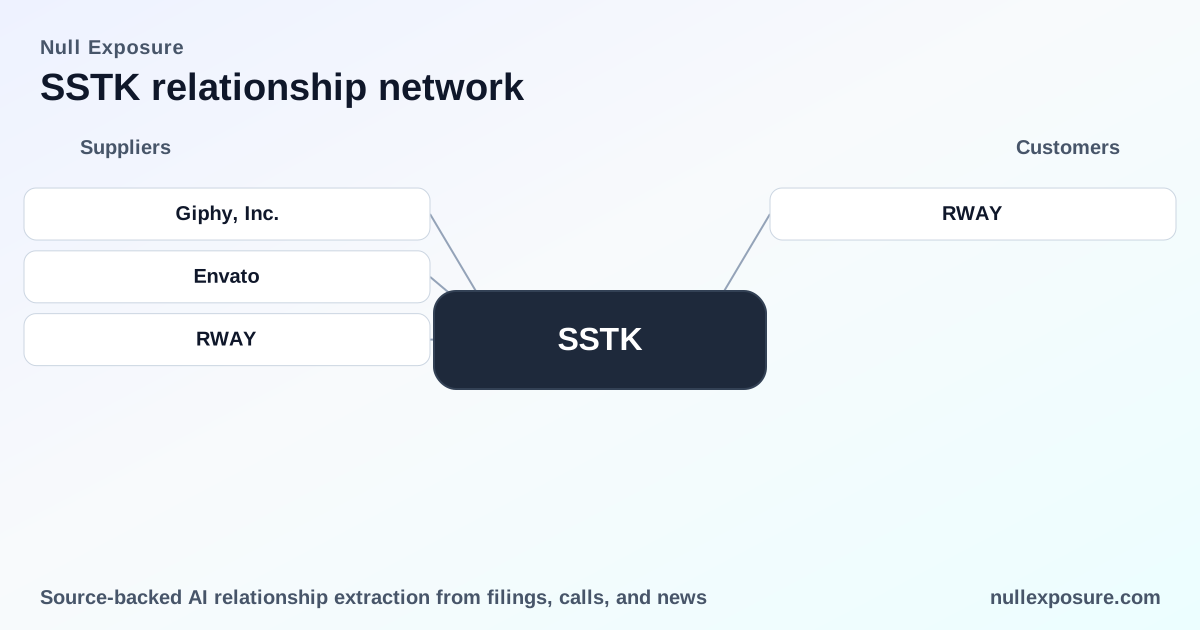
Shutterstock’s customer relationships: where recurring licensing meets AI partnerships
Shutterstock operates a global content licensing platform that monetizes through recurring subscriptions, transactional licensing, and growing data and service offerings for enterprise and creative customers. The company drives scale by aggregating contributor content, selling licenses to creators, agencies, and large enterprises, and increasingly licensing its curated content and metadata to AI and tooling partners. For investors, the thesis is straightforward: consistent cash flow from subscription and spot licensing underpins core content revenue while data-licensing relationships — particularly with AI platform partners — represent a higher-margin growth vector.
If you want a concise, relationship-focused view of Shutterstock’s customer posture and commercial exposures, explore the analysis at https://nullexposure.com/.
Executive snapshot: predictable core, opportunistic data plays
Shutterstock generated roughly $946 million in trailing twelve‑month revenue and maintains a market capitalization near $592 million as of the latest quarter ending March 31, 2026. Content licensing remains the majority of revenue, supported by subscription (monthly and annual) and transactional purchases, while Data, Distribution, and Services are clearly positioned to capture incremental margin as companies deploy AI creative tooling. Shutterstock services more than 4 million customers across 150+ countries, giving the business both scale and diversification across geographies and customer sizes.
Customer relationships in plain English
The following entries cover every relationship surfaced in the review set. Each item is provided as a short, plain-English summary with the source noted.
Runway — runwayml.com (FY2025 entry)
Runway uses Shutterstock’s multimodal content to train and refine models that power creative tools, leveraging Shutterstock’s varied image, video, and metadata assets to improve model performance for creators. This relationship is described on Runway’s customer page and was first reported in March 2026. (Source: Runway customer post, March 10, 2026)
Runway — runwayml.com (duplicate FY2025 entry)
An additional indexed mention from the same Runway customer page reiterates that Shutterstock’s dynamic content feeds help Runway develop “best-in-class” creative models, signaling a strategic data-and-content supply relationship rather than a simple licensing transaction. (Source: Runway customer post, March 10, 2026)
Runway — PR Newswire (FY2025 announcement)
Shutterstock publicly positioned new AI services for model training and evaluation and quoted Runway’s Head of Operations and Partnerships praising Shutterstock as “a key strategic partner” for developing industry‑leading AI models, emphasizing collaborative feedback beyond pure content licensing. (Source: PR Newswire release announcing Shutterstock AI services, March 2026)
Runway — PR Newswire (duplicate FY2025 announcement)
A second capture of the PR Newswire release repeats Runway’s endorsement and underscores the commercial framing of the partnership as data licensing plus operational collaboration for AI product development. (Source: PR Newswire release announcing Shutterstock AI services, March 2026)
Takeaway: all indexed relationship hits identify Runway as a visible strategic partner for Shutterstock’s data-licensing and AI services initiatives; the citations include both a Runway customer page and a Shutterstock PR release from March 2026.
What these customer relationships reveal about Shutterstock’s operating model
Shutterstock’s customer evidence supports a hybrid commercial posture that blends subscription stability with transactional flexibility and an emerging enterprise-grade data licensing practice. Key operating characteristics:
- Contracting posture: The company relies heavily on short‑term and subscription contracts — monthly and annual plans dominate consumer and SMB channels — while transactional spot purchases remain available for low‑volume users. This produces stable recurring revenue with predictable churn dynamics.
- Concentration and counterparty mix: Revenue flows across a broad base — from individual creatives and SMBs to large enterprise accounts and resellers — reducing dependence on any single counterparty while enabling upsell into higher-value enterprise agreements.
- Criticality and maturity: Content licensing is mature and well‑established as core product revenue, while data-licensing for AI (exemplified by Runway) is an increasingly critical growth channel that commands higher pricing leverage and closer operational integration.
- Geographic diversification: Shutterstock operates globally with material revenue weight in North America and Europe, and meaningful exposure outside those regions, which supports resilience to localized demand shocks.
- Relationship roles: Customers act mostly as licensees and end buyers; the company also distributes through resellers and direct enterprise deals, reflecting a multi-channel go-to-market model.
These characteristics combine to produce predictable cash generation from content plus optional upside from enterprise-level data services, an important distinction for valuation and risk assessment.
Risk profile implied by customer patterns
- Revenue sensitivity to creative spending cycles: Subscription and spot licensing are exposed to marketing and advertising budgets, which are cyclical.
- Execution risk on enterprise upsell: Capturing durable, high-margin data-licensing contracts requires operational rigor and legal clarity around content and training rights.
- Reputational and IP risk: As Shutterstock deepens AI partnerships, content governance and contributor compensation models must scale to avoid disruption.
How this informs investor decisions
For investors, the relevant framing is stability plus optionality: core content licensing yields steady cash flow and broad counterparty diversification; partnerships like Runway demonstrate how Shutterstock monetizes its content beyond traditional licensing into AI model training and services — a route to expanding margins and lifting forward multiples if executed at scale. Monitor subscriptions, data-licensing revenue, and enterprise contract cadence as the primary drivers of upside.
If you want a tailored briefing or deeper relationship mapping for due diligence or competitive analysis, visit https://nullexposure.com/ for a structured view of vendor and customer exposures.
Final assessment
Shutterstock is a content platform with a proven licensing engine and rising strategic relevance in AI training markets. The Runway citations from March 2026 are concrete proof points of Shutterstock’s move from a primarily transactional/subscription content seller to an enterprise data partner — a shift that changes both growth prospects and risk dynamics. Investors should value the predictable content business conservatively while allocating optionality to the nascent but expanding data-and-services line.