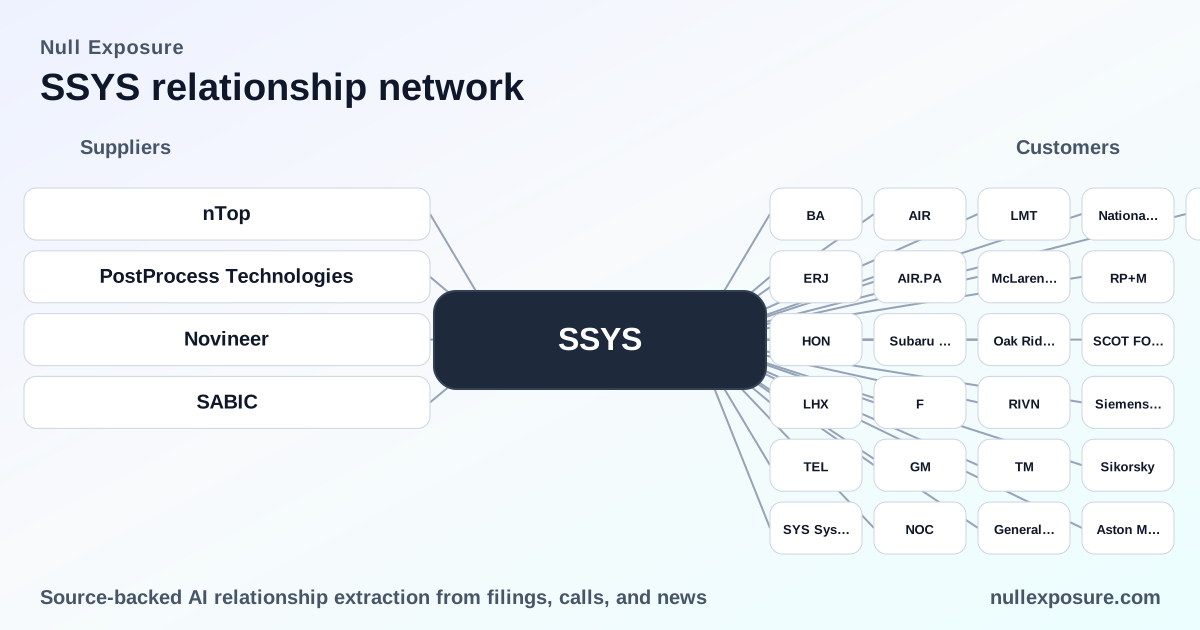
Stratasys customer map: industrial anchor clients, aerospace scale, and revenue levers
Stratasys (NASDAQ: SSYS) sells polymer-based 3D printers, materials, and services to industrial customers and monetizes through hardware sales, recurring consumable materials, service contracts, and enterprise software enabling production workflows. Its commercial strategy combines high-value OEM placements with wider channel partnerships to lock in materials and service revenue. For deeper company intelligence visit https://nullexposure.com/.
What investors should know in one paragraph
Stratasys converts capital equipment placements into recurring economics: printers are the entry point, materials and service drive lifecycle revenue, and strategic programs with aerospace and automotive OEMs validate high-margin use cases like flight‑ready parts and production tooling. Recent public disclosures and press coverage show both scale deployments and advisory-board led product improvements that support higher utilization and reliability.
How customer relationships translate into operating characteristics
Stratasys’s customer signals point to a strategic, enterprise-style contracting posture—large OEMs and defense primes adopt systems for production, not only prototyping. The customer base is concentrated around high-value industrial accounts (aerospace, automotive, defense) which increases per-account revenue but also creates dependence on a relatively small group of large buyers. The relationships documented indicate high criticality (flight-ready aircraft parts, assembly-line tooling) and maturing adoption—multi-year partnerships, high utilization installations, and advisory boards that feed product improvements all reflect a transition from niche prototyping to production-grade manufacturing.
Relationship catalog: every customer mention and what it means
Below I list each relationship captured in the available reporting and filings; each entry has a one- to two‑sentence plain-English summary and the source cited.
-
BA / Boeing (general) — Stratasys reported securing wins with Boeing among other major manufacturers, signaling ongoing enterprise-level adoption of Stratasys systems in aerospace programs. Source: Q3 2025 earnings call transcript (InsiderMonkey), 2026 reporting.
-
Boeing 737 Innovation Center — The Boeing 737 Innovation Center purchased two F3300 printers for production tooling in the fourth quarter, a direct example of Stratasys systems being used on aircraft production lines. Source: Q4 2025 earnings call coverage (InsiderMonkey), March 2026.
-
SYS Systems — SYS Systems has been a Stratasys partner since 2009 and has deployed Stratasys machines across prototyping, medical modeling, and low- to medium-volume manufacturing, demonstrating long-term channel enablement. Source: 3DPrintingIndustry article, March 2026.
-
Airbus / AIR / AIR.PA — Airbus uses Stratasys technology to produce more than 25,000 flight‑ready parts annually and has over 200,000 certified parts in service, marking a significant production application of Stratasys materials and systems. Sources: TCT Magazine and Morningstar/BizWire coverage, 2025–2026.
-
Embraer — Embraer is cited among industry leaders that have selected Stratasys solutions, reflecting adoption by multiple commercial aircraft OEMs. Source: Q3 2025 earnings call transcript (InsiderMonkey), 2026.
-
Honeywell / HON — Honeywell is listed among defense-sector purchasers of Stratasys equipment, reinforcing penetration into aerospace and defense supply chains. Source: Q3 2025 earnings call transcript (InsiderMonkey), 2026.
-
TE Connectivity / TEL — TE Connectivity is named as a repeat purchaser and advisory‑board participant, indicating use of Stratasys systems for industrial manufacturing and tooling. Source: Q3 2025 earnings call and BizWire advisory board release, 2026.
-
L3 Harris / LHX — L3 Harris made notable purchases cited in earnings materials, underscoring defense-sector demand for Stratasys additive manufacturing. Source: Q3 2025 earnings call transcript (InsiderMonkey), 2026.
-
Subaru of America / Subaru / FUJHF — Subaru implemented the T25 high-speed head on F770 printers and reported roughly a 50% reduction in tooling development time, a clear productivity lift for automotive assembly tooling. Sources: Earnings call coverage (InsiderMonkey) and Globes/EngineerLive reporting, 2026.
-
CollPlant / CLGN — CollPlant and Stratasys announced a joint effort to print regenerative breast implants using the Origin printer and CollPlant’s bioinks, with preclinical demonstration at 200cc scale, showing Stratasys involvement in advanced medical applications. Sources: Medical Design & Outsourcing and CollPlant PR release, 2024–2025.
-
Rivian / RIVN — Rivian operates an extensive fleet of Stratasys systems (28 systems cited), with the F900 running at over 90% utilization and newer F3300s delivering substantial throughput—evidence of scaled deployment in automotive product development and low-volume production. Source: Q4 2025 earnings call coverage (InsiderMonkey), March 2026.
-
General Motors / GM — General Motors is named as a major corporate customer consuming significantly more materials per machine than prototyping users, illustrating large-scale internal manufacturing usage. Source: Earnings call coverage (InsiderMonkey), 2026.
-
Toyota / TM — Toyota participates in Stratasys’s industrial advisory board and is cited among manufacturing leaders engaged in scaling additive manufacturing at enterprise scale. Source: BizWire/FinnancialContent advisory board announcement, Feb 2026.
-
Ford / F — Ford is a participating member of Stratasys’s industrial customer advisory board, signaling collaborative product refinement with leading automakers. Source: BizWire/FinnancialContent advisory board announcement, Feb 2026.
-
Lockheed Martin / LMT — Lockheed Martin is among advisory-board members and industrial customers advancing additive manufacturing use in aerospace and defense applications. Source: BizWire/FinnancialContent and earnings call coverage, 2026.
-
Northrop Grumman / NOC — Northrop Grumman’s inclusion on advisory and customer lists points to continued defense adoption for production and tooling applications. Source: BizWire/FinnancialContent advisory board announcement, Feb 2026.
-
RP+M — RP+M is listed among participants in Stratasys’s industrial advisory board, illustrating a networked customer base of manufacturing specialists. Source: BizWire/FinnancialContent, Feb 2026.
-
National Institute for Aviation Research (NIAR) — NIAR’s participation on the advisory board strengthens the R&D and certification pathway for aerospace additive manufacturing. Source: BizWire/FinnancialContent, Feb 2026.
-
McLaren Formula One — McLaren uses Stratasys SLA, FDM, and PolyJet technologies in race engineering, demonstrating performance‑critical, time‑sensitive applications of Stratasys systems. Source: Q4 2025 earnings call coverage (InsiderMonkey), March 2026.
-
Oak Ridge Systems — Oak Ridge Systems will add Stratasys PolyJet, SLA, and P3 technologies to its portfolio to target aerospace, automotive, medical, and industrial customers—an example of channel expansion agreements. Source: Q4 2025 earnings call coverage (InsiderMonkey), March 2026.
-
SCOT FORGE — SCOT FORGE is listed among advisory-board participants, showing engagement with heavy-industry metalworking and tooling firms. Source: BizWire/FinnancialContent, Feb 2026.
-
Sikorsky — Sikorsky’s advisory-board membership highlights defense‑aerospace OEM engagement for certifiable additive parts and tooling. Source: BizWire/FinnancialContent, Feb 2026.
-
Siemens Mobility — Siemens Mobility participates in the advisory board, indicating interest from rail and mobility OEMs in additive workflows. Source: BizWire/FinnancialContent, Feb 2026.
-
General Atomics — General Atomics is named among advisory and industrial participants, reinforcing defense and advanced manufacturing ties. Source: BizWire/FinnancialContent, Feb 2026.
-
Aston Martin F1 — Aston Martin F1’s involvement demonstrates Stratasys penetration into high-performance motorsports engineering applications. Source: BizWire/FinnancialContent, Feb 2026.
Business-model and operational implications for investors
- Revenue mix: hardware placements are catalysts for downstream materials and service revenue, supported by long-term enterprise deployments reported at customers like Airbus, Rivian, and major OEMs.
- Concentration risk: reliance on a set of large industrial customers increases revenue volatility if program dynamics change, but each placement is higher value and typically generates recurring material sales.
- Contracting posture: the evidence points to strategic partnerships, multi-year installations, and advisory‑board relationships—Stratasys sells into programs rather than one-off prototyping deals.
- Maturity and criticality: flight‑ready parts and assembly‑line tooling deployments indicate a movement from experimental adoption toward production-critical use, which supports stickier revenue streams.
If you want a structured extraction of these customer relationships for due diligence or portfolio monitoring, visit https://nullexposure.com/ for tailored briefings.
Bottom line for investors
Stratasys’s customer roster reads like a who’s‑who of industrial adoption: aerospace OEMs, automakers, defense primes, and performance engineering teams. That mix supports a repeatable revenue model (materials + services) but concentrates risk in a relatively small number of strategic customers. Monitor utilization metrics at large installations and the conversion rate from pilot projects to certified production runs as leading indicators of durable revenue growth.