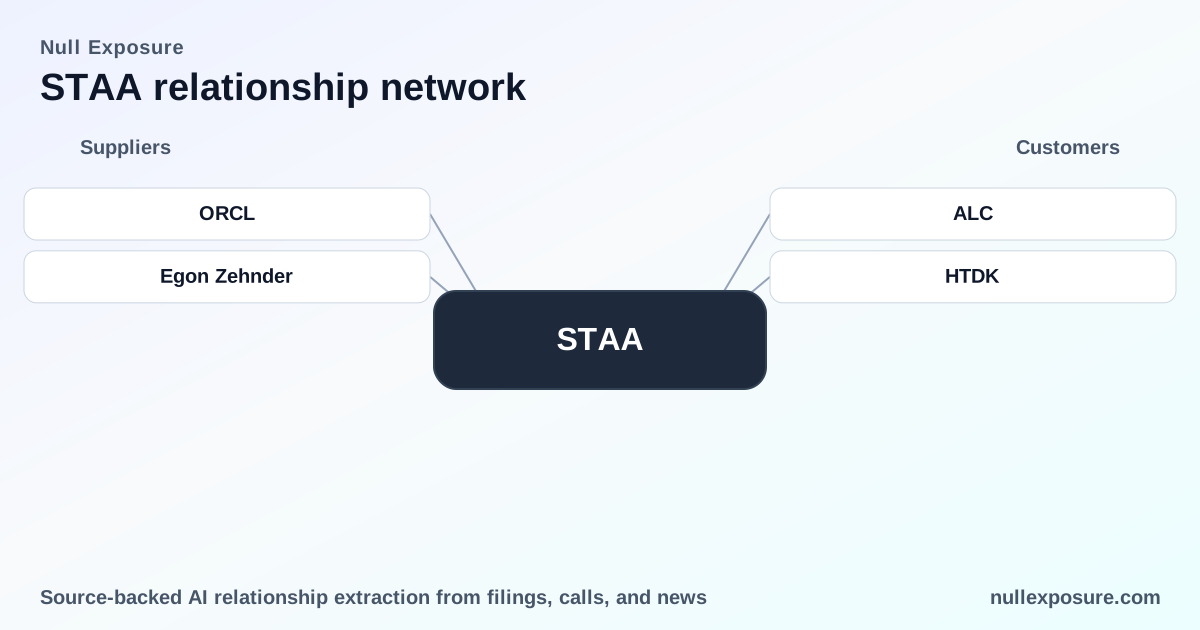
STAAR Surgical (STAA): customer relationships that define the business
STAAR Surgical designs, manufactures and sells implantable collamer lenses (ICLs) and associated delivery systems, and monetizes almost exclusively through product sales to ophthalmic surgeons, vision centers and distribution partners worldwide. Its commercial model is channel-driven: STAAR sells direct in key markets and relies on independent distributors elsewhere, with China distributors representing a disproportionate share of revenue—an outcome that drives both near-term revenue concentration and strategic risk for investors.
For a concise dossier on counterparty exposure and distribution dynamics, visit https://nullexposure.com/.
The acquisition headline every investor must factor in
Alcon agreed to acquire STAAR in an all‑cash transaction valued at roughly $1.5 billion, a development that materially changes STAA’s customer and channel profile going forward. The deal removes standalone equity optionality for public holders and places STAAR’s distributor relationships and China concentration under Alcon’s strategic control. This transaction was reported by market coverage in March 2026 and discussed again in subsequent analyst commentary. According to a Bitget news note on March 10, 2026, Alcon reached an agreement to acquire STAAR in an all‑cash deal valued at about $1.5 billion; SimplyWall later ran a feature (May 4, 2026) framing the acquisition as the central catalyst for reassessing STAA’s outlook.
Customer relationships on the record
Below are the specific counterparties referenced in available coverage and the plain‑English facts investors should consider.
Alcon (ALC) — acquirer and strategic counterparty
Alcon announced a binding agreement to acquire STAAR in an all‑cash deal valued at about $1.5 billion, converting STAAR’s independent distribution and customer relationships into Alcon-owned assets. This is the single most consequential customer/partner development for STAA because it changes negotiating leverage, integration risk and future channel strategy. (Sources: Bitget news, March 10, 2026; SimplyWall feature, May 4, 2026.)
HTDK — distributor-level partner referenced in earnings commentary
HTDK figures in STAAR’s public commentary as a distributor partner brought on to expand market access and training in a large, diverse market; company executives said the two distributors, including HTDK, were intensively engaged in inventory buildup and training to support thousands of hospitals. This positions HTDK as an active commercial partner in STAAR’s international channel mix. (Source: Q4 2025 earnings call transcript reported by InsiderMonkey, March 2026.)
What the corporate disclosures and evidence say about how STAAR operates
The available excerpts from STAAR’s filings and public remarks paint a consistent operational blueprint. Presenting these as company‑level signals gives investors a clear sense of concentration, contracting posture, geography and product dependence.
-
Distributor‑first commercial model with short payment cycles. STAAR’s distributor agreements carry payment terms typically between 30 and 90 days, reflecting a transactional, near‑term cash conversion posture rather than long multi‑year supply contracts. (Company disclosure.)
-
High concentration in China. Two China distributors accounted for approximately 51% of consolidated net sales during fiscal 2024, a level of concentration that classifies those relationships as critical to STAAR’s revenue profile. This is an enterprise‑level constraint: macroeconomic or procedural disruptions in China drive material revenue volatility. (Company filing, FY2024.)
-
Global footprint with APAC exposure. STAAR sells in more than 75 countries, with direct distribution in the U.S., Japan and several European markets and mixed direct/independent distribution across China, Korea, India and parts of EMEA; APAC experienced the largest recent swing, with declines in China shown as a driver of APAC unit softness. These geography signals indicate revenue sensitivity to regional procedural volumes, particularly in APAC. (Company filing; FY2024 commentary.)
-
Distributor role is operationally active and material. Management disclosed large shipments to distributors (for example, a $27.5 million ICL shipment in Q4 2024) and described distributors’ operational work to secure inventory and conduct training, confirming distributors are not passive resellers but integral to adoption, training and inventory flow. (Company filings and earnings commentary.)
-
Product concentration around ICLs. Approximately 100% of reported net sales in the referenced fiscal period were generated from ICLs, making product diversification minimal and reliance on refractive surgery volumes acute. This is a maturity signal: STAAR is a single-product specialist rather than a multi-platform device company. (Company filing; FY2024.)
-
Spend bands indicate material counterparties. The company reported Net Sales to China Distributors listed as $161,321 (FY2024) representing 51.4% of consolidated sales, and management referenced discrete, large single-ship orders in the tens of millions, illustrating that individual distributor contracts can be transactionally large. (Company filing; FY2024; Q4 2024 disclosure.)
Investment implications: what investors should monitor next
-
Integration and channel strategy under Alcon. The Alcon acquisition converts STAAR’s distribution network into an asset Alcon will manage—this reduces public equity exposure but introduces execution and antitrust/approval considerations that will determine whether the China concentration and distributor contracts are preserved, renegotiated or replatformed. Investors should track integration milestones and regulatory filings. (Acquisition reporting, March–May 2026.)
-
China procedural volumes and distributor health remain the proximate revenue lever. Given that two distributors drove more than half of FY2024 sales, operational or macro shocks in China will transmit directly to consolidated revenue. Monitor Chinese surgical volumes, distributor inventory levels and any public statements from those distributors.
-
Working capital dynamics are compressed and visible. Short payment terms (30–90 days) and large, lump‑sum shipments create tight working capital cycles; shifts in distributor creditworthiness or demand forecasts could stress cash flows before top‑line signals become apparent.
-
Concentration and product risk persist until Alcon executes integration. With near‑total reliance on ICLs, adoption risk in refractive surgery and competitive dynamics in lenses remain the dominant business risks unless Alcon changes product strategy or invests in diversification.
For regular updates on counterparty exposure and evolving partner lists, see https://nullexposure.com/.
Bottom line
STAAR’s commercial value lies in a narrow, high‑margin product sold through a concentrated distributor network—most materially in China—and that network is now transitioning under Alcon’s control following a reported ~$1.5 billion acquisition agreement. The deal resolves the standalone equity case but elevates execution risk around integration, regulatory approvals and channel rationalization. Investors evaluating STAA should prioritize tracking the Alcon integration plan, distributor contract status in China, and procedural volume trends in APAC.