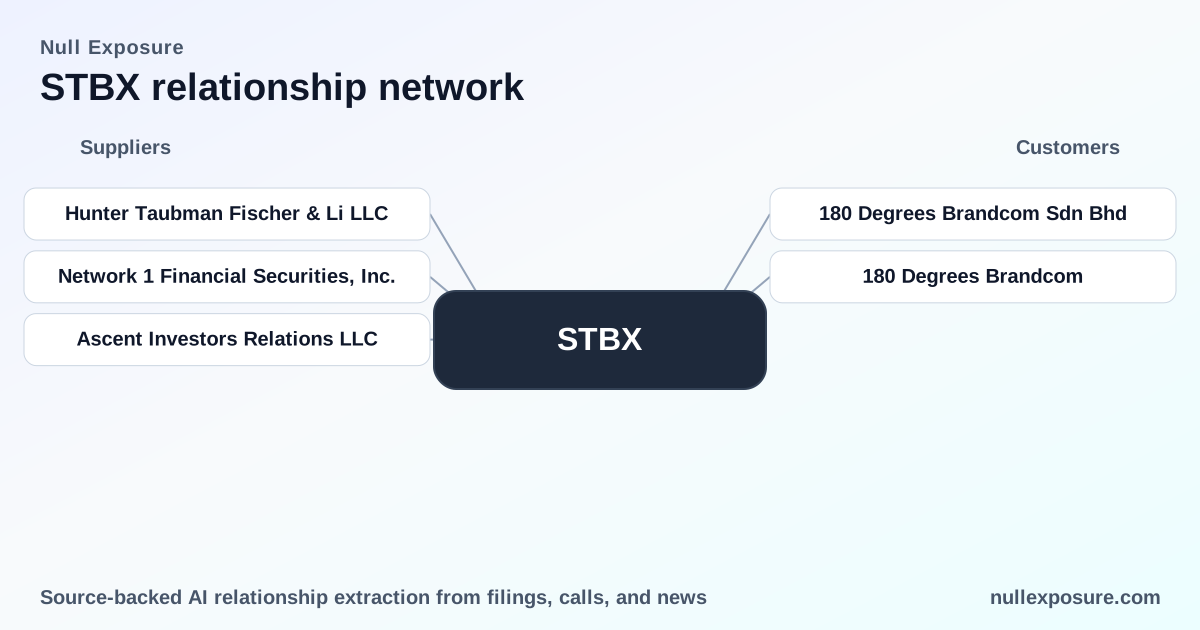
Starbox (STBX) — Customer Relationships and Commercial Implications
Starbox Group Holdings Ltd. operates as a digital advertising services provider and payments/rebates facilitator for retail advertisers, monetizing through advertising solutions, software licensing, and merchant-facing marketing services. Revenue is generated by delivering ad inventory and AI-driven marketing tools to merchants and related advertising firms, supplemented by payment/rebate services that deepen merchant engagement. For investors, the relationship profile signals how product deployment and consolidation of subsidiaries drive both near-term operating focus and long-term platform value capture.
Visit the firm overview at https://nullexposure.com/ for linked analytics and background on STBX’s commercial model.
One customer stands out: 180 Degrees Brandcom
Starbox’s customer relationships in the reviewed records are concentrated: all cited customer interactions involve 180 Degrees Brandcom Sdn Bhd. The engagement is commercial and operational, pivoting on Starbox’s rollout of multiple StarboxAI products to support advertising and campaign optimization for 180 Degrees Brandcom.
- 180 Degrees Brandcom Sdn Bhd — Starbox is provisioning the company with its StarboxAI Pro Series for image, video and live-stream content capabilities and deploying additional modules (IntelliDistribute, IntelliContentCreate, IntelliCampaignOptimize) to optimize campaign performance and content creation for the advertiser. This is reported across multiple press releases and financial news outlets including GlobeNewswire (Oct 24, 2024; Jan 8, 2025; Jan 16, 2025), Yahoo Finance (Jan 2025), and Taiwan News (May 2026). Several announcements specify that 180 Degrees Brandcom is an indirect (51% owned) subsidiary of Starbox, which frames these deployments as intra-group product adoption as well as external customer support (GlobeNewswire, Jan 16, 2025).
Sources: GlobeNewswire press releases (Oct 24, 2024; Jan 8 & Jan 16, 2025); Yahoo Finance summary (Jan 2025); Taiwan News coverage (May 4, 2026); MarketBeat and related aggregator mentions in FY2025 coverage.
What the 180 relationship means commercially
Starbox is shifting from basic ad inventory and rebate services toward AI-driven marketing software deployed directly into the operations of a closely related advertising firm. The relationship is both a product showcase and a use-case deployment: StarboxAI modules are being used to create content, distribute information intelligently, and optimize campaign KPIs for 180 Degrees Brandcom. GlobeNewswire’s announcements highlight product-led commercialization where internal adoption supports future external sales narratives and potential SaaS upsell. (GlobeNewswire, Jan 8 & Jan 16, 2025.)
This arrangement is strategically meaningful because 180 is identified as an indirect 51% owned subsidiary, converting what could be an external customer into a near-term internal reference account and operational testbed. That structure reduces commercial friction for early-stage deployments while concentrating implementation risk within the corporate group (GlobeNewswire, Jan 16, 2025).
Operating model signals and business-model constraints
Starbox’s public disclosures and newsflow produce several company-level signals relevant to investors evaluating customer risk and scalability:
- Contracting posture: Product rollouts documented in press releases indicate direct deployments and internal adoption patterns rather than broad third-party licensing agreements. That points to an early commercial posture focused on controlled, captive implementations rather than mass-market channel distribution.
- Concentration: The reviewed results show a tight customer focus—all cited engagements reference 180 Degrees Brandcom—which signals current concentration risk in commercial validation and revenue generation.
- Criticality: The adoption of multiple StarboxAI modules for content creation, distribution, and campaign optimization suggests these tools are positioned as operationally important to the client’s advertising workflows, especially when the client is a majority-held affiliate.
- Maturity: Announced products and internal deployments are consistent with a company in early commercialization and product iteration stage rather than a mature, diversified software vendor. Press releases present feature introductions and pilot-scale implementations rather than large contract backlogs or multinational rollouts (GlobeNewswire, Jan 2025; Oct 2024).
No formal third-party contracting constraints or external dependency disclosures were present in the review data; the absence of explicit constraints in the record is itself a signal that contracting and partner limitations have not been identified as notable in these sources.
Financial context that matters for customers
Starbox’s financial profile frames how customers like 180 influence valuation and operational choices. The company’s trailing revenue is modest in absolute terms (Revenue TTM: 6,174,200), operating margins are negative, and EBITDA is materially negative, reflecting investment into product development and commercial expansion. Commercial relationships that convert into recurring software revenue and wider external client adoption are critical to shift the company toward profitability. Investors should treat intra-group deployments as valuable proof points but not yet evidence of diversified revenue streams.
Investor implications — what to watch and why it matters
- Proof-of-product versus commercial scale: The 180 relationship is a strong internal proof point for StarboxAI, but investors should track whether Starbox converts this into third-party paying customers beyond its affiliate. GlobeNewswire and other press accounts document internal adoption; the next material signal is external commercial traction.
- Concentration risk: Current public record shows customer concentration; failure to diversify would leave revenue vulnerable to intra-group reallocation decisions. Diversification into independent agency and merchant customers is required to de-risk growth.
- Monetization path: The company is transitioning toward AI-enabled software offerings layered on top of advertising and payment services. Investors should prioritize evidence of recurring license fees, retention metrics, and third-party contract value as indicators of a durable monetization model.
- Operational leverage: Given Starbox’s negative EBITDA and operating margin pressure, successful scaling of StarboxAI into external clients is the lever that converts technology investments into improved profit margins.
For an at-a-glance company profile and further relationship mapping, see https://nullexposure.com/.
Bottom line
Starbox’s publicly documented customer relationships are currently concentrated and internally oriented: the single recurring customer relationship identified across public sources is 180 Degrees Brandcom Sdn Bhd, which is both a primary operational partner and an indirect majority-owned subsidiary. This relationship validates StarboxAI’s product strategy but also underscores the need for external client diversification and demonstrable recurring revenue expansion to convert technical deployments into sustainable financial progress.
Key takeaway: internal commercialization of AI modules demonstrates capability; externalization and revenue diversification determine investment upside.
Sources referenced in-text include GlobeNewswire press releases (Oct 24, 2024; Jan 8 & Jan 16, 2025), Yahoo Finance summarizations (Jan 2025), Taiwan News reporting (May 4, 2026), MarketBeat and other news aggregators covering FY2025.