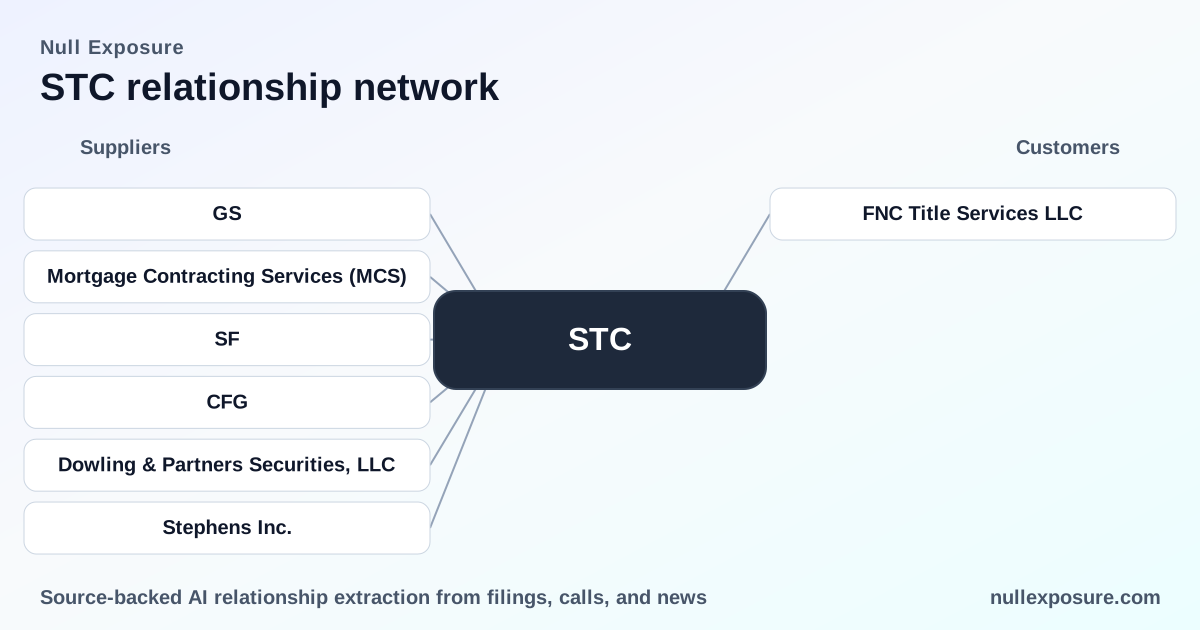
Stewart Information Services (STC) — how customer relationships drive the business
Stewart Information Services monetizes a mix of one‑time title premiums and recurring real‑estate services and subscription products, selling directly through its owned operations and a global network of approved agencies. The firm earns durable fee income from title policies that transfer with property ownership, while supplementing margins with ratable, subscription-style software and services used by lenders, servicers and real‑estate professionals. This hybrid monetization—long‑duration insurance economics combined with service subscriptions—creates both stable cashflow anchors and higher‑growth service revenue streams for investors.
If you want deeper visibility into customer relationships and contract posture, see the coverage at https://nullexposure.com/ for more structured analysis.
How Stewart’s customer contract mix shapes its economics
Stewart operates with a dual contract posture that materially influences revenue recognition and risk. Company disclosures state: “For those products and services where delivery occurs over time, the related revenue is recognized ratably over the duration of the subscription.” This confirms a material subscription component in the services bucket that delivers recurring, ratable revenue. At the same time, Stewart’s core title product is a single‑premium policy with long‑lived coverage — the owner’s policy protects for as long as the property is owned or the lender retains its insured lien — a contract design that produces front‑loaded premium receipts but long‑tail liability exposure.
The customer base spans individuals and institutions. Stewart explicitly serves “homebuyers and sellers; residential and commercial real estate professionals; mortgage lenders and servicers; title agencies and real estate attorneys; and home builders,” indicating broad counterparty diversity with significant individual consumer exposure alongside institutional clients. The company also describes itself as a global real‑estate services firm, operating through direct offices, a network of independent agencies and related businesses, which supports cross‑border reach and distribution. Company filings for the year ended December 31, 2024 note that approximately 52% of consolidated title revenues were generated in Texas, New York, Ohio, California, Pennsylvania, Florida and international markets (principally Canada) — a signal that revenue concentration is meaningful by geography, even as global distribution exists.
Taken together, these facts imply a business with:
- Stable, long‑duration policy economics that underpin capital adequacy and loss reserving,
- Growing ratable service streams that smooth quarter‑to‑quarter volatility, and
- Geographic concentration that creates state‑level exposure while still leveraging an international footprint.
The relationship inventory: FNC Title Services LLC
A March 2026 industry report documents Stewart’s strategic acquisition of FNC Title Services LLC, described as a reverse mortgage title leader. The transaction is presented as a capability play to expand Stewart’s offerings into the reverse‑mortgage segment and to leverage Stewart’s platforms for broader product distribution. (Source: National Mortgage Professional, March 10, 2026 — nationalmortgageprofessional.com)
Why the FNC relationship matters to customers and investors
The FNC acquisition enhances Stewart’s product depth in a niche with specialized regulatory and servicing requirements (reverse mortgages), and it aligns with the company’s strategy of buying capability to expand recurring service revenue and distribution. According to the March 2026 coverage, Stewart intends to leverage its existing products and platforms to deliver security and ease‑of‑use for FNC’s market, which fits the company‑level move toward integrating subscription and service offerings with traditional title underwriting. (Source: National Mortgage Professional, March 10, 2026)
Operational constraints and what they signal about risk and opportunity
Stewart’s disclosures provide a clear set of operating constraints that explain how the business performs for customers and how investors should assess durability:
- Contracting posture (subscription + long‑term insurance): Subscription revenue is recorded ratably; title insurance is sold as a one‑time premium with coverage that persists for the life of ownership. This structure balances volatile origination cycles with recurring, contractually‑defined services.
- Counterparty mix (individuals and institutions): The customer mix includes high volume retail buyers and material institutional partners (lenders, servicers and agencies), implying the need for both consumer distribution and enterprise sales capabilities.
- Geography and concentration: The company is global in reach but shows meaningful state concentration — over half of title revenues were generated in a handful of U.S. states plus Canada in 2024 — which concentrates regulatory and market cycle exposure.
- Materiality and segment focus: Title and related services are core and material to consolidated revenue; the company positions itself primarily as a services business within the property & casualty insurance framework.
- Maturity and criticality: Stewart has established market position with a long operating history and products that are critical to real‑estate transactions, making its service continuity and claims management capabilities central to underwriting credibility.
These constraints create a predictable economics profile: balance sheet exposure tied to claims and reserve adequacy, offset by recurring service revenue and an agency network that supports origination. Investors should treat subscription growth as margin accretive over time, while reserving and state‑level cycles remain the primary episodic risks.
Investment implications — what to watch next
- Revenue mix evolution: Track growth in ratable subscription services versus one‑time title premiums; subscription acceleration will improve revenue visibility and reduce origination volatility.
- Geographic concentration risk: Monitor title volumes in the core states named in SEC disclosures; state‑level housing slowdowns will disproportionately affect reported top‑line.
- Integration outcomes from FNC: Assess cross‑sell metrics and technology integration milestones post‑acquisition to confirm that the FNC deal expands recurring revenue rather than adding only near‑term transaction fees.
- Reserve and underwriting trends: Loss ratios, reserve development and combined ratio dynamics remain the principal determinants of free cashflow and capital returns.
- Regulatory and product complexity: Reverse mortgage work is specialized; successful operational integration is necessary to avoid increased claims or compliance costs.
For a concise view of Stewart’s customer relationships and how they influence commercial exposures, consult additional analysis at https://nullexposure.com/.
Bottom line for investors
Stewart combines long‑duration title policy economics with growing subscription and services revenue, a mix that offers both stability and optionality. The FNC acquisition is consistent with a strategy of buying vertical expertise to broaden recurring revenue and product depth; it reinforces Stewart’s positioning in specialized mortgage segments. The principal risks are state‑level concentration and underwriting volatility, which investors should offset by monitoring subscription adoption and reserve trends. Overall, Stewart presents a defensible franchise with a clear path to modest growth in services and durable cashflows from legacy title economics.