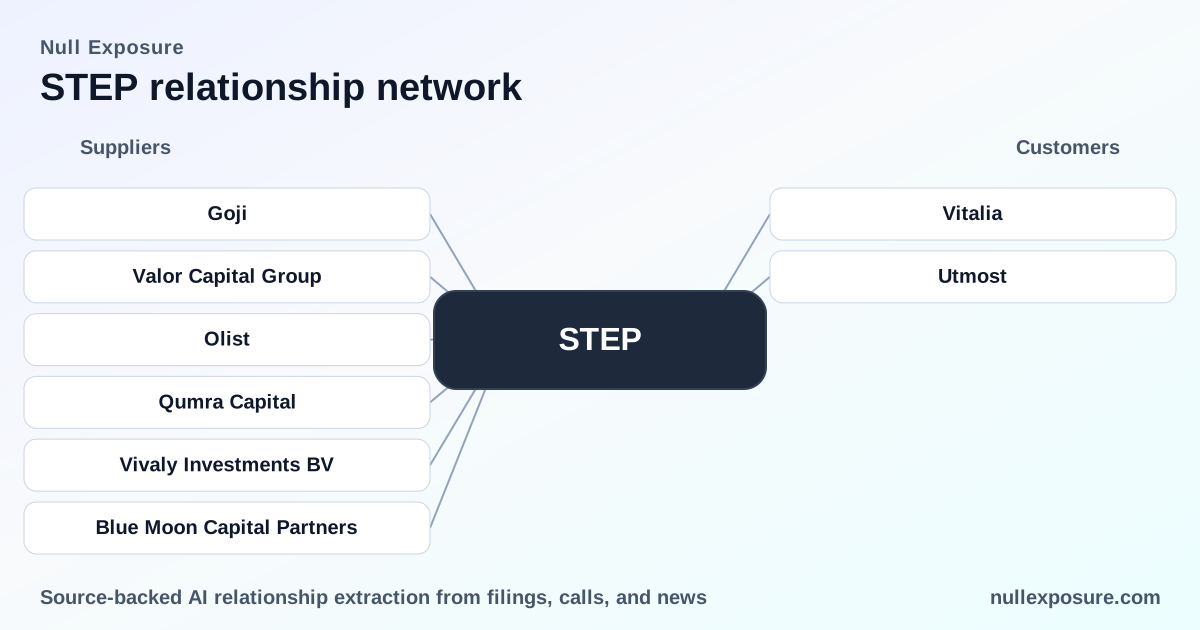
STEP’s customer map: What the Vitalia and Utmost links reveal about franchise economics
StepStone Group (NASDAQ: STEP) runs a fee-first private markets franchise: it packages and manages SMAs and commingled funds across private equity, real estate, infrastructure and private debt, charging management, advisory and performance fees to a broad institutional and wealth client base. Revenue derives from durable management fees on long-dated mandates and episodic performance fees tied to realized outcomes, creating a hybrid flow and event-driven cash profile that investors must price for cyclicality and fee rate durability. For a concise gateway to further research, see the firm’s public materials at the StepStone website or visit NullExposure for curated coverage: https://nullexposure.com/.
How StepStone monetizes client relationships — the operating model in plain English
StepStone acts primarily as an investment adviser and general partner to separately managed accounts (SMAs) and focused commingled funds, and earns management, advisory and performance fees as its core revenue streams. Company filings note that SMAs and focused funds are typically long-term contracts (8–18 years including extensions), which enforces a slow-burning but predictable management-fee base while concentrating performance-fee volatility into discrete realization windows. As of March 31, 2025, StepStone reported 460 revenue-generating asset management and advisory programs, indicating broad product distribution and low client-level concentration—no single client represented 10% or more of net management and advisory fees for fiscal years through 2025.
- Contracting posture: predominantly long-term mandates that lock in management fees over multi-year horizons.
- Concentration: deliberately low at the client level, reducing counterparty revenue risk.
- Criticality: StepStone’s services are strategically important to large pensions, sovereign wealth funds and family offices that require private markets access.
- Maturity: the business sits at scale with hundreds of active programs, but revenue is sensitive to private markets fundraising and realized performance.
Two customer ties worth noting
Below I cover every customer relationship returned in the results and provide a short investor-oriented read on each.
Vitalia — a large real estate recap with StepStone Real Estate Partners V
StepStone Real Estate completed a €1.5 billion planned recapitalization of Vitalia, Spain’s second-largest care-home owner-operator, as part of SREP V’s transactions; this transaction demonstrates StepStone’s use of fund-level GP-led and secondary solutions to extract and redeploy value from portfolio companies. According to a Quiver Quant news item published March 10, 2026, SREP V participated in the Vitalia recapitalization as an emblematic deal for the program (Quiver Quant, Mar 10, 2026).
Utmost — distribution and product partnership in the UK
StepStone has partnered with Utmost to offer UK clients access to evergreen global private markets strategies, extending StepStone’s distribution reach into UK wealth and retirement channels and broadening recurring-fee opportunities. Sahm Capital reported this StepStone–Utmost collaboration on February 15, 2026, noting the partnership’s intent to expand UK client access to StepStone’s evergreen strategies (Sahm Capital, Feb 15, 2026).
What the relationship list and corporate signals mean for investors
The two relationships in the results highlight two structural behaviors that define StepStone’s customer playbook.
- Product-led, global distribution: The Utmost partnership is a distribution extension, converting StepStone’s private markets capabilities into channels that scale fee-bearing AUM in retail and institutional segments across the UK. Company disclosures emphasize StepStone’s global footprint and revenue from clients both in the U.S. and internationally, reinforcing that the firm sells services into multiple jurisdictions.
- Sponsor-level value creation and liquidity engineering: The Vitalia recapitalization reflects StepStone’s active sponsor role in real asset secondaries and GP-led liquidity solutions, where the firm participates in structured recapitalizations to capture realized gains and reset hold periods for funds.
Company-level constraint signals further sharpen these conclusions: filings identify a diversified mix of counterparties—sovereign wealth funds, pension funds, insurance companies, endowments, foundations, family offices and high-net-worth individuals—and classify the business as a services-oriented asset manager whose revenue base comes almost entirely from management and advisory fees. These constraints constitute company-level facts rather than relationship-specific attributes.
Risk and resilience — practical implications from the contract and client profile
StepStone’s long-term contract posture delivers stability in management fees but creates a multi-year lag between fundraising and performance fee realization, magnifying sensitivity to private markets exit environments. The company’s low client concentration (no single client >10% of net management/advisory fees through FY2025) reduces counterparty dependence; however, the client roster includes very large enterprises and government-related investors, concentrating reputational risk and regulatory exposure in certain jurisdictions.
Other investor-relevant points:
- Revenue composition: management and advisory fees dominate the top line; performance fees are episodic and amplify earnings volatility in up cycles.
- Geographic footprint: a global client base reduces single-region macro risk but increases operational complexity and regulatory compliance burden.
- Service role: StepStone acts as both seller of products and service provider/adviser, reinforcing the stickiness of relationships but requiring continuous investment in distribution and due diligence capabilities.
Key takeaways for investors
- Durable fee base, event-driven upside: Long-dated SMAs and commingled funds create a reliable management-fee runway, while GP-led deals and realizations drive outsized episodic gains (Vitalia exemplifies this dynamic).
- Low client concentration: No client accounted for 10%+ of net fees through FY2025, lowering single-counterparty revenue risk.
- Distribution is a growth lever: Partnerships like the Utmost tie expand institutional and wealth channels and accelerate fee-bearing AUM expansion in targeted markets.
- Earnings volatility ahead despite scale: Performance fees will produce lumpy earnings swings; investors must underwrite a dual-profile business—steady base fees plus cyclical carry.
- Global footprint raises compliance costs: Serving sovereign funds, pensions and cross-border clients increases regulatory and operational demands that scale with international expansion.
For a deeper customer-level view and periodic updates on how StepStone converts deal flow into realized fees, NullExposure maintains ongoing coverage and analysis at https://nullexposure.com/.
StepStone’s customer architecture balances long-term contractual revenue against performance-dependent upside; investors should value the stock with both sources of cashflow in mind and stress-test scenarios for private market exit cycles and distribution growth trajectories.