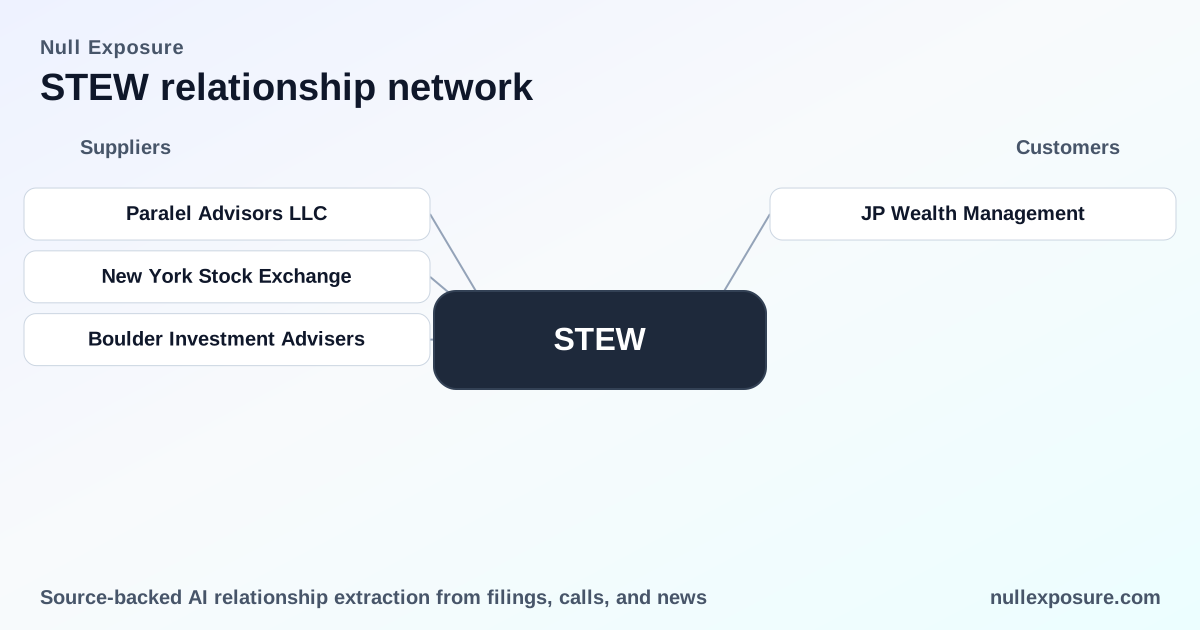
SRH Total Return Fund (STEW): Customer Footprint and Commercial Signals for Investors
SRH Total Return Fund Inc. (STEW) is a closed-end investment company that generates revenue through net investment income, realized and unrealized capital gains across a diversified portfolio of equities, fixed income and hybrid instruments, and ongoing management fees embedded in fund expenses. STEW monetizes by delivering total return to shareholders while capturing fee income and retaining NAV-driven upside; its closed-end structure concentrates return drivers into asset selection and distribution policy rather than direct product sales. For investors and operators evaluating customer relationships, the fund’s commercial footprint is best read through large advisory allocations and ownership concentration rather than traditional vendor-customer contracts.
For a concise overview of coverage and monitoring options, visit https://nullexposure.com/.
How the fund operates in plain language
STEW operates as an actively managed closed-end fund listed on the NYSE. The fund’s economics are driven by portfolio performance, distribution policy, and expense management rather than recurring product sales. Closed-end funds realize liquidity through secondary market trading and NAV management, which creates two distinct revenue levers: investment performance (capital gains and interest/dividends) and distribution yield that attracts income-sensitive investors. With a trailing P/E of 9.89, a Price/Book of 0.771 and a dividend yield around 3.7%, STEW trades with valuation characteristics consistent with mature income-oriented funds. The fund’s market capitalization (~$1.70 billion) and insider ownership (47.1% of shares) underline a governance and ownership profile that materially influences strategic choices.
Who actually holds and allocates to STEW: the customer relationships
Institutional and advisory allocations are the effective “customers” for a closed-end fund: large advisors and wealth managers incorporate the fund into model portfolios and client accounts. The relationship data returned for STEW identifies one material advisor allocation.
JP Wealth Management — a concentrated allocation in FY2026
JP Wealth Management disclosed a purchase that pushed STEW to 19.3% of an advisor portfolio after a $3.9 million buy; the filing lists STEW as a top-five holding at $27.36 million (19.3% of AUM) for FY2026. This position size signals that STEW functions as a core income/total-return sleeve in at least one multi-asset advisory mandate. Source: The Globe and Mail reporting on a filing dated March 10, 2026 (https://www.theglobeandmail.com/investing/markets/stocks/QQQM-Q/pressreleases/37073870/a-3-9-million-buy-just-pushed-this-closed-end-fund-to-19-of-an-advisors-portfolio/).
That listing is the only explicit customer-level relationship surfaced in the reviewed record set. The single flagged relationship is notable because advisory allocations at or near 20% of an advisor’s AUM reflect meaningful commercial adoption rather than token exposure.
What the absence of explicit constraints signals about STEW’s operating profile
The relationship constraints feed contained no entries, which is a company-level signal in itself: there are no flagged contractual limitations, exclusivity clauses, or vendor-specific constraints captured in this review. From that absence and the firm metrics, several operating model characteristics are clear:
- Contracting posture — market-driven, not contract-locked. Closed-end funds do not rely on long-term customer contracts in the way vendors do; distribution and advisory adoption are voluntary and liquid through secondary markets. The empty constraints set reinforces that STEW’s commercial relationships are allocation-based rather than contractually captive.
- Concentration — ownership-driven influence. Insider ownership stands at 47.15%, while institutional ownership is 16.68%. High insider ownership creates concentrated governance and lowers the likelihood of aggressive external structural changes without insider alignment.
- Criticality — mission-critical for select advisors. The JP Wealth Management allocation demonstrates that STEW can be a core component in specific advisor portfolios, creating concentrated exposure for those customers even when the fund’s overall institutional ownership figure remains modest.
- Maturity — established product with stable income profile. Financials show modest profitability and a low beta (0.838), consistent with a mature closed-end fund positioned for steady income and capital appreciation rather than high-growth volatility.
Investment implications: upside drivers and concentrated risks
STEW offers investors a blend of income and low-volatility equity exposure with several structural characteristics that matter to allocators:
- Upside drivers: steady distribution yield (~3.7%), a diversified mix of income-producing assets, and insider alignment via high insider ownership that can support long-term NAV management.
- Concentration risks: meaningful allocations by individual advisors (as shown by JP Wealth Management) create distribution concentration risk at the customer level; if a handful of advisors reduce allocations, secondary market pressure can widen discounts to NAV.
- Governance signal: near-half insider ownership is a double-edged sword — it supports management continuity and strategic patience but reduces free float and may complicate activist interventions.
- Valuation context: trading below book value (P/B 0.771) with a low trailing P/E (9.89) frames the fund as attractively priced for income-oriented investors, while modest ROE (8.01%) and slim profit margins require active portfolio performance to drive returns above peers.
Practical next steps for investors and operators
- Monitor advisor filings and top-holder updates quarterly to detect concentration shifts similar to the JP Wealth Management position disclosed in FY2026. The single large advisor allocation flagged here demonstrates how allocation moves can meaningfully affect market perception.
- Track discount-to-NAV dynamics and distribution policy changes; these are the primary levers by which fund management converts portfolio performance into shareholder returns.
- Evaluate governance outcomes given the high insider ownership; activist risk is muted, but strategic flexibility is concentrated.
For a tailored view of STEW’s customer footprint and ongoing monitoring tools, explore NullExposure coverage at https://nullexposure.com/.
Final takeaways
- STEW is a classic closed-end fund that earns via portfolio returns and embedded fees, not customer contracts.
- Advisory allocations can be large and consequential; JP Wealth Management’s FY2026 filing shows a 19.3% allocation that functions as a material customer relationship.
- No explicit contractual constraints were found, which reflects the open-market, allocation-based distribution model of the fund.
- High insider ownership and below-book valuation combine to create a locked-down governance profile with a value-oriented market opportunity for income investors.
Investors evaluating STEW should weight advisor concentration and insider governance alongside valuation and yield when determining position sizing and monitoring cadence.