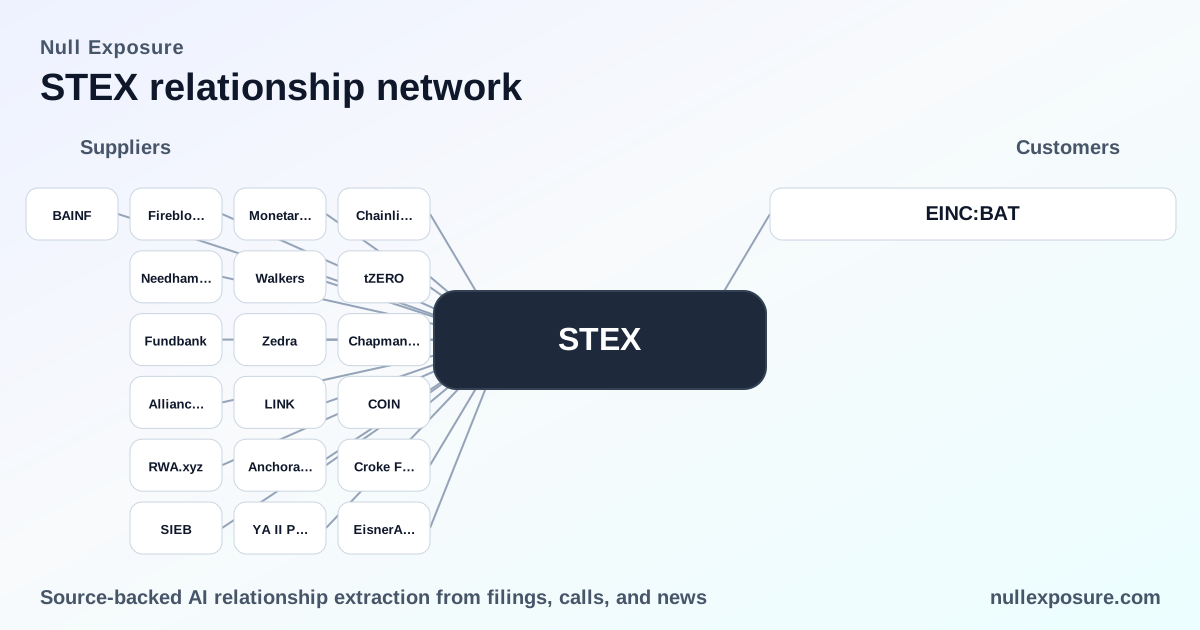
Streamex (STEX): Customer relationships determine value creation — and risk
Streamex monetizes primarily by selling and leasing its PURE EP medical device and by charging for related support, maintenance, and software upgrades recognized over time. Revenue is hardware-led, supplemented by subscription-style service revenue, and the company’s commercial progress is tightly coupled to a very small set of customers and its access to external financing. For investors, the most important variables are customer concentration, traction in healthcare adoption, and the company’s ability to replace or supplement standby financing arrangements. Learn more at https://nullexposure.com/.
How Streamex charges customers and the shape of its contracts
Streamex’s core revenue model is straightforward: one-time device sales or multi-year leases for PURE EP, plus ratable service/subscription revenue for ongoing support and upgrades. The company disclosed leases entered in 2022 with 30-month terms and optional extensions, and it recognizes support, maintenance, and upgrades ratably over service periods, consistent with subscription-like revenue recognition. These contract features produce a mix of upfront hardware cash and predictable, lower-margin recurring revenue from services, which influences valuation comparables and working capital cadence (company filings, FY2022–FY2024 disclosures).
Revenue concentration is the dominant risk factor
Streamex reported that one customer accounted for 97.5% of revenue in the year ended December 31, 2024, and that in 2023 three customers together accounted for most of sales (48.1%, 29.7% and 22.2%). This level of concentration makes each customer relationship strategically critical to near-term revenue and cash generation, and it magnifies counterparty and collection risk in a capital-constrained early commercial stage (company filing, FY2024). Investors should treat customer wins and retention as binary events for near-term valuation.
The Yorkville financing relationship and its termination
EINC:BAT (feed tag)
TradingView reported on March 10, 2026 that Streamex terminated a Standby Equity Purchase Agreement that had been sourced and reported under the tag "EINC:BAT" in the news feed; this entry reflects the financing relationship’s discontinuation as captured in market coverage. (TradingView, 2026-03-10 — https://www.tradingview.com/news/tradingview:fd0bcec6490fa:0-streamex-terminates-standby-equity-purchase-agreement-with-yorkville/)
Yorkville
TradingView’s coverage explicitly notes that Streamex terminated its Standby Equity Purchase Agreement with Yorkville on March 10, 2026, removing a standby liquidity source previously available to the company. The termination reduces Streamex’s committed financing optionality and forces management to pursue alternative capital or accelerate revenue-generating activities. (TradingView, 2026-03-10 — https://www.tradingview.com/news/tradingview:fd0bcec6490fa:0-streamex-terminates-standby-equity-purchase-agreement-with-yorkville/)
What the contracts and constraints tell investors about operations
Treat the following as company-level signals (these excerpts do not assign constraints to a specific counterparty):
- Contracting posture — long-term hardware leasing plus ratable services. The company’s leases (30-month terms with extension options) and ratable recognition of support services indicate a hybrid commercialization approach that blends upfront capital recovery with recurring revenue smoothing (company filings, FY2022 disclosures).
- Customer criticality — single-customer dependence. The 97.5% concentration figure in FY2024 is a structural vulnerability: a single revenue shock or contract loss would substantially impair cash generation and likely force dilutive financing or cost-cutting (company filing, FY2024).
- Commercial maturity — ramping stage. Management describes an active market development program and expanding sales/distribution capabilities, which positions the commercial model in a ramp rather than a mature scale phase; execution on these initiatives determines medium-term growth (company filings, FY2023–FY2024 disclosures).
- Segment and product focus — hardware-first, services adjunct. PURE EP is the core product; historical transactions include direct sales and leases to major health systems, which confirms hardware is the primary revenue driver while support and upgrades act as subscription-like add-ons (company filings, 2020–2022 revenue notes).
Financial context that colors customer risk
Streamex’s reported trailing revenue is immaterial relative to operating losses: Revenue TTM is $13,000 while EBITDA is deeply negative (-$67.56M), and the company carries high valuation multiples on a Price-to-Sales basis (company overview metrics, latest quarter). Combined with high insider ownership (≈27%) and low institutional ownership (~15%), these factors indicate a founder- or management-centric capital structure and limited institutional cushions. The loss of a standby financing arrangement, such as the Yorkville agreement, directly pressures the company’s short-term liquidity options and elevates the importance of converting pilot customers into paying deployments. (Company overview; TradingView report, March 2026)
Learn more about how concentrated customer bases and contract structures affect valuation at https://nullexposure.com/.
Practical implications for investors and operators
- For investors: Focus on customer diversification and financing runway. The FY2024 revenue concentration and the termination of the Yorkville standby agreement place a premium on near-term operational milestones (device installations, recurring service contracts) and on management’s ability to access capital without materially diluting equity.
- For operators and partners: Prioritize converting leases and pilot installations into multi-year service contracts to create predictable cashflows; emphasize reimbursement evidence and clinical adoption to reduce purchase friction with hospitals and health systems.
- For risk managers: Monitor counterparty health for the handful of major customers and track any re-engagement or replacement financing after the Yorkville termination; contractual remedies and termination clauses in major customer agreements will be pivotal if cash stress emerges.
Bottom line: concentrated customers, hardware-led monetization, and financing sensitivity
Streamex’s value proposition is clear — a proprietary medical device monetized through sales and leases with recurring service revenue — but the business is high-risk because of acute customer concentration and recent termination of a standby financing facility. Execution on commercialization, successful diversification of the customer base, and restoration of committed capital are the three variables that will determine near-term survival and mid-term upside. Investors should prioritize tracking customer-level revenue disclosures, contract rollouts, and any new financing arrangements as primary catalysts.