Star Holdings (STHO): Customer relationships that move the needle
Star Holdings operates and monetizes a portfolio of non-ground-lease commercial real estate in the United States, generating cash through a mix of operating leases, subleases, and systematic sales of land assets to third‑party developers, plus ancillary revenue from tenant reimbursements and asset management agreements. Investors should read Star as a monetization vehicle: real estate held for cash flow and for selective disposition rather than a pure long‑hold landlord. For a concise vantage into customer and partner links, see https://nullexposure.com/.
Company snapshot: Star reported TTM revenue of $118.1M and EBITDA of $25.7M, with a market capitalization near $99.6M and notable leverage in operational margins (operating margin TTM 45.1%). Institutional ownership is high at ~70%, while insider ownership is modest at ~4%.
Why these customer relationships matter to investors
Star’s external relationships are directly tied to its monetization strategy. Management agreements, distribution partnerships and lease counter‑parties affect cash conversion, concentration of receipts, and the timeline for planned asset disposition. Key operational themes from observed relationships: concentrated U.S. geography, a hybrid of long‑term and short‑term leases, and an active disposition posture that converts real estate into realized gains.
Explore more primary signals and archival sourcing at https://nullexposure.com/.
How each reported relationship connects to Star Holdings
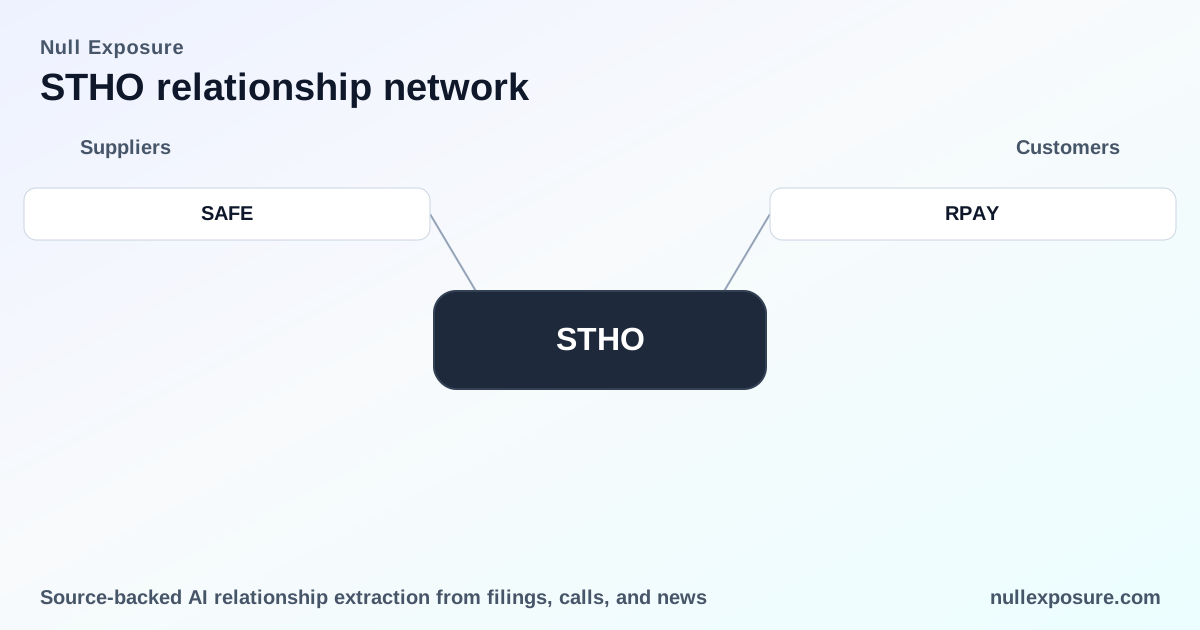
SAFE — management agreement to monetize legacy leases
TradingView captured language from Safehold's FY2026 public filings indicating a formal management arrangement: Safehold entered into a management agreement with Star Holdings to manage and monetize legacy non‑ground lease assets. This is a direct outsourcing/partnership for asset realization and implies Star uses third‑party or joint management to accelerate monetization (TradingView summary of Safehold 10‑K, March 10, 2026: https://www.tradingview.com/news/tradingview:f3c2ca64d41c5:0-safehold-inc-sec-10-k-report/).
Repa (reported as Repa / RPAY) — exclusive master distributor for Star Holdings Group brands
A Comunicaffe article (March 2026) reported that Repa, a division of Parts Town Unlimited, is the exclusive master distributor in Europe for seven manufacturers that the article identifies as part of Star Holdings Group, including legacy appliance brands such as Star, Toastmaster and Wells. This linkage positions Star Holdings Group on the commercial products/distribution side and indicates a wholesale channelalization in Europe for appliance brands listed under the Star umbrella (Comunicaffe, March 10, 2026: https://www.comunicaffe.com/repa-is-an-exclusive-master-distributor-for-star-holdings-group/).
RPAY (duplicate extraction) — same Comunicaffe coverage captured again
Our sources captured the same Comunicaffe item twice under a second extraction labeled RPAY; the content is identical to the Repa entry and reiterates that Repa serves as the exclusive European master distributor for seven manufacturers identified with Star Holdings Group. The duplication is an artifact of separate ingestion runs, not a separate commercial arrangement (Comunicaffe, March 10, 2026: https://www.comunicaffe.com/repa-is-an-exclusive-master-distributor-for-star-holdings-group/).
Constraints and operating‑model signals that flow from the filings
The textual evidence and excerpts generate company‑level operating signals that inform counterparty risk, cashflow timing and concentration.
- Contracting posture — mixed maturity: Star carries a portfolio of long‑term non‑cancelable operating leases scheduled for future minimum receipts (examples: ~$4.16M in 2025, ~$4.07M in 2026, ~$1.35M in 2027), but the company also holds short‑term monetization positions, specifically two subleases with an aggregate carrying value of $3.2M as of December 31, 2024. That dual posture accelerates liquidity in the near term while preserving a backend of recurring lease receipts.
- Geographic concentration — domestic focus: All real estate and loan collateral are located in the United States, concentrating jurisdictional, regulatory and market risk domestically rather than diversified internationally.
- Revenue model — sale and lease hybrid: Management commentary and accounting language show Star recognizes gains on sales of real estate and collects tenant reimbursements (insurance, utilities, taxes), indicating a hybrid monetization model blending transactional gains and pass‑through operating cash flow.
- Role and strategy — buyer and seller behavior: Management explicitly states a strategy to sell land assets to third‑party developers, positioning the company as an asset seller rather than a long‑term acquirer of operating properties.
- Counterparty performance signal — active stage: As of December 31, 2024, the company reported no non‑performing loans, a signal of an active and performing receivables profile at that reporting date.
Together these signals describe a business with concentrated geographic exposure, mixed lease tenors for cash‑management, and a disposition-driven revenue engine. Institutional holders should view Star as a monetizer of assets rather than a compounding real estate owner.
Investment implications and risk framing
- Cash timing is the principal risk lever. The company’s near‑term receipts and discrete sublease values mean realized gains and timing of developer sales will drive reported earnings volatility.
- Domestic concentration amplifies local cyclicality. With all collateral tied to the U.S., any localized weakness in commercial real estate demand materially impacts recoverability and sale proceeds.
- Third‑party management agreements change operational exposure. The Safehold management arrangement shifts execution risk to partners; investors should watch counterparty alignment and fee structures because fees will reduce gross monetization proceeds.
- Non‑core brand distribution exists alongside real estate monetization. The Repa exclusive distribution arrangement shows Star Holdings Group has a distinct commercial product channel which could provide diversification in cash flow if material.
Bottom line and next steps
Star Holdings is structured to extract cash from non‑ground lease assets through coordinated sales, subleases and third‑party management—a monetization‑first operating model. Investors evaluating STHO should prioritize timeline visibility on planned land sales, the economics of management agreements (such as with Safehold), and the extent to which distribution channels (Repa) contribute operating cash versus being immaterial brand carryovers.
For a consolidated feed of company‑level relationship intelligence and to monitor new extraction hits as filings and press coverage roll in, visit https://nullexposure.com/.