Steakholder Foods (STKH): Partner-driven commercialization with dual food and industrial product lines
Steakholder Foods monetizes through a mix of B2B product licensing and supply (premixes and know‑how), royalties on partner manufacturing, and direct equipment sales via its Twine Solutions subsidiary. The company converts its proprietary 3D‑printing and premix formulations into revenue by contracting manufacturing partners for retail rollouts while simultaneously selling TwineX1 dyeing systems into textiles — a hybrid commercial model that blends recurring royalties with one‑time capital equipment sales. For investors evaluating customer relationships, the critical signal is that early revenue is partner‑dependent and concentrated, while product diversification into industrial equipment provides a parallel path to scale. Learn more at Null Exposure.
How Steakholder sells and scales: a concise commercial thesis
Steakholder’s go‑to‑market relies on three levers: 1) licensing and supplying premixes and know‑how to established food manufacturers who produce and distribute consumer products; 2) royalty agreements that tie Steakholder economics to partner sales; and 3) capital sales of Twine Solutions’ TwineX1 systems to industrial textile customers. This combination yields low immediate capital intensity for scaling food production (partners assume manufacturing) while providing higher‑margin, productized revenue from Twine equipment sales. The strategy accelerates market presence but concentrates early revenue streams into a small set of industrial and food partners.
Customer and partner relationships — a quick tour
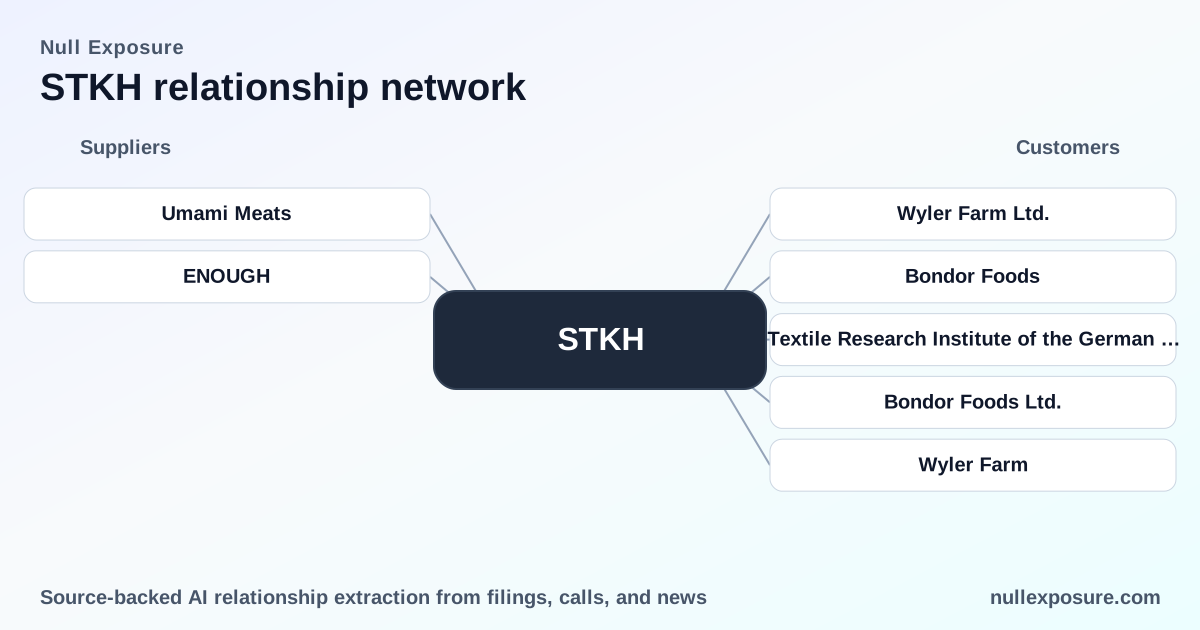
Below are every customer or partner relationship flagged in public reporting, summarized for an investor audience with source references.
-
Wyler Farm Ltd. — Steakholder executed a royalties and raw‑materials supply agreement under which Wyler will manufacture alternative proteins at commercial scale using Steakholder premixes and know‑how, paying royalties on sales; the partnership produced a first purchase order under a commercial cooperation agreement. Sources: PR Newswire press release (announcing the royalties and supply agreement, 2026) and PerishableNews (reporting the first purchase order, March 10, 2026).
PR Newswire: https://www.prnewswire.com/news-releases/steakholder-foods-signs-commercial-cooperation-agreement-with-wyler-farm-302143459.html
PerishableNews: https://perishablenews.com/meatpoultry/steakholder-foods-receives-first-purchase-order-under-its-commercial-cooperation-agreement-with-wyler-farm/ -
Wyler Farm (MoU / installation plan) — Earlier disclosures described an MoU with Wyler Farm to install a commercial‑scale 3D meat printer between Q4‑2024 and Q1‑2025 with targeted production capacity for plant‑based steaks, reflecting an intent to move from pilot to full production. Source: Steakholder investor release summarizing 2023 results and business update (reported via PR/Reuters channels, 2025).
TradingView/Reuters (company update summary, Mar 31, 2025): https://www.tradingview.com/news/reuters.com,2025-03-31:newsml_GNEbSG4YB:0-steakholder-foods-reports-2024-financial-results-and-provides-business-update/ -
Bondor Foods Ltd. — Steakholder signed a sales agreement to supply proprietary plant‑based premixes to Bondor for production of white fish and salmon patties, and Bondor manufactured kebabs and patties during pilot and commercial scale‑up phases; Steakholder identifies this relationship as the seed of its initial revenue generation in 2024. Sources: Food Engineering, GlobeNewswire, PerishableNews; TradingView/Reuters summary noting Bondor as the partner that initiated revenue in 2024.
Food Engineering: https://www.foodengineeringmag.com/articles/103142-steakholder-foods-plant-based-fish-products-roll-out-in-retail-outlets
GlobeNewswire (product rollout release, Jul 15, 2025): https://www.globenewswire.com/news-release/2025/07/15/3115456/0/en/First-Steakholder-Formulated-Plant-Based-Fish-Products-Rolled-Out-in-Retail-Outlets.html
PerishableNews (retail rollout): https://perishablenews.com/seafood/first-steakholder-formulated-plant-based-fish-products-rolled-out-in-retail-outlets/ -
Textile Research Institute of the German state of Thuringia, Vogtland (TITV) — Twine Solutions, Steakholder’s wholly‑owned subsidiary, sold a TwineX1 digital, waterless dyeing system to TITV; the sale is positioned as a milestone in scaling sustainable thread manufacturing. Source: GlobeNewswire (January 5, 2026 press release).
GlobeNewswire (Jan 5, 2026): https://www.globenewswire.com/news-release/2026/01/05/3212731/0/en/Steakholder-Foods-Twine-Solutions-Sells-First-TwineX1-System-to-TITV-for-Next-Generation-Textile-Application-Development.html -
Henderson Sewing Machine — Twine Solutions expanded a long‑standing collaboration with Henderson by adding entry‑level TwineX1 systems to Henderson’s distribution portfolio, extending Twine’s route to market through established textile equipment channels. Source: Intellectia news aggregation (May 2026).
Intellectia (news summary, May 4, 2026): https://intellectia.ai/en/stock/STKH/news -
Vegefarm Co. Ltd. — Steakholder sold an MX200 3D printer to Vegefarm, an earlier commercial equipment sale that demonstrates Steakholder’s capacity to sell printing hardware to third‑party manufacturers. Source: Food Engineering (coverage noting the MX200 sale, FY2022).
Food Engineering (MX200 printer coverage): https://www.foodengineeringmag.com/articles/100700-steakholder-foods-ltds-new-stem-cell-line-for-whole-cut-3d-printed-pork
What the relationships collectively signal about the business model
- Concentration and partner reliance: Early commercial revenues are concentrated in a small number of manufacturing partners (Bondor, Wyler), indicating that revenue volatility is tied to partner production schedules and distribution scale.
- Contracting posture: The company operates predominantly B2B via supply agreements, royalties, and equipment sales, which transfers manufacturing CAPEX and execution risk to partners while preserving revenue upside through royalties and recurring premix sales.
- Criticality and leverage: Partners are critical go‑to‑market vectors — Bondor and Wyler provide manufacturing and distribution reach that Steakholder lacks internally, making partner execution a gating factor for revenue growth.
- Maturity profile: Commercialization is nascent — reported RevenueTTM is minimal and public disclosures show first purchase orders and initial rollouts; Twine’s equipment sales present an early, complementary revenue stream in industrial markets.
- Diversification: The Twine Solutions line materially diversifies the business from food premixes into industrial equipment sales and textile sustainability, reducing single‑industry exposure over time.
Key risks and what to watch next
- Revenue concentration risk remains the dominant operational risk until additional manufacturing and distribution partners are onboarded and retail penetration scales.
- Royalty recovery vs. one‑time sales: Royalties offer recurring upside but require sustained partner sales; Twine equipment provides upfront revenue but requires a separate industrial sales motion.
- Execution milestones to monitor: sustained purchase orders from Wyler, expanded retail rollouts via Bondor, follow‑on TwineX1 orders to industrial customers, and any disclosure of production volumes for installed 3D printers.
Bottom line for investors
Steakholder is executing a partner‑led commercialization strategy that couples low‑capex scaling in food through royalties and premix supply with higher‑margin industrial equipment sales from Twine. The company’s near‑term prospects hinge on partner execution and the pace at which pilot projects convert to repeat, scaled production. For a deeper relationship map and ongoing signal tracking, see the company customer profiles at Null Exposure.