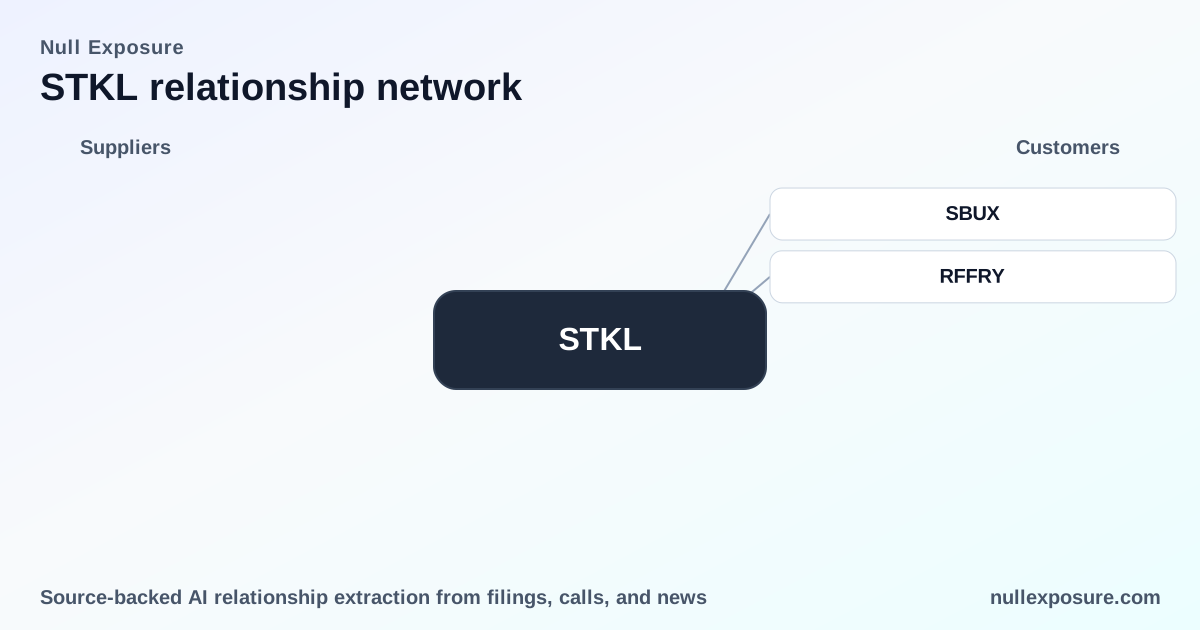
SunOpta (STKL) — Customer Map and Commercial Risk Profile
SunOpta manufactures and sells plant- and fruit-based foods and beverages principally to retail and foodservice channels, branded food companies and manufacturers, monetizing through a mix of private-label contracts, co-manufacturing agreements and its own branded SKUs. Revenue is concentrated, largely U.S.-centric, and driven by a core shelf-stable and plant-based beverage portfolio, which produces predictable volume-based margins but leaves the company exposed to a small number of large customers and short-term contracting dynamics. For a concise, investor-grade view of customer exposures and implications, visit https://nullexposure.com/.
What the press coverage actually lists — every relationship in the source results
-
SunOpta and SBUX (vegconomist report, March 10, 2026): Press coverage linked SunOpta to a major barista-format oatmilk rollout; investment-bank commentary from DA Davidson suggested Starbucks as the likely commercial partner, a claim that drove a sharp share reaction. (Source: Vegconomist, March 10, 2026 — https://vegconomist.com/company-news/sunopta-shares-jump-dream-oatmilk-barista-rolls-out-6700-more-locations/)
-
SunOpta and Starbucks (same vegconomist item, March 10, 2026): The company has not publicly confirmed the partner, but market commentary tied SunOpta’s Dream Oatmilk barista expansion to Starbucks’ broader plant-based initiative, implying a meaningful demand channel if the relationship is operational. (Source: Vegconomist, March 10, 2026 — https://vegconomist.com/company-news/sunopta-shares-jump-dream-oatmilk-barista-rolls-out-6700-more-locations/)
-
SunOpta and Refresco (aijourn, report flagged March 10, 2026): Legal notices show investor scrutiny after a reported sale agreement — Halper Sadeh LLC announced an investigation into whether SunOpta shareholders received fair value in a reported $6.50-per-share cash offer from Refresco. (Source: AIJourn summary of Halper Sadeh announcement, March 10, 2026 — https://aijourn.com/stkl-stock-alert-halper-sadeh-llc-is-investigating-whether-sunopta-inc-is-obtaining-a-fair-price-for-its-shareholders/)
-
SunOpta and RFFRY (same aijourn item, March 10, 2026): Refresco’s investor-facing ticker reference (RFFRY) is used in commentary about the proposed transaction; the item frames Refresco as the acquiring counterparty for the reported $6.50 cash consideration. (Source: AIJourn, March 10, 2026 — https://aijourn.com/stkl-stock-alert-halper-sadeh-llc-is-investigating-whether-sunopta-inc-is-obtaining-a-fair-price-for-its-shareholders/)
-
SunOpta and Refresco (Sahm Capital note, May 4, 2026): Follow-up market commentary reiterated that the sale to Refresco for $6.50 per share is the transaction under review, underlining active investor dialogue around deal terms and governance. (Source: Sahm Capital note, May 4, 2026 — https://www.sahmcapital.com/news/content/are-pkst-ctra-udmy-stkl-obtaining-fair-deals-for-their-shareholders-2026-03-24)
What the relationship evidence implies about commercial exposure
-
Concentration is a formal business constraint. SunOpta disclosed that its ten largest customers accounted for roughly 80% of revenues in 2024, which establishes a high dependence on a narrow customer set and elevates single-counterparty risk for revenues and working capital. This is a company-level operating signal; it is not tied to any individual named customer in the constraint excerpt.
-
Top-customer single-name risk exists. Management disclosure that one customer (Customer A) represented ~32% of consolidated revenues in recent years is a materiality signal for investors assessing resale risk, pricing leverage and renegotiation exposure.
-
Contracting posture is short-term. SunOpta states that it conducts business primarily under purchase orders or terminable contracts with notice periods, which establishes operational flexibility for customers and revenue volatility risk for SunOpta when volumes or margins change quickly.
-
Geographic concentration is North America. Revenues are reported principally from the U.S. (roughly $710 million of the referenced $723.7 million total in the cited period), confirming U.S.-centric demand and regulatory/market sensitivity rather than a broadly diversified global revenue base.
-
Customer role and product mix are clear. The company sells into buyers across grocery, club stores, foodservice and branded manufacturers; plant-based beverages (oat, almond, soy, etc.) are characterized as SunOpta’s core product, creating focused category exposure and predictable channel behavior.
-
Relationships are active and commercial. Revenue reporting across the cited years signals active, ongoing customer engagements rather than legacy or one-off transactions.
Investment implications — risk, upside, and what to watch
SunOpta’s value proposition is margin capture in co-manufacturing and private label at scale, but that proposition is paired with several structural risks:
-
High customer concentration constrains pricing power. With ~80% of revenues from the top ten customers and a single customer at ~32%, negotiation leverage resides with major buyers; contract termination rights and short-term buying patterns increase revenue volatility.
-
U.S. exposure amplifies demand-cycle sensitivity. The business’s concentrated U.S. footprint means macro softness in U.S. retail or foodservice has outsized earnings leverage.
-
Product concentration is a double-edged sword. The core plant-based beverage portfolio gives SunOpta category leadership and scale but creates category-specific risk if consumer preferences or input-cost structures change.
-
M&A headlines alter investor calculus. Multiple news items reporting a potential sale to Refresco at $6.50 per share and subsequent legal scrutiny introduce transaction risk and governance questions that directly affect valuation and near-term liquidity outcomes. (See Halper Sadeh announcement and Sahm Capital commentary, March–May 2026.)
-
Commercial proofs (Starbucks linkage) would be transformational if confirmed. Press linkage to Starbucks for barista-format oatmilk distribution suggests a substantial channel opportunity; confirmation and contractual terms would materially de-risk top-line assumptions. (Vegconomist coverage, March 10, 2026.)
If you track STKL, prioritize monitoring: confirmation of any Starbucks supply partnership and its contract length and pricing mechanics; development and outcome of the Refresco transaction and related litigation; and quarterly revenue concentration disclosures to see whether top-customer dependence is increasing or alleviating.
For a structured, comparable view of customer exposures across mid-cap consumer names, see our analysis hub at https://nullexposure.com/.
Bottom line for investors and operators
SunOpta is a scale manufacturer in an attractive plant-based category with clear strengths in production and distribution, yet its commercial profile is high concentration, short-term contract exposure, and North American concentration—a combination that produces volatile earnings tail risk and concentrated governance sensitivity during takeover discussions. Active monitoring of named-customer confirmations, transaction outcomes and the cadence of quarterly customer disclosures will determine whether SunOpta’s monetization model supports a re-rating or requires a valuation haircut for concentration and contract fragility.