StoneCo (STNE): What the Linx divestiture tells investors about customer strategy and risk
StoneCo provides fintech solutions that enable merchants to accept payments and run commerce across in-store, online and mobile channels in Brazil, monetizing primarily through merchant acquiring, payment processing fees and value-added software services. The company is executing portfolio optimization while doubling down on core payments economics, a strategy underscored by the recent sale of Linx-related software assets to TOTVS; investors should read the transaction as a capital-allocation move that clarifies where StoneCo expects durable margins to come from. For a concise, data-driven view of StoneCo’s customer relationships and implications for investors, visit https://nullexposure.com/.
The simple fact investors need first: who pays StoneCo and how it makes money
StoneCo sells payment processing and merchant services to small and medium merchants and integrated partners across Brazil. Revenue is concentrated in transaction-related flows and software-enabled services, which deliver recurring economics and high operating leverage — the company reported RevenueTTM of roughly USD 13.4 billion with an OperatingMarginTTM of 46.3% and a ProfitMargin of 17.3% (latest quarterly data). Those margins and scale make the company a strategic counterparty to merchants and a natural acquirer of adjacent software when it serves the core payments thesis.
Deal evidence: what the records show about StoneCo’s customer relationships
The dataset contains two related entries describing the same commercial transaction; both require explicit inclusion.
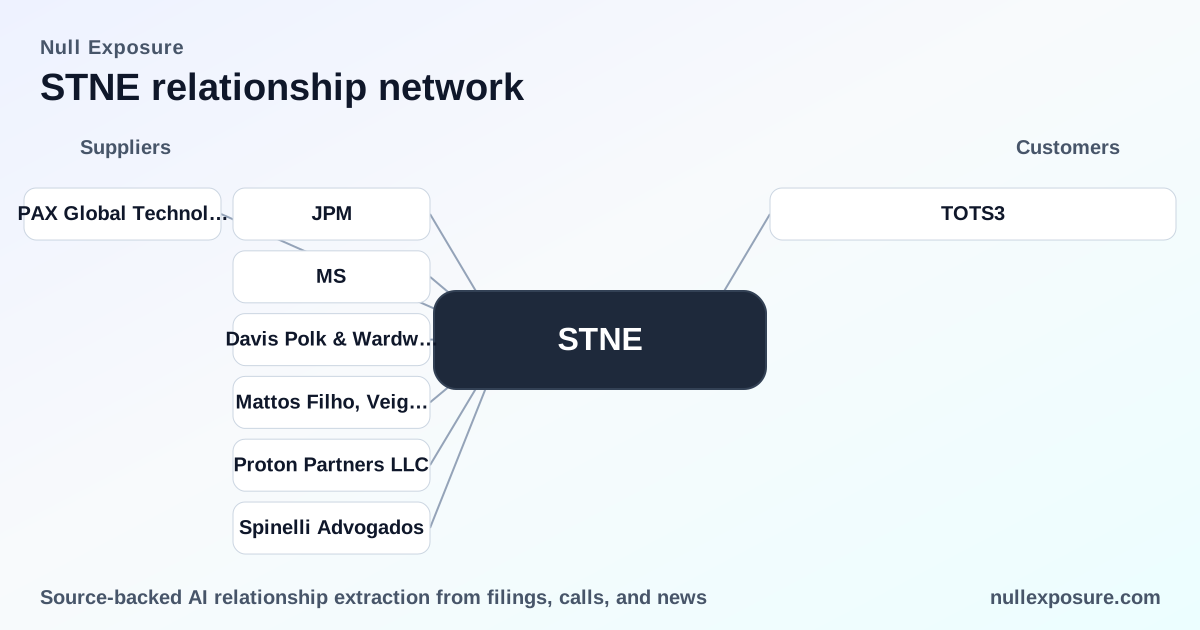
- TOTVS S.A. (TOTS3) executed a definitive agreement to acquire Linx and certain other software assets from StoneCo in a transaction valued at BRL 3.0 billion. This is a clear asset sale of StoneCo software holdings to a large Brazilian enterprise software vendor. According to Simply Wall St (reported March 10, 2026), TOTVS completed the agreement to buy Linx and related assets from StoneCo; full report at https://simplywall.st/stocks/us/diversified-financials/nasdaq-stne/stoneco.
- The same coverage is also recorded under the symbol TOTS3 with identical terms — confirming market reporting consistency that TOTVS is the acquirer and StoneCo the seller in the BRL 3.0 billion transaction. The Simply Wall St note (March 10, 2026) repeats the agreement specifics and valuation at the same URL.
Both entries document the same counterparty and transaction; include them together in model updates and cap‑allocation assessments for FY2023/FY2026 comparatives.
Why the Linx sale matters for StoneCo’s customer-facing posture
The Linx divestiture is not a mere housekeeping item. Selling Linx and selected software assets to TOTVS signals a shift from owning a broad software stack toward prioritizing the payments and merchant-acquiring franchise. That has several investor-relevant consequences:
- Contracting posture: StoneCo is moving from an owner/operator of horizontally-oriented software assets toward a leaner contracting posture focused on payments relationships and partner integrations, reducing direct responsibility for non-core software maintenance.
- Concentration and criticality: The company retains core merchant relationships that generate high-margin transaction economics; payments remain mission-critical for merchants, preserving StoneCo’s leverage in commercial negotiations.
- Maturity and capital allocation: At a market cap near USD 2.64 billion with strong operating margins, StoneCo is operating at a mature, cash-generative stage where monetizing non-core assets and redeploying capital to payments or returning capital to shareholders are credible strategies.
Constraints and business-model signals investors should factor into analyses
The source feed supplied no explicit contract constraints tied to specific relationships, which itself is a signal for modeling: there are no listed lockups, exclusivity clauses or regulatory covenants disclosed in the results set. Treat this as a company-level data posture — absence of disclosed constraints requires conservative scenario work in financial models. From available company metrics, the following operational characteristics are relevant:
- High operating leverage — OperatingMarginTTM of 46.3% implies incremental revenue from payments scales well to profit, making customer retention and transaction volume growth economically potent.
- Institutional ownership concentration — PercentInstitutions sits above 80%, which typically produces disciplined governance and lower idiosyncratic volatility in strategic moves like asset sales.
- Market and regional concentration — StoneCo’s merchant footprint is Brazil-centric, introducing country-specific regulatory and macrocyclical sensitivity that will be the dominant external risk factor for its customer base.
If you want a consolidated exposure map and historical relationship timeline, explore the full coverage at https://nullexposure.com/ for in-depth charts and notes.
Risks to monitor after the Linx transaction
Investors should calibrate upside against several clear risks:
- Execution transition risk: transferring software assets to TOTVS creates short-term integration and service continuity considerations for merchants that relied on bundled StoneCo products.
- Revenue mix shift: divesting software can lower recurring license revenues while concentrating economics in payments fees; if transaction volumes slow, the top line becomes more cyclical.
- Brazil macro and regulatory exposure: operating predominantly in one jurisdiction concentrates sovereign and regulatory risk on the merchant portfolio.
Financials support resilience: RevenueTTM of USD 13.4 billion, EBITDA of ~USD 7.25 billion, and a trailing PE of 6.41 position StoneCo as profitable and able to absorb strategic reconfigurations — but the directional impact on growth and margins requires monitoring through subsequent quarters.
Investment read and recommended watchpoints
The Linx sale to TOTVS is a clarifying move: StoneCo is narrowing its operating footprint to prioritize a payments-first commercial model, which should preserve high operating margins and increase capital flexibility. For investors and operators evaluating customer relationships, the critical next steps are:
- Track merchant retention and transaction volumes over the next four quarters to detect any service disruption fallout.
- Watch revenue mix disclosures to see whether recurring software revenue decline is offset by higher payments take-rates or lending/factor revenue.
- Monitor announcements from TOTVS and StoneCo about integration timelines and customer migration terms to assess continuity risk.
StoneCo’s fundamental position — strong operating margins, meaningful EBITDA and concentrated institutional ownership — supports a constructive view, conditional on stable Brazilian payments volumes and a clean transition of software customers to TOTVS.
For more detailed relationship maps and continual monitoring, visit https://nullexposure.com/ for curated coverage and alerts.