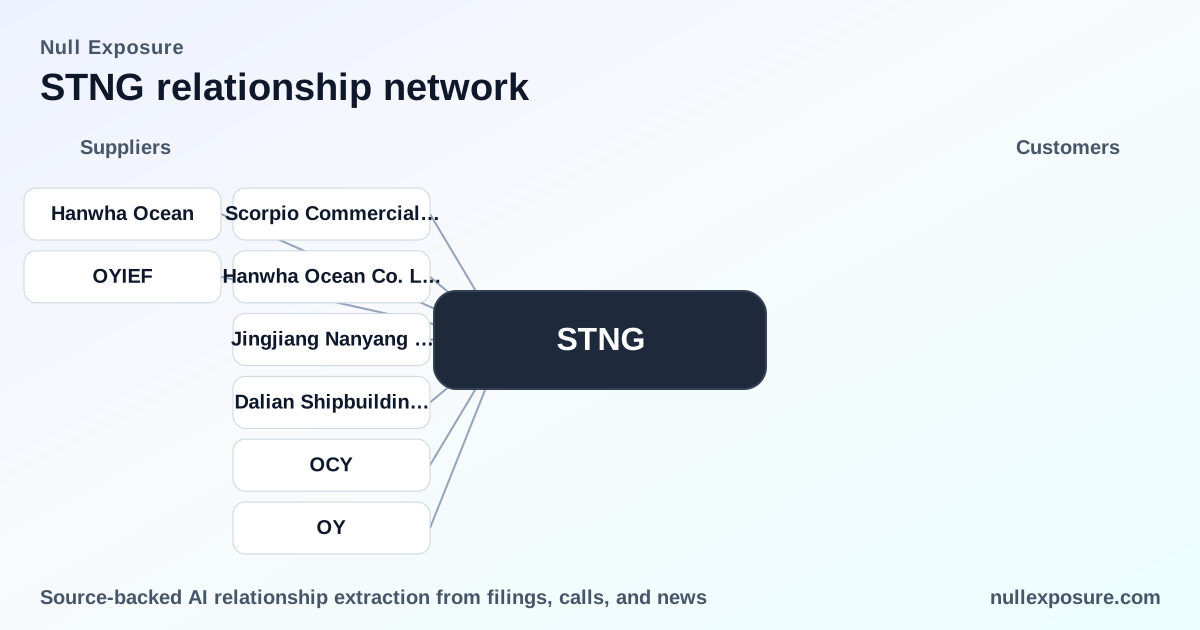
Scorpio Tankers (STNG): Customer Relationships and Commercial Footprint
Scorpio Tankers operates a global fleet that transports refined petroleum products and monetizes primarily through vessel chartering and fleet asset optimization—a business that converts shipping capacity into predictable charter revenue while retaining optionality through active asset sales and redeployments. For investors and operators assessing counterparty exposure, the company’s customer relationships and occasional vessel transfers are signals of commercial strategy, revenue concentration, and asset lifecycle management.
If you want a consolidated view of counterparty connections and commercial signals for diligence, visit https://nullexposure.com/ for more detail on comparable shipping counterparties.
How Scorpio Tankers makes money and why customer relationships matter
Scorpio Tankers is an asset-heavy, cash-generative operator in the product tanker segment. The company leverages owned and chartered vessels to provide shipping services and converts those services to revenue through charter contracts—delivering operating leverage when freight markets tighten and generating stable cash when charters are longer-term. Financial metrics underline a mature, profitable operator: 2025 EBITDA around $453 million, operating margins above 34%, and a reported profit margin north of 36%, supporting both dividend distributions and disciplined fleet investment. Customer relationships—charterers, trading houses, and other shipping firms—drive utilization and rates; changes in those relationships, including vessel sales or transfers to other operators, are actionable signals about market positioning and concentration.
Operating posture and firm-level commercial constraints
Scorpio Tankers shows the characteristics of a commercially mature tanker operator:
- Contracting posture: The business emphasizes charter revenues and fleet utilization rather than one-off transactions; its margin profile and cash generation reflect recurring operational income. The company also executes asset transactions as part of fleet optimization.
- Concentration: Customers in refined product shipping are sector-focused; commercial exposure links closely to global refined product demand and a relatively concentrated set of large charterers and trading houses.
- Criticality: For counterparties, Scorpio’s fleet provides essential logistics capacity; for Scorpio, relationships with major charterers and resale markets determine earnings volatility and asset disposability.
- Maturity: Profitability and positive ROE demonstrate an established company with scale and institutional investor interest (insider and institutional ownership figures both material).
These firm-level signals are drawn from Scorpio’s financial profile and public disclosures and should be treated as company-level context rather than consequences of any single commercial relationship.
Customer relationship snapshot: who matters right now
Below I cover every customer/partner relationship surfaced in the available records. Each entry includes a concise investor-oriented summary and a source reference.
Hafnia Limited (HAFN)
Hafnia expanded into product-tanker capacity by acquiring 12 LR1 tankers from Scorpio Tankers in 2022 as part of its fleet buildup and consolidation following acquisitions, reflecting Scorpio’s use of vessel sales to rebalance fleet composition and redeploy capital. This transaction underscores a commercial relationship that is transactional and strategic—a buyer-seller dynamic where Scorpio monetized assets to optimize its fleet mix and liquidity profile. A FinancialContent markets deep dive (April 2026) documents the transfer, noting Hafnia’s prior CTI acquisition and the 2022 purchase of the 12 LR1 vessels originally from Scorpio Tankers. (FinancialContent, April 3, 2026.)
What the Hafnia relationship signals for investors
The Hafnia transaction is straightforward commercial evidence of Scorpio’s approach to fleet and cash management:
- Asset monetization is part of the operating model. Selling LR1s to a peer like Hafnia demonstrates an active asset market for product tankers and a pathway for Scorpio to capture vessel value rather than only relying on charter cashflows.
- Counterparty type matters. A sale to an established industry buyer reduces execution risk for Scorpio and signals that fleet rebalancing can be performed through credible market counterparties.
- Customer vs. counterparty distinction. In this instance, the relationship is transactional (asset sale) rather than a long-term charter partnership; that distinction matters when scoring revenue stability versus one-time cash events.
Financial and strategic implications for STNG’s customer exposure
Scorpio’s public financials and the Hafnia transaction taken together produce a clear investor checklist:
- Revenue profile: With TTM revenue around $938 million and strong margins, Scorpio converts charter activity into solid operating cashflow; customer concentration should be monitored because a few large charterers can influence short-term utilization and rates.
- Liquidity and capitalization: Market capitalization near $4.2 billion and healthy EBITDA create flexibility to pursue opportunistic sales (as with the LR1s) or to meet market-driven redeployments.
- Market sensitivity: Product-tanker earnings are cyclical; charter counterparties and freight-rate environments are the primary drivers of operating leverage, so relationship continuity with major charterers is a risk factor for short-term earnings volatility.
For a focused view of counterparties and to benchmark Scorpio’s counterparties across shipping subsectors, explore more at https://nullexposure.com/.
Key takeaways for investors and operators
- Scorpio Tankers monetizes through chartering and selective asset sales; its commercial relationships span recurring charter clients and transactional counterparties.
- The Hafnia deal (12 LR1 tankers purchased in 2022) is a clear example of Scorpio using the asset market to redeploy capital and adjust fleet composition. (FinancialContent, April 2026.)
- Monitor customer concentration and charter tenor: recurring charter business supports margin stability, while asset sales are one-off enhancements to liquidity and ROIC.
- Profitability and scale provide strategic optionality, but exposure to freight-rate cycles means relationship continuity and counterparty credit quality are central investment risks and operational priorities.
If you are evaluating counterparties, portfolio exposures, or preparing commercial diligence on product-tanker relationships, our platform aggregates these connection signals to support underwriting and monitoring—see https://nullexposure.com/ for details and subscription options.