Strategic Education (STRA): Customer Relationships and Commercial Architecture
Strategic Education, Inc. (NASDAQ: STRA) operates as a vertically integrated postsecondary education services provider that monetizes primarily through tuition and subscription-style program fees, employer-sponsored partnerships, and targeted workforce learning offerings delivered across its Capella, Strayer and Torrens platforms and the Sophia Learning portfolio. For investors, the company’s commercial model blends recurring subscription pricing for modular learning paths with one-off tuition revenues from degree programs and employer-funded cohorts, producing a mix of stable cash flow and growth tied to corporate and institutional partnerships. Learn more about how we track customer links at NullExposure.
What strategic relationships tell us about revenue channels
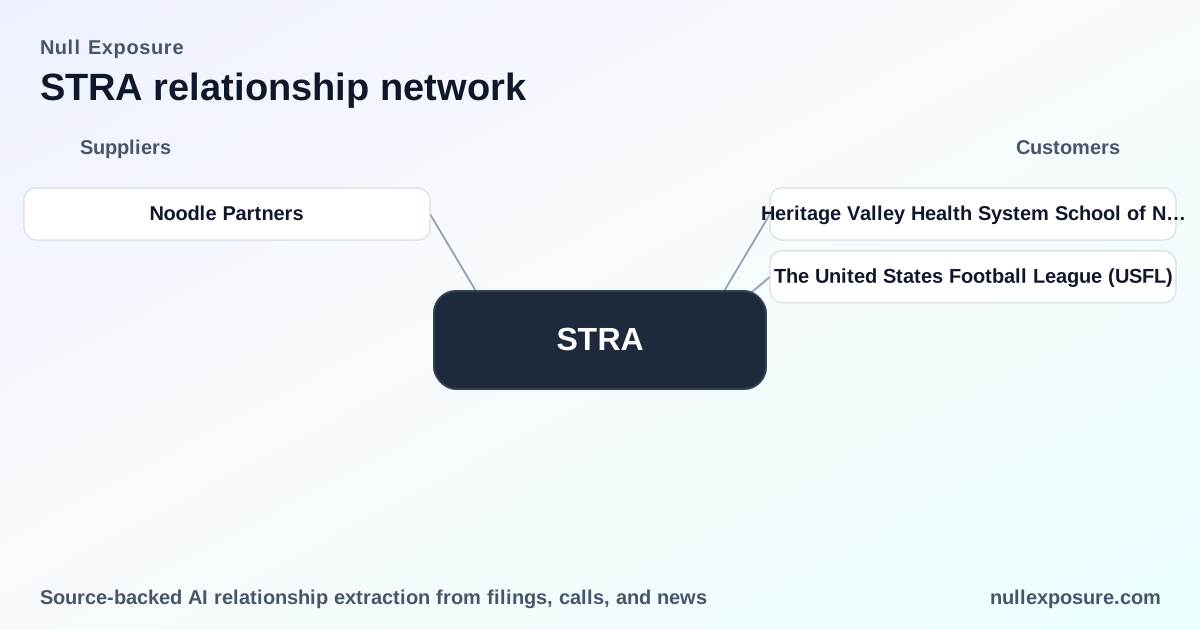
Strategic Education’s disclosed customer relationships reveal three distinct commercial use cases that illuminate how different partner types feed enrollment, revenue stability and brand reach:
- Healthcare partnerships drive vocational pipelines and program credibility through co-branded nursing pathways.
- Employer and league sponsorships (employee benefit models) advance enrollment via tuition-free programs paid or underwritten by third parties.
- Retail and corporate alliances expand the “education as an employee benefit” channel into mass employers, increasing lifetime value per learner.
Each relationship below is summarized with the source of the disclosure and the likely revenue implication for investors.
Heritage Valley Health System School of Nursing — nursing pipeline via Sophia Learning
Heritage Valley Health System School of Nursing launched a partnership with Sophia Learning, a Strategic Education unit, to provide flexible, lower-cost online pathways into nursing careers; this arrangement underscores SEI’s role as a content and platform seller to healthcare education partners and supports enrollment inflows into nursing-related offerings. According to Simply Wall St reporting in March 2026, the partnership highlights rising demand for flexible nursing pathways and positions Sophia as a delivery partner for hospital systems seeking scalable training options (FY2025, SimplyWallSt, March 2026).
Key takeaway: This relationship underscores the company’s ability to monetize B2B2C healthcare training channels and to position Sophia as a lower-cost feeder into degree programs.
United States Football League (USFL) — tuition-free degree access for players and staff
The USFL established a partnership with Strategic Education to offer players and league staff a tuition-free, debt-free college degree program, illustrating a sponsorship-funded benefit model where Strategic Education provides curriculum and delivery while a counterparty funds enrollment. An account of the arrangement was published by XFLNewsHub referencing the program launch in FY2022 (XFLNewsHub, historical coverage of 2022 program).
Key takeaway: Employer- or sponsor-funded tuition programs reduce direct acquisition cost per student for SEI and create predictable cohort enrollments paid via third-party arrangements.
Best Buy — employee education transitioned to an all-inclusive no-cost model
Best Buy’s employee education partnership transitioned to an all-inclusive degree program at no cost to employees, which industry coverage notes could increase U.S. Higher Education enrollment and revenue for Strategic Education’s campus and online segments. According to a Simply Wall St analysis in May 2026, the program’s shift to full-coverage for employees is expected to boost program uptake and incremental revenue capture in FY2026 (SimplyWallSt, May 2026).
Key takeaway: Large corporate employer agreements that remove employee financial barriers materially accelerate uptake and convert employer cohorts into predictable revenue streams for the U.S. Higher Education segment.
Operational constraints and what they imply for investors
Strategic Education’s commercial profile is characterized by operational patterns that influence contract stability, growth sensitivity and execution risk. These are company-level signals derived from corporate disclosures rather than relationships-specific assertions:
- Subscription contract posture: The company runs subscription-based pricing for modular offerings — for example, Capella’s FlexPath and Sophia Learning subscription models — which creates recurring revenue and narrower churn risk compared with purely term-based tuition billing. This structure supports margin predictability in the Education Technology Services line.
- Direct-to-individual counterparty mix: A meaningful portion of revenue derives from individual learners who supply sensitive personal and financial data, which means the company must maintain high standards of data protection and retention practices to avoid operational disruption and regulatory fallout.
- Geographic diversification across NA and APAC: Strategic Education operates primarily in North America through Capella and Strayer and maintains institutional operations in Australia/New Zealand via Torrens and related assets; this lowers single-market concentration risk while exposing the company to multi-jurisdiction regulatory complexity.
- Seller role in the value chain: The company’s core identity is as a seller of education services—degree programs, certificates and workforce training—so performance is directly tied to enrollment trends and pricing power rather than royalty or licensing income.
- Services-led segment maturity: The business operates as a mature services provider with established brands and accreditations, suggesting steady cash generation but also necessitating ongoing investment in curriculum relevance and employer relationships to sustain growth.
These operational constraints combine to produce a mixed risk/reward profile: recurring revenue and strong employer partnerships support cashflow visibility, while individual-dependency and regulatory complexity increase execution risk.
What investors should watch next
- Enrollment trends across employer-funded programs (Best Buy, USFL) versus organic individual enrollments; employer programs are the fastest route to scale.
- Growth in Sophia Learning subscriptions and pipeline partnerships with healthcare systems, which will determine Education Technology Services momentum.
- Regulatory developments in the U.S. and Australia that affect accreditation, funding and consumer protections; these have outsized impact given the company’s geographic footprint.
Risk-focused investors should note two operational vulnerabilities:
- Data privacy and student-finance exposure tied to individual customers.
- Execution risk on converting employer-funded benefit pilots into long-term contract revenue.
Conclusion and how to follow coverage
Strategic Education’s customer relationships reveal a dual monetization engine: subscription-style modular learning and employer-funded degree programs. The company leverages B2B partnerships to seed B2C enrollments while maintaining a services-led revenue base across North America and APAC. For a concise snapshot of current coverage and relationship mapping, visit NullExposure home.
For deeper tracking of SEI’s partner pipeline and to receive updates when new relationships are reported, see our main page at https://nullexposure.com/.