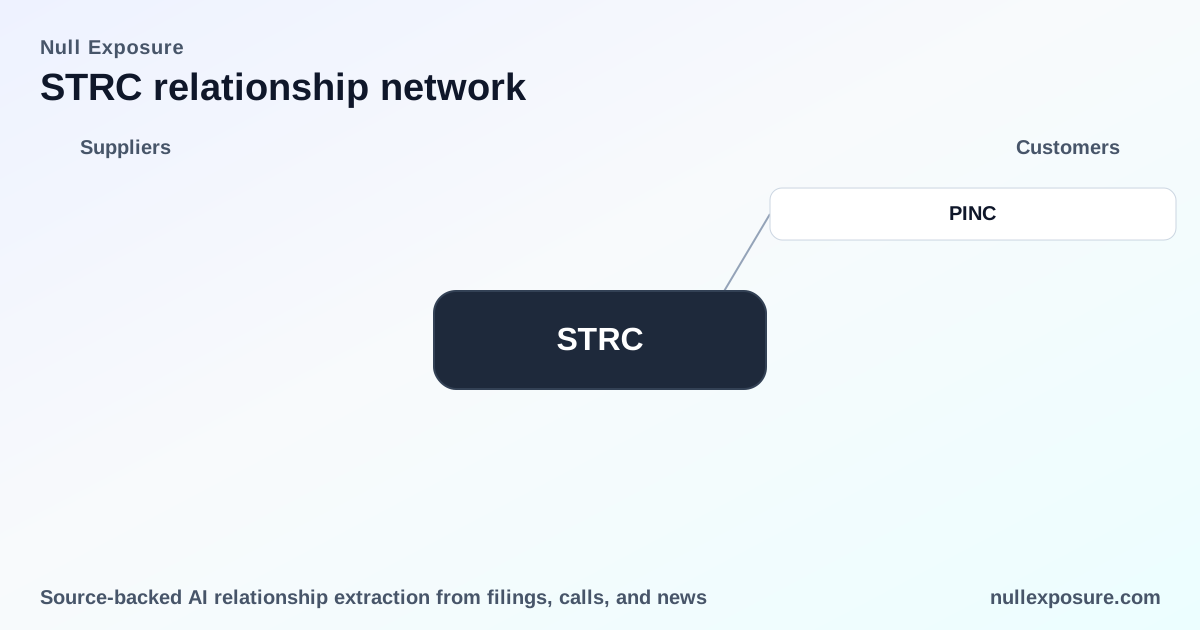
STRC Customer Relationships: Contracts, Counterparties, and What Investors Should Price In
Stratageum, Inc. (ticker STRC) operates as an enterprise software company that monetizes through a mixed licensing and cloud-subscription model, complemented by professional services and support. The firm sells perpetual and term licenses for on‑premise deployments, offers multi‑year cloud subscriptions managed by the company, and drives incremental revenue through consulting, implementation and support contracts—delivering a blend of recurring revenue and services-driven margin leverage. For a detailed look at counterparties and customer signals, visit https://nullexposure.com/.
How STRC’s customer model shapes recurring revenue and contract risk
STRC’s disclosed contract and go-to-market posture shows a classical enterprise software geometry: legacy perpetual licensing combined with modern multi‑year cloud subscriptions and services. Company disclosures describe term licenses commonly ranging from 12 to 36 months and cloud subscriptions typically sold on 36‑month terms, with cloud revenue recognized on a straight‑line basis over the access period. That combination produces predictable top‑line recognition on subscription renewals while retaining revenue variability from one‑off services and license upgrades.
Key operating signals for investors:
- Contracting posture: STRC is a seller of both perpetual licenses and managed cloud access, implying dual sales motions (transactional license sales and subscription renewals) and a mix of short and medium‑term contractual commitments.
- Customer mix and criticality: The company explicitly sells to government and large enterprise customers, indicating higher procurement rigor and potential stickiness once deployed.
- Global reach and footprints: Revenue reporting by region shows North America and EMEA exposure, supporting diversified demand but also multi‑jurisdictional sales and delivery complexity.
- Business model maturity: Product licensing and established support offerings indicate a mature software business model, while continued emphasis on cloud subscriptions signals ongoing product transition and recurring revenue growth potential.
- Revenue dependence: STRC states it depends on its installed customer base for a “substantial portion” of software revenue—this implies that retention of legacy customers and successful migration to subscriptions are material to future cash flow.
Together these signals suggest recurring-revenue backbone with services-enabled variability—an attractive mix if retention rates and subscription renewals remain high, but one that requires scrutiny of renewal and migration execution.
All named counterparties in the public record
PINC
NBC News reported that SRI/Surgical Express, Inc. (listed in the article under Nasdaq:STRC) was awarded an agreement for surgical instrument tray reprocessing and sterilization services with a group purchasing organization associated with Premier. This item establishes a commercial engagement where STRC’s business (as reported) is the counterparty supplying sterilization/reprocessing services. Source: NBC News (FY2010) — https://www.nbcnews.com/id/wbna39779089.
Premier Purchasing Partners, L.P.
The same NBC News item states that Premier Purchasing Partners, L.P., the group purchasing unit of the Premier healthcare alliance, contracted for surgical instrument tray reprocessing/sterilization services from SRI/Surgical Express (Nasdaq:STRC), indicating STRC’s access to GPO channels in the healthcare vertical. Source: NBC News (FY2010) — https://www.nbcnews.com/id/wbna39779089.
(These two entries reflect every named counterparty found in the search results.)
Constraints and what they mean for commercial durability
STRC’s disclosure excerpts present company-level constraints that shape investor due diligence and valuation modeling:
- Contract types: The business sells licenses (perpetual and term) and cloud subscriptions; the mixed model reduces single‑point revenue risk but requires active management of migration and support.
- Contract duration and recognition: Term licenses typically 12–36 months; cloud subscriptions commonly 36 months with straight‑line recognition—this produces mid‑term visibility into revenue but creates renewal cliffs to monitor.
- Customer sectors: Public sector and large enterprise buyers are explicitly targeted, which increases procurement friction but enhances stickiness and lifetime value when contracts are secured.
- Geographic diversification: Reported NA and EMEA revenue splits demonstrate global sales coverage, lowering single‑market concentration while increasing operational complexity.
- Materiality: The company reports dependence on its installed base for a substantial portion of software revenue, which elevates the importance of retention, upsell, and migration strategies.
- Segments: STRC is a software-first business with a services layer (consulting, support) that is integral to deployments and customer success.
These constraints should be treated as company‑level signals that inform assumptions about churn, multi‑year ARR growth, and services margin contribution. None of these company-level constraints is tied specifically to any single customer in the record unless the excerpt explicitly names that counterparty.
What investors should watch next: growth levers and risk factors
Strategically, STRC’s strengths include diversified monetization (license + subscription), government and enterprise distribution channels, and an installed base that creates upsell opportunities. Operational risks and investor considerations include:
- Profitability profile: Reported operating margin is deeply negative (OperatingMarginTTM -44.02) and EBITDA is materially negative, calling for a focus on cost structure and cash runway in forecasts.
- Revenue scale and margins: Revenue TTM is reported at about $477m with gross profit near $328m, signaling a meaningful software revenue base but pressure below the operating line.
- Market volatility: A high beta (3.595) points to stock price sensitivity; institutional ownership is modest (about 12.9%), and analyst coverage metrics are sparse—investors should assume limited sell‑side guidance.
- Contract concentration & renewal risk: Dependence on the installed base makes renewal rates and migration to subscriptions pivotal to sustaining revenue—model scenarios should stress renewal performance.
- GPO and government contracting exposure: Engagements through group purchasing organizations and government channels can deliver volume but introduce payment and procurement timing considerations.
Key takeaway: value STRC as a software company in transition—its recurring revenue potential is meaningful, but near‑term cash flow and margin recovery are the primary value drivers investors must validate.
For a concise, investor‑oriented package of STRC customer intelligence and structured counterparty data, explore additional analysis at https://nullexposure.com/.
Bottom line for portfolio decisions
STRC combines a classic enterprise software revenue architecture with healthcare and public sector channel signals in its public record. Assess renewal economics, migration rates from perpetual licenses to cloud subscriptions, and services margin levers before assigning a persistent valuation premium. Monitor contract renewals with large government and GPO customers closely; those outcomes will determine whether STRC converts its installed base into durable ARR and improved operating margins.