Sterling Construction (STRL): Hyperscaler projects anchor growth but concentration and contract mix demand active monitoring
Sterling Construction monetizes through large-scale site development and heavy civil construction across three segments — E‑Infrastructure, Transportation, and Building Solutions — billing clients on a mix of long‑term infrastructure contracts and shorter residential/commercial projects. The company captures value from high-margin, capital‑intensive E‑Infrastructure work for data centers, semiconductor plants and distribution hubs, while Transportation and Building Solutions provide steady backlog diversification. For investors, the thesis is straightforward: STRL leverages construction expertise to win hyperscaler and government work that supports higher revenue per project, but its returns hinge on contract duration, project execution, and customer concentration. Learn more about how Null Exposure tracks customer signals at https://nullexposure.com/.
How Sterling wins and earns: a concise operating model picture
Sterling operates primarily as a service provider executing site development, heavy civil, and building works. The company’s E‑Infrastructure Solutions focus on large, complex projects for large enterprise hyperscalers and manufacturers, while Transportation Solutions delivers highway, bridge, airport and rail projects often contracted with government authorities. Building Solutions handles shorter residential and multi‑family concrete and plumbing work.
Key operating characteristics to internalize:
- Contracting posture: Revenue derives from a mix of long‑term contracts in E‑Infrastructure and Transportation and short‑term projects in Building Solutions, creating a hybrid cashflow profile that blends predictable, multi‑year arrangements with cyclical, project‑level variability (company filings and segment disclosures).
- Counterparty mix: The business serves both government entities (state DOTs, transit, ports) and large enterprises (data centers, e‑commerce, power), exposing Sterling to public procurement cycles and procurement‑grade customers with strong bargaining power.
- Geographic footprint: Operations are U.S.-centric, concentrated across the Southern, Northeastern, Mid‑Atlantic, Rocky Mountain regions and Pacific Islands — all domestic revenue and assets per company disclosures.
- Concentration and criticality: No single customer exceeded 10% of consolidated revenue in 2022–2024, signaling low revenue concentration, but management warns that the loss of major customers could have material adverse effects, creating a tension between apparent diversification and real downside risk.
- Maturity and scale: With trailing revenue near $2.49 billion and EBITDA of $490.6 million, Sterling sits at a scale that supports multi‑site, capital‑intensive work; the company trades with elevated multiples (trailing P/E ~56.8), reflecting expectations of durable, higher‑margin E‑Infrastructure wins.
Customers called out in recent coverage — what the record shows
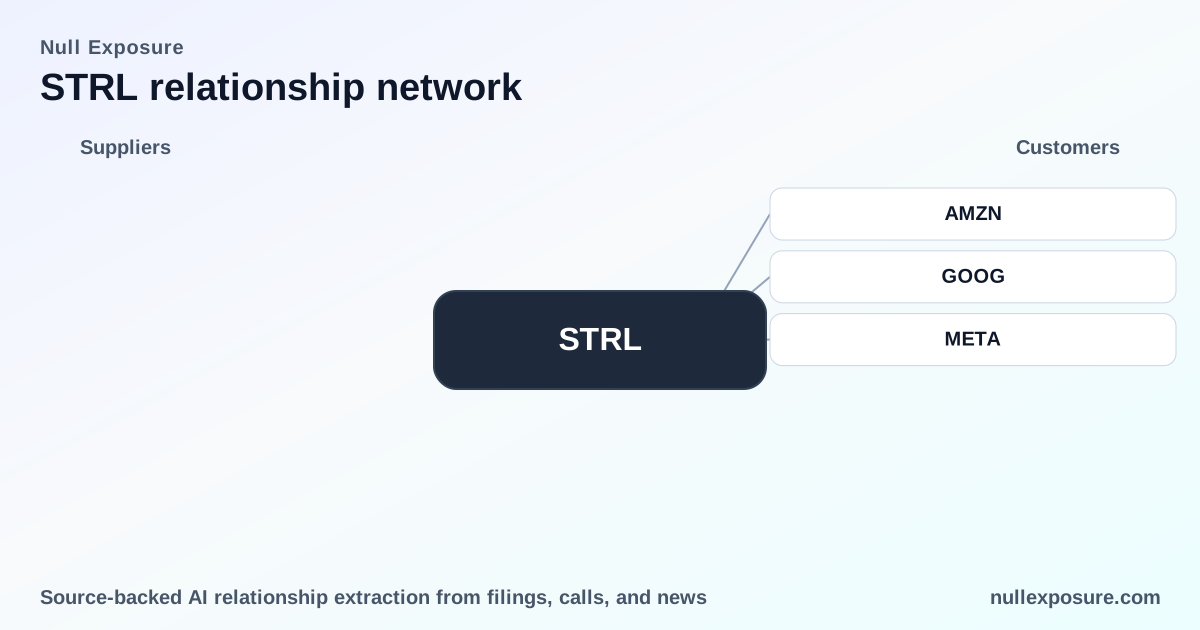
Sterling’s recent press and market commentary emphasize relationships with hyperscalers and manufacturers. The following lists every relationship mentioned in the reviewable results and provides a concise, sourced take on each.
Amazon
Sterling is identified as serving hyperscalers such as Amazon in its E‑Infrastructure business, meaning Sterling provides large‑scale site development for Amazon’s data center or distribution footprint. According to a Finterra analysis published on FinancialContent in March 2026, Amazon is cited alongside other hyperscalers as a primary client type for Sterling’s E‑Infrastructure work (FinancialContent / Finterra, March 2026).
Google is likewise named as a customer archetype in the E‑Infrastructure segment, implying Sterling competes for or executes large site and data‑center related civil projects supporting Google’s facilities. This relationship appears in the same March 2026 Finterra coverage on FinancialContent that profiles Sterling’s hyperscaler clientele (FinancialContent / Finterra, March 2026).
Meta
Meta (Facebook) is listed among the hyperscaler clients Sterling targets, consistent with the company’s stated focus on data centers and large enterprise site development for technology customers. The March 2026 Finterra piece on FinancialContent explicitly groups Meta with Amazon and Google as primary clients for E‑Infrastructure Solutions (FinancialContent / Finterra, March 2026).
META (duplicate mention)
The coverage contains a duplicate reference to META (capitalized), repeating that Meta is a representative hyperscaler client for Sterling’s E‑Infrastructure work. This repeated mention derives from the same Finterra/FinancialContent article and reinforces the editorial emphasis on hyperscaler exposure (FinancialContent / Finterra, March 2026).
What the customer matrix implies for valuation and risk
Interpret Sterling’s customer signals as strategic levers that influence both upside and downside:
-
Upside drivers
- Higher average project economics from hyperscaler and manufacturing work increase gross margins and revenue per contract when Sterling wins and executes well.
- Long‑term contracts in E‑Infrastructure and Transportation provide backlog visibility and revenue durability when projects are multi‑year and tied to capital expansion cycles.
-
Key risks
- Execution and timing risk: Large, capital‑intensive projects carry schedule and cost overrun exposure that can compress operating margins quickly.
- Counterparty bargaining and concentration paradox: Although no single customer exceeded 10% of revenue historically—which is a diversification positive—management’s disclosure that losing any of these customers could be material signals high project criticality and the potential for outsized revenue shock.
- Public sector exposure: Government contracting introduces payment timing, bid‑cycle variability, and political/appropriation risk into the revenue profile.
Brief checklist for investors evaluating STRL customer relationships
- Monitor awarded contracts and public filings for backlog size, contract duration, and margin assumptions.
- Track fiscal exposure to hyperscaler pipeline vs. government work to assess revenue cyclicality.
- Watch execution metrics (change orders, completion schedules) that presage margin erosion or margin expansion.
- Evaluate how management allocates capital between margin‑accretive E‑Infrastructure projects and the lower‑margin but steady Building Solutions work.
Bottom line: Sterling’s business model is anchored in high‑value E‑Infrastructure and government‑sourced Transportation projects that can produce attractive returns, but investors must treat customer relationships as both a growth lever and a concentration risk; execution, contract mix, and the cadence of hyperscaler spending are the primary catalysts and hazards. For a closer read on customer signals and to track changes in real time, visit https://nullexposure.com/.
What to watch next (operational milestones)
- Wins or losses of hyperscaler site development contracts and associated backlog disclosure.
- Quarterly commentary on contract mix (long‑term vs short‑term) and any shifts toward one segment.
- Contract execution updates that affect margin outlook, including change orders and dispute resolutions.
Investors should pair these qualitative customer signals with Sterling’s financial cadence—revenue growth, margin trends, and cash conversion—to form a conviction on valuation trajectory.