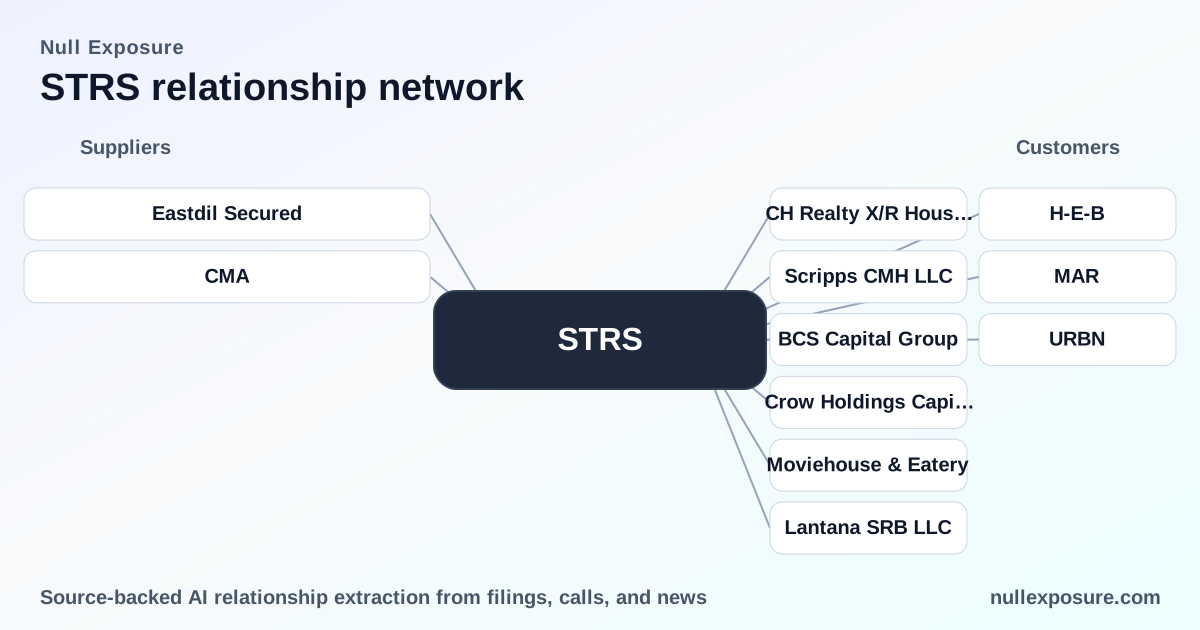
Stratus Properties (STRS): How customer and buyer relationships are reshaping a Texas-focused developer
Thesis — Stratus Properties operates as a Texas-focused developer and manager of mixed-use, retail and residential real estate, monetizing through property sales, long-term retail leases, multi-family leasing and development/asset management fees; recent activity shows the company is executing a deliberate disposition program to strengthen liquidity and refocus its portfolio. For investors and operators, the commercial counterparties and buyers cited in press coverage over FY2025–FY2026 convert directly into realized cash, valuation mark-ups and concentrated tenant risk profiles that drive near-term returns and strategic optionality. For deeper company coverage visit https://nullexposure.com/.
Recent transactional relationships that matter to cash flow and valuation
Below I cover each counterparty cited in public coverage of STRS transactions. Each item is a plain-English summary with the primary source.
-
Crow Holdings Capital — Stratus agreed to sell the 54-acre Kingwood Place project to an affiliate of Crow Holdings Capital, signaling the company’s willingness to monetize stabilized retail assets to unlock equity. See MarketMinute coverage of the December 18, 2025 signing (Markets FinancialContent, Dec 2025): https://markets.financialcontent.com/stocks/article/marketminute-2025-12-22-stratus-properties-announces-608-million-sale-of-kingwood-place-as-part-of-strategic-pivot.
-
CH Realty X/R Houston Kingwood Place — The buyer entity for Kingwood Place executed a cash purchase of the Houston mixed-use retail center for roughly $60.8 million, producing substantial pre-tax net cash proceeds to Stratus. See the TradingView notice and MarketMinute reporting on the $60.8M sale (FY2025): https://www.tradingview.com/news/tradingview:e6f54c98f2183:0-stratus-properties-signs-asset-sale-agreement-with-ch-realty-x-r-houston-kingwood-place/ and https://markets.financialcontent.com/stocks/article/marketminute-2025-12-22-stratus-properties-announces-608-million-sale-of-kingwood-place-as-part-of-strategic-pivot.
-
Scripps CMH LLC — Stratus sold the retail component of its Lantana Place development in Austin to Scripps CMH LLC (alongside Lantana SRB LLC) for approximately $57.4–$57.5 million, crystallizing value from a mixed-use project. See the press release reporting of the October 17, 2025 agreement (The Globe and Mail / Business Wire, Oct 2025): https://www.theglobeandmail.com/investing/markets/stocks/STRS-Q/pressreleases/35668141/stratus-properties-sells-lantana-place-retail-component/.
-
Lantana SRB LLC — A co-buyer on the Lantana Place retail sale, Lantana SRB LLC participated in the purchase that transferred the retail parcel and its anchor tenancy out of Stratus’s consolidated hold. See the Lantana Place closing announcement (The Globe and Mail / Business Wire, Oct 2025): https://www.theglobeandmail.com/investing/markets/stocks/STRS-Q/pressreleases/35668141/stratus-properties-sells-lantana-place-retail-component/.
-
BCS Capital Group — BCS Capital Group completed acquisition of 53 acres from Stratus for the Magnolia Place mixed-use project, indicating Stratus’s reuse of land assets to capture development economics and then monetize parcels to institutional buyers. See KHOU / Houston Business Journal coverage of the acreage transfer (FY2025): https://www.khou.com/article/money/business/houston-business-journal/magnolia-place-development-home-depot/285-8e96bb22-775f-4faa-8566-d37662da7b25.
-
H-E-B (H‑E‑B Grocery) — H‑E‑B serves as an anchor tenant in Stratus’s Houston retail properties (notably Kingwood Place and new Magnolia Place plans), providing stable foot traffic and credit tenancy that support retail valuations. Market and press coverage identify H‑E‑B as a 103,000 sq ft anchor at Kingwood Place and a shadow‑anchoring tenant for Magnolia Place (BusinessWire / MarketMinute, FY2025–FY2026): https://markets.financialcontent.com/stocks/article/marketminute-2025-12-22-stratus-properties-announces-608-million-sale-of-kingwood-place-as-part-of-strategic-pivot and https://finviz.com/quote?t=STRS.
-
Moviehouse & Eatery — Moviehouse & Eatery is identified as the anchor entertainment tenant at Lantana Place (opened May 2018), which was part of the retail component sold in 2025 and therefore influences the income profile and buyer interest in that asset. See the Business Wire completion notice and ConnectCRE reporting (FY2025): https://www.theglobeandmail.com/investing/markets/markets-news/Business%20Wire/36239525/stratus-properties-inc-completes-sale-of-lantana-place-retail-for-57-5-million/ and https://www.connectcre.com/stories/stratus-offloads-austin-retail-space-for-57-5m/.
-
Urban Outfitters / URBN — Historical leasing activity shows Stratus sourced national apparel tenants for downtown Austin retail, with brokers representing Stratus in an Urban Outfitters lease (reported from 2011); this highlights Stratus’s long-standing capability to secure national retail credit tenants. See Statesman coverage of the Urban Outfitters lease (FY2011): https://www.statesman.com/story/business/2011/04/28/urban-outfitters-to-open-downtown/6691964007/.
-
AC Hotel by Marriott / MAR — Stratus executed a ground lease enabling the development and opening of an AC Hotel by Marriott (opened Nov 2021), demonstrating the firm’s use of ground leases to partner with national hotel operators and extract development fees or leasing income. See ConnectCRE coverage referencing the ground lease and hotel opening (FY2025): https://www.connectcre.com/stories/stratus-offloads-austin-retail-space-for-57-5m/.
-
Ryman Hospitality Properties, Inc. (RHP) — Public reporting lists Ryman Hospitality as the buyer for Block 21 in a separate Stratus transaction, a large institutional disposition that materially shifts asset composition and balance-sheet exposure when executed. See the Finviz aggregation referencing a Business Wire announcement on the Block 21 sale (FY2026): https://finviz.com/quote?t=STRS.
What these buyer and tenant relationships reveal about Stratus’s operating model
-
Contracting posture: The company balances short-term cash-generation via property sales with longer-term leased income from retail anchors; corporate disclosures note multifamily leases are typically 12 months while retail leases commonly run five to ten years or longer, reflecting mixed contracting horizons.
-
Concentration and criticality: Stratus maintains concentrated, high-impact tenant relationships — anchor grocery tenants like H‑E‑B materially support retail valuations, making a small number of anchors disproportionately critical to asset-level cash flow.
-
Maturity and business role: The firm operates as both developer and seller; revenue is materially driven by real estate operations (64% of total revenue in 2024 versus 15% in 2023), which flags that asset sales and lease-up outcomes are central to near-term results rather than stable recurring cash flow alone.
-
Segment focus: The company’s core product is residential and retail mixed-use development in Texas, with operations concentrated around entitlement, development, leasing and selective dispositions.
These characteristics create a hybrid risk-return profile: repeatable development economics plus the timing and market-risk of asset dispositions.
Strategic implications, risks and what to watch
-
Balance-sheet impact: Recent dispositions (Kingwood Place, Lantana retail, Block 21) are explicitly improving liquidity and generating realized gains, so investor focus should be on how proceeds fund debt reduction, shareholder returns or redevelopment pipelines (see press releases across FY2025–FY2026).
-
Tenant concentration risk: Anchor tenants such as H‑E‑B materially underwrite retail valuations; monitor anchor lease roll schedules and any subordination of cash flows to understand downside exposure.
-
Execution and market timing: The firm’s model requires consistent execution on leasing and successful asset sales; market liquidity for large retail parcels is the key macro risk.
-
Operational optionality: Stratus’s ability to transact with institutional buyers (Crow Holdings-affiliates, Ryman, BCS Capital) demonstrates market appetite for its product when assets are stabilized, creating strategic optionality for further portfolio rotation.
Bottom line and next steps for analysts
Stratus is an Austin/Texas-centric developer whose monetization via targeted retail and mixed‑use sales is driving near-term cash and rebalancing the portfolio. For valuation and credit work, prioritize the cadence of dispositions, disposition proceeds use, lease maturity schedules for anchors, and the pace of new ground-lease development with hotel and national retail operators.
For a consolidated view of STRS counterparties and transaction history, and to track follow-up press releases and filings, see our coverage hub at https://nullexposure.com/.
Key tracking items: confirmed cash proceeds from announced sales, changes in leverage metrics post-disposition, and any updates to ground-lease or anchor tenant agreements that affect NOI.