Strattec Security (STRT): Customer Concentration and What the OEM Roster Means for Investors
Strattec Security designs, engineers and manufactures vehicle access control hardware—locks, latches, key fobs and associated mechanical systems—and monetizes by selling these components directly to major automotive OEMs as an incumbent supplier on discrete vehicle platforms. Revenue is heavily concentrated in a small set of OEM relationships, and those contracts are long‑lived and platform‑linked, which supports predictable backlog but concentrates commercial and production risk with a handful of customers.
If you want a concise directory of the customer relationships that drive Strattec’s topline, see the company’s filings and coverage summarized below. For a broader view of supplier risk and customer concentration across automotive supply chains, visit https://nullexposure.com/.
Why the customer list matters: concentrated, platform-based hardware supply
Strattec’s business model is built on hardware that is designed into a vehicle platform and supported for the life of that platform. This creates durable, recurring production revenue while also meaning that a small number of OEM wins capture a disproportionate share of sales. The FY2025 10‑K discloses that a limited set of customers accounted for the majority of net sales, which directly ties Strattec’s growth and margin profile to OEM production cycles and platform lifecycles.
- Concentration: Three OEMs represented a material majority of FY2025 sales.
- Contracting posture: Once awarded, the company typically supports products through the five‑to‑seven year life of the vehicle, creating sticky relationships.
- Criticality: As an incumbent supplier on access systems, Strattec benefits from high switching costs for OEMs once systems are validated and certified.
Relationship-by-relationship: the OEMs that drive Strattec revenue
General Motors Company (GM)
General Motors is the single largest customer disclosed for FY2025, accounting for 29% of net sales and representing critical scale in Strattec’s revenue base. According to Strattec’s FY2025 10‑K filing, GM accounted for $165.7 million of net sales (29%) for the period ended June 29, 2025. (Source: Strattec FY2025 10‑K, filed June 29, 2025.)
Ford Motor Company
Ford is another major production customer, contributing 23% of FY2025 net sales under the company’s customer concentration table. Investors should treat Ford as a primary demand driver for Strattec’s platform‑based hardware revenue. (Source: Strattec FY2025 10‑K, filed June 29, 2025.)
Stellantis (and legacy Fiat Chrysler)
Stellantis accounted for 12% of FY2025 net sales per the FY2025 10‑K, and historical reporting lists Fiat Chrysler (now part of Stellantis) among meaningful quarterly customers. For the three months ended December 28, 2025, market coverage cited Strattec’s disclosure that Stellantis comprised roughly 18% of net sales for that quarter, illustrating quarter‑to‑quarter variability tied to program timing. (Sources: Strattec FY2025 10‑K, filed June 29, 2025; trading commentary citing 10‑Q, March 2026.)
The company’s sales history also shows legacy Fiat Chrysler purchase levels: a 2017 regional business profile reported a quarter with $28 million of parts sold to Fiat Chrysler, underscoring a long relationship that survived the FCA–Stellantis corporate transition. (Source: Milwaukee Journal Sentinel / jsonline, July 2017.)
Hyundai / Kia (regional OEM group)
Hyundai and Kia are described in multiple local reports as meaningful buyers in historical quarters. A 2017 local profile assigned roughly $8.2 million of quarterly sales to Hyundai/Kia, and Strattec has continued to reference Hyundai/Kia as a customer group in press coverage. These relationships add geographic diversification beyond the Detroit OEMs, with a different program cadence and vehicle mix. (Sources: Milwaukee Journal Sentinel / jsonline, July 2017; BizTimes/Bizjournals coverage, January 2022.)
Additional naming and duplicate entries in public coverage
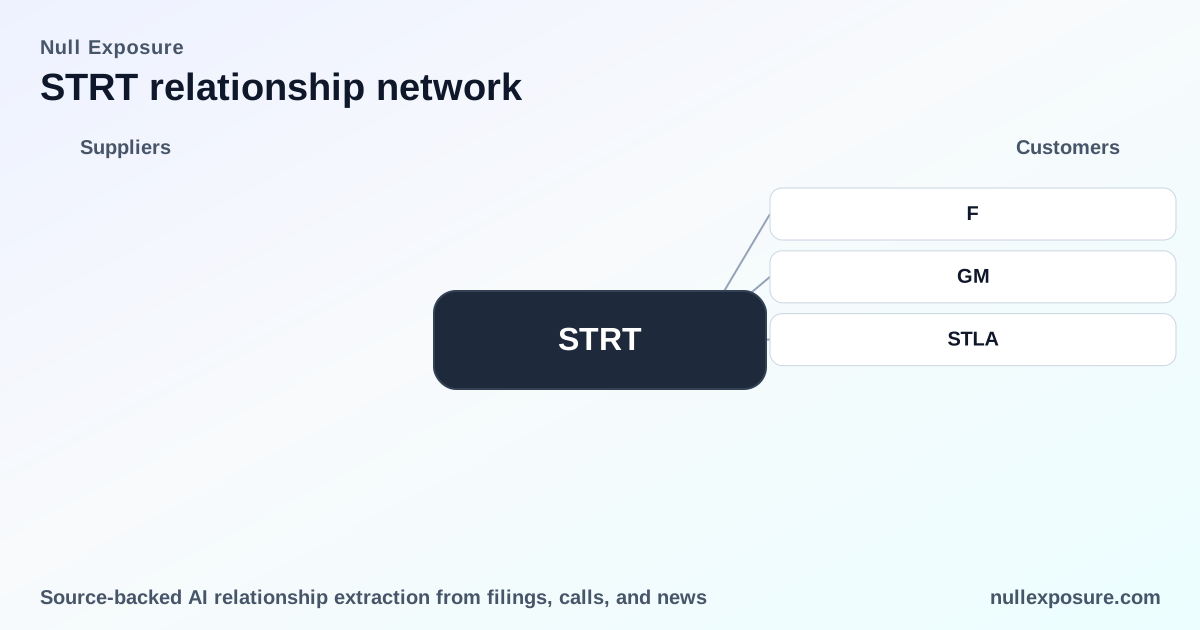
Public and media sources sometimes list the same OEM under alternate names (for example, “General Motors” vs. “GM”, or “Fiat Chrysler” vs. “Stellantis/Fiat Chrysler”). The underlying commercial reality is a compact set of large OEM accounts that account for the bulk of sales; Strattec’s filings and subsequent reporting consistently point to the GM–Ford–Stellantis triad plus regional OEMs like Hyundai/Kia as the principal customer block. (Sources: Strattec FY2025 10‑K; TradingView market note March 2026; Milwaukee Journal Sentinel July 2017; BizJournals January 2022.)
If you need consolidated access to supplier/customer mappings and related contract signals, Null Exposure maintains supplier profiles and relationship scoring at https://nullexposure.com/.
Operating‑model constraints and investor implications
The company‑level constraints described by Strattec and observable in filings produce a clear investor playbook.
- Long‑term contracts and platform support. Strattec states that once a product is awarded to a platform it typically supports that product for the life of the vehicle (normally five to seven years). This generates predictable revenue runs once a program ramps and reduces churn risk versus commodity suppliers. (Source evidence: Strattec FY2025 10‑K excerpts.)
- Geographic footprint centered on North America. Approximately 65% of sales ship to U.S. production sites, with Mexico and Canada also meaningful; the company runs operations in the U.S. and Mexico but serves a global OEM base. This structure gives Strattec exposure to North American light‑vehicle production cycles while preserving incremental global opportunities. (Source evidence: Strattec FY2025 10‑K excerpts.)
- Materiality and concentration. The FY2025 disclosure quantifies the concentration: GM 29%, Ford 23%, Stellantis 12%—a combined ~64% of net sales. That degree of concentration creates earnings leverage when program volumes rise and corresponding downside if any of these OEM relationships materially slow or transition away. (Source: Strattec FY2025 10‑K, sales by customer table.)
- Seller role and product segment. Strattec is a direct OEM supplier of hardware‑centric vehicle access solutions—locks, latches, keys/fobs and related systems—meaning the company competes on engineering, certification and incumbent status rather than on low‑cost commodity components. (Source evidence: Strattec FY2025 10‑K product descriptions.)
- Relationship maturity and incumbency advantage. The company emphasizes that once designed into an application it is well positioned as the incumbent for the platform life cycle due to customization and certification requirements; that incumbency is a structural moat against rapid customer attrition. (Source evidence: Strattec FY2025 10‑K excerpts.)
Investment takeaways: what to watch next
- Topline sensitivity to OEM production: Expect revenue bends to track GM/Ford/Stellantis production schedules and new model launches. The FY2025 concentration table makes this explicit. (Source: Strattec FY2025 10‑K.)
- Program awards and ramp cadence: New platform wins change the growth profile—monitor OEM bidding outcomes and announced program awards in dealer and supplier press. Trading and industry coverage around quarterly 10‑Q disclosures already highlight quarter‑level swings for GM/Ford/Stellantis. (Source: TradingView, March 2026.)
- Geographic exposure to North America: North American vehicle production trends (USMCA region) will disproportionately affect Strattec relative to suppliers with more diversified manufacturing footprints. (Source: Strattec FY2025 10‑K.)
For a searchable, investor‑grade roster of OEM supplier relationships and contract signals, visit Null Exposure’s platform at https://nullexposure.com/.
Bold conclusion: Strattec’s revenue model is durable because of platform incumbency and multi‑year warranties, but investor returns are tightly correlated with a handful of OEMs—GM, Ford and Stellantis—making program wins and production cadence the dominant drivers of upside and downside. (Source: Strattec FY2025 10‑K and related coverage referenced above.)