Sharps Technology (STSS): Customer relationships that define commercialization and risk
Sharps Technology designs and manufactures safety syringes and commercializes them through a combination of direct manufacturing and distribution agreements. The company monetizes by selling Securegard and Sologard syringes to distributors and healthcare groups, scaling manufacturing from its Hungary facility while pursuing qualification pilots across Europe and North America. For investors, the value proposition is commercialization execution — turning patented products and pilot qualifications into recurring revenues — while key risks cluster around low current revenue, concentrated large contracts, and execution of manufacturing scale-up.
Visit NullExposure for more structured relationship intelligence: https://nullexposure.com/
How Sharps operates and what matters to buyers
Sharps is a pre‑revenue medical device company that has moved into commercial agreements after a long development phase. The company both manufactures (facility and fixed assets in Hungary) and sells through distribution partners, targeting healthcare systems in EMEA and the U.S. Its contracts include multi‑year terms and purchase commitments that, if executed, would rapidly change revenue scale relative to current trailing revenues of roughly $204k and a gross loss reported in the trailing twelve months. Execution of manufacturing scale, qualification approvals in hospitals, and fulfillment against large purchase commitments are the central operational levers for near‑term valuation.
Company-level operating constraints and what they signal
- Long-term contracting posture: The company discloses agreements that are structured with multi‑year initial terms and automatic renewals, indicating a preference for extended, predictable commercial relationships rather than one-off orders. This supports predictable revenue if customers complete qualification and ordering.
- EMEA operational focus with North American operations present: Sharps is shipping Securegard to Europe for qualification and has substantial fixed assets in Hungary, signaling a production footprint focused on EMEA; U.S. operations are also disclosed and factor into cost structure.
- Integrated manufacturer–distributor model: Filings describe Sharps both as a manufacturer and as a seller/distributor, implying the company controls production and wholesale sales channels rather than relying solely on contract manufacturers or licensing.
- Pilot‑to‑scale commercial stage: The company is executing pilot tooling and qualification processes, which positions relationships in a pilot stage that must convert to full commercial orders for revenue to scale.
- Large spend band implied by disclosed contract economics: Management projects that specific agreements are expected to generate well in excess of $50 million in revenues under the disclosed terms, which places material revenue concentration risk on execution.
These constraints are company‑level signals drawn from public filings and are not attributed to a single customer unless explicitly named in the source.
Customer and partner relationships — what investors need to know
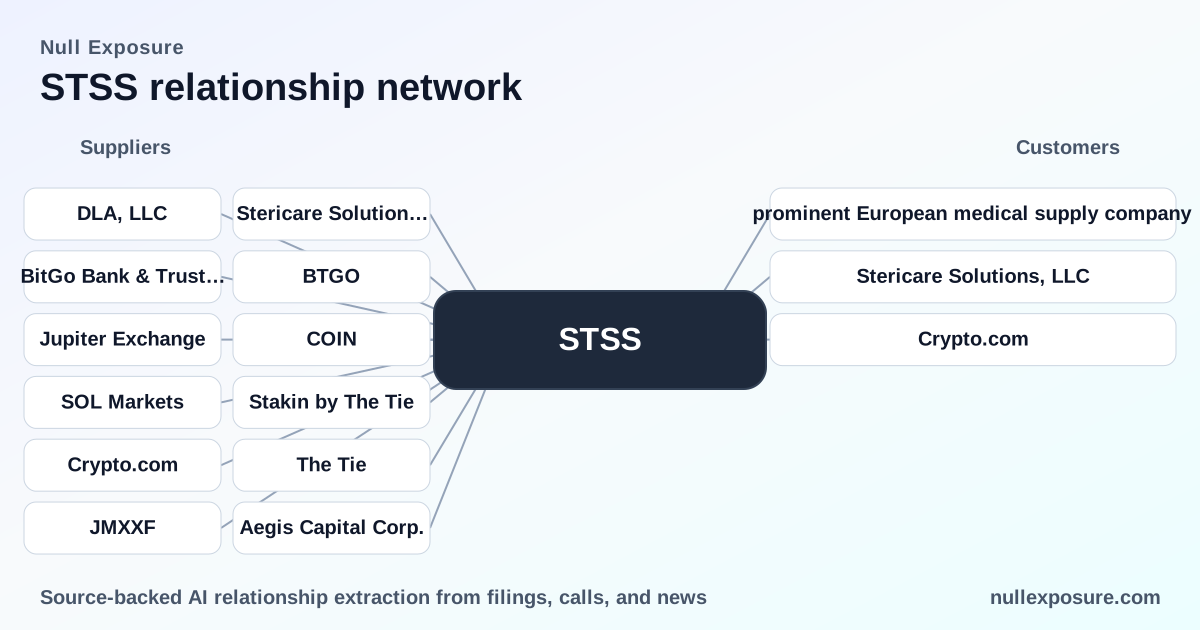
A prominent European medical supply company (Poland, Slovakia, Czech Republic)
Sharps signed a sales agreement in December 2024 with a European medical supply company covering Poland, Slovakia, and the Czech Republic and began deliveries from its Hungary facility for qualification of Securegard syringes. According to the FY2024 10‑K, early qualification shipments are underway across Europe while the company advances approvals with regional healthcare groups.
Stericare Solutions, LLC
Stericare committed to a large purchase profile of 520 million units of 10ml PP Sologard syringes under an agreement that specifies 40 million units in year one and 120 million units annually thereafter for the remaining term. The precise purchase price is confidential, but management expects revenues from such agreements to exceed $50 million; this commitment is described in the FY2024 10‑K.
CoinFund
CoinFund was listed among large crypto investment funds that participated in a fundraising round for Sharps (reported in August 2025), indicating institutional capital support from crypto‑focused investors. A Fortune article in August 2025 noted that CoinFund contributed to the raise alongside other crypto funds.
Pantera Capital
Pantera Capital is similarly reported as a contributor to the company’s fundraising round, providing capital support that supplements operating cash and potentially funds manufacturing and go‑to‑market activities. Fortune’s coverage in August 2025 identifies Pantera Capital as a participant in the raise.
ParaFi
ParaFi was reported as another crypto investor involved in the August 2025 financing, representing strategic financial support from digital‑asset focused funds. Fortune’s August 2025 article lists ParaFi among the contributors.
Crypto.com
Crypto.com is cited in March 2026 reporting as a partner in managing a substantial Solana treasury that Sharps is associated with, highlighting Sharps’ engagement with crypto platforms and treasury arrangements that sit outside its core medical sales but affect financing and liquidity strategies. A March 2026 piece on Bitcoin.com covers this treasury management agreement.
Sol Markets
Sol Markets was mentioned in the context of securities issuance mechanics tied to cryptocurrency‑related warrants approved by shareholders, reflecting capital structure activity that involves crypto market participants. TipRanks reported on shareholder approvals and the issuance of warrants to Sol Markets in 2025/2026.
Why the mix of distributors, large purchase commitments and crypto investors matters
- Commercial leverage and concentration: Large, multi‑year purchase commitments (Stericare and the European supply agreement) create near‑term revenue upside if Sharps satisfies qualification and delivery milestones, but also concentrate revenue risk into a handful of counterparties. The company projects material revenue from these agreements, making execution risk binary from an investor perspective.
- Manufacturing and geographic concentration: Fixed assets and production activities in Hungary support EMEA deliveries but concentrate operational risk geographically; any scaling issues there directly affect fulfillment. Pilot tooling and qualification status mean revenue is conditional on approvals.
- Non‑traditional capital relationships: Participation by crypto funds and platform partners (CoinFund, ParaFi, Pantera, Crypto.com, Sol Markets) provides growth capital and liquidity alternatives, but introduces non‑traditional investor profile and potential governance or market‑access complexities for a healthcare device company listed on NASDAQ.
- Financial starting point: Trailing revenues are nominal (~$204k) and margins are negative, with EBITDA loss of approximately $13.16M; therefore the company’s valuation and investor returns hinge on converting commercial agreements into repeatable revenues.
Investment implications and risk checklist
- Upside: Execution on Stericare and the EMEA supply agreement could rapidly scale revenue toward the tens of millions, validating the product and manufacturing model. Successful qualification by large healthcare groups is the key value inflection.
- Downside: Failure to convert pilots, production setbacks in Hungary, or cancellation/renegotiation of large purchase commitments would materially compress expectations and valuation. Concentration and pilot-stage qualification are the primary single‑point risks.
- Capital and governance: Crypto‑linked investors and treasury arrangements provide capital flexibility but require monitoring for how they affect dilution, warrants issuance, and shareholder alignment.
For a structured view of counterparties and contract terms, see NullExposure’s relationship pages: https://nullexposure.com/
Bottom line
Sharps is at the commercialization hinge: its core value is execution of manufacturing scale and qualification conversions against large, long‑horizon purchase commitments, while concentrated counterparties and pilot-stage operations present material execution risk. Investors should track qualification milestones, shipment cadence to the European partner, fulfillment against Stericare’s committed volumes, and any material developments tied to treasury/capital arrangements reported with crypto partners.