State Street (STT): Customer Relationships That Drive Fee Momentum and Strategic Reach
State Street is a global custodian and asset manager that monetizes through servicing and management fees on assets under custody/administration (AUC/A) and assets under management (AUM), supplemented by software licensing and trading-related revenue streams. Its business model blends high-margin, recurring fee income from large institutional clients with growing software and product distribution via State Street Global Advisors and the Charles River platform — a mix that produces scale economics and concentrated counterparty exposure. For investors, the key signals are global scale, client concentration among very large institutions and governments, and a hybrid contract mix of recurring subscriptions, multi-year licenses and transactional spot flows. Learn more about our relationship signals and methodology at https://nullexposure.com/.
What the operating posture tells you about risk and return
State Street’s customer contracts are not homogeneous. The company runs a hybrid contracting posture: long-term, strategic servicing agreements coexist with short‑notice or spot transactional activity (for FX, securities finance and derivatives). This structure produces both resilience—through recurring servicing and management fees that accounted for roughly 70% of fee revenue—and cyclicality in trading and custody flows.
- Concentration and criticality: State Street’s historical emphasis on very large asset managers and official institutions gives it strong pricing power on scale but creates idiosyncratic concentration risk; the loss or renegotiation of a single large mandate can materially affect AUC/A and fee revenue (State Street 2024 filings).
- Contract maturity: Contracts range from short‑term, terminable arrangements to multi‑year renewals. The firm routinely negotiates pricing concessions in exchange for term extensions or scope expansion, indicating active relationship management and potential margin pressure during renewals.
- Product mix: The business is services-first—custody, accounting, fund administration and trading services—while software (Charles River) contributes recurring license/SaaS revenue and expands stickiness. State Street also operates in FX, securities finance and prime services, which bring transactional, spot-driven revenue.
These company-level signals are evident across the current relationship set below; each relationship highlights how State Street translates capabilities into clients, custody roles, product distribution or strategic partnerships.
Relationship inventory: every customer relationship in the feed
- PRSD — State Street Short Duration IG Public & Private Credit ETF: State Street Investment Management launched PRSD as a private‑credit ETF vehicle and reached early asset traction (reported assets of ~$90 million post‑launch). According to The Daily Upside, the ETF is part of State Street’s push into private credit ETFs (The Daily Upside, May 3, 2026).
- PRSD (duplicate coverage) — The Daily Upside also noted that PRSD was one of two private credit funds added by State Street Investment Management as it expanded product offerings into private markets (The Daily Upside, May 3, 2026).
- CTWO — COtwo Advisors’ Physical European Carbon Allowance Trust: State Street was appointed as the service provider for CTWO, reflecting its role in custody and fund servicing for specialised commodity/allowance trusts (AssetServicingTimes, Mar 9, 2026).
- State Street Investment Management (tokenised fund servicing adoption): Industry reporting indicates State Street Investment Management is poised to be an early adopter of tokenised fund servicing capabilities being launched from Luxembourg, signaling interest in distributed ledger-based NAV and servicing workflows (LeapRate, May 4, 2026).
- VAVX — VanEck tokenized US Treasuries fund: The fund’s U.S. Treasury bills are custodied by State Street Bank & Trust, with on‑chain NAV data supplied by oracles — illustrating a custody role in tokenized product structures (CryptoSlate, Mar 10, 2026).
- LVLN — New leveraged loans ETF: State Street Investment Management launched another leveraged‑loans ETF as it expands fixed‑income offerings, showing active product innovation and distribution from the asset management arm (Benzinga, Mar 10, 2026).
- WDS — Woodside Energy Group acquisition participation: State Street was named among institutional buyers in a Tellurian acquisition financing syndicate, demonstrating the firm’s participation as an investor/asset holder through relationships with large energy transactions (SimplyWall.st / ADVFN reporting, July 2023 as cited May 2026).
- RMM — RN Managed Dur Muni Inc Fund custody: State Street Bank & Trust is listed as the custodian for specific municipal fund accounts, evidencing routine custody relationships across fund types (EDGAR filing cited via ADVFN, referenced 2026).
- Public Investment Fund (PIF) — Saudi anchor investor for SAQL ETF: PIF anchored the launch of the State Street Saudi Arabia Enhanced Active Equity UCITS ETF (SAQL), with State Street IM as manager—this shows sovereign partnership and distribution scale in the Middle East (PIF press release, 2026).
- RMM (second mention) — Another EDGAR-sourced note reiterates State Street Bank and Trust’s role as custodian for RMM-class funds (EDGAR filing / ADVFN, 2026).
- BLK — BlackRock ETF custody: Reporting on an iShares fund lists State Street Bank and Trust Company as the fund’s custodian, demonstrating inter-manager servicing where State Street provides infrastructure even for competitors’ products (MoneyDJ, Mar 9, 2026).
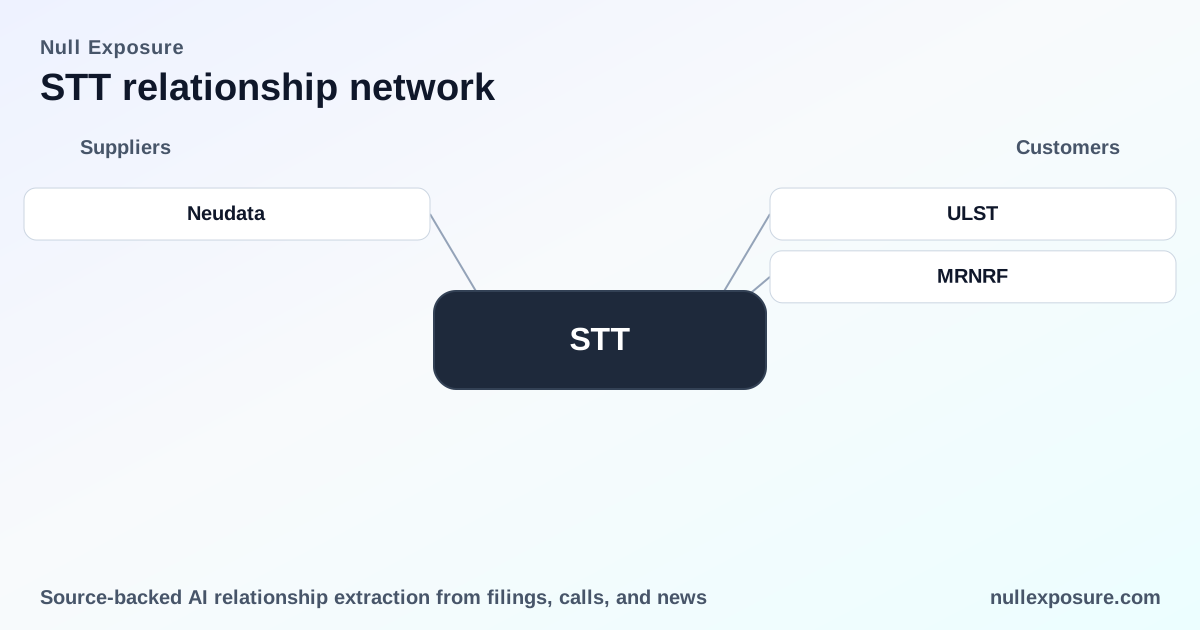
- ULST — SPDR SSgA Ultra Short Term Bond ETF: Coverage highlights that ULST is managed by State Street, underscoring the firm’s long-established ETF manufacturing and management business (DefenseWorld, Mar 10, 2026).
- SPDR SSgA Ultra Short Term Bond ETF (duplicate ULST mention) — Additional reporting reiterates State Street’s management role for ULST (DefenseWorld, Mar 10, 2026).
- GAPR — FT Vest buffered US equity ETF holdings: Fund holdings disclosures show exposure to the State Street SPDR S&P 500 ETF Trust, indicating distribution and ETF holdings interplay across third‑party funds (MoneyDJ, May 4, 2026).
- WDS (duplicate coverage) — SimplyWall.st again records State Street’s investor position in a corporate acquisition context, reinforcing institutional ownership patterns (SimplyWall.st, May 4, 2026).
- TBLD — Thornburg Income Builder Opportunities Trust administrator: State Street Fund Services (Ireland) Limited is the administrator for TBLD, demonstrating the firm’s Irish/European fund servicing footprint (MarketScreener, Mar 10, 2026).
- Mariner / MRNRF — Charles River Wealth Management Solution partnership: State Street partnered with Mariner to roll out Charles River Wealth Management Solution across Mariner’s advisory network, reflecting software distribution and SaaS/license activation into wealth channels (SahmCapital, Feb 25, 2026).
- MRNRF (duplicate) — The same SahmCapital coverage repeats the partnership detail for Mariner, confirming the distribution deal and product deployment (SahmCapital, Feb 25, 2026).
What investors should take away
State Street’s client map demonstrates three durable advantages and corresponding risks. First, scale and global custody reach (AUC/A ~ $46.56 trillion and AUM ~$4.72 trillion as of Dec‑2024) create high barriers to entry and recurring fee capture. Second, concentration among very large and governmental counterparties increases revenue sensitivity to a few relationships, so contract renewals and term negotiation are material to near‑term revenue. Third, software licensing and tokenisation initiatives (Charles River deployments and early tokenised servicing pilots) diversify revenue toward recurring SaaS/license streams and new product distribution.
Key investor considerations:
- Upside: Durable fee base, product innovation (private credit ETFs, money market ETFs, tokenised servicing) and sovereign anchor partnerships expand distribution and credibility.
- Risk: Client concentration, potential pricing concessions at renewal, and transactional revenue volatility (FX, securities finance, derivatives) can compress margins in periods of market stress.
For a deeper breakdown of State Street’s client exposures and signal-driven analytics, visit https://nullexposure.com/.
Boldly positioned as a global custodian and growing software vendor, State Street’s customer relationships are the foundation of both resilience and concentrated sensitivity — investors should watch renewals, sovereign partnerships and adoption of tokenised operating models as immediate indicators of strategic momentum.