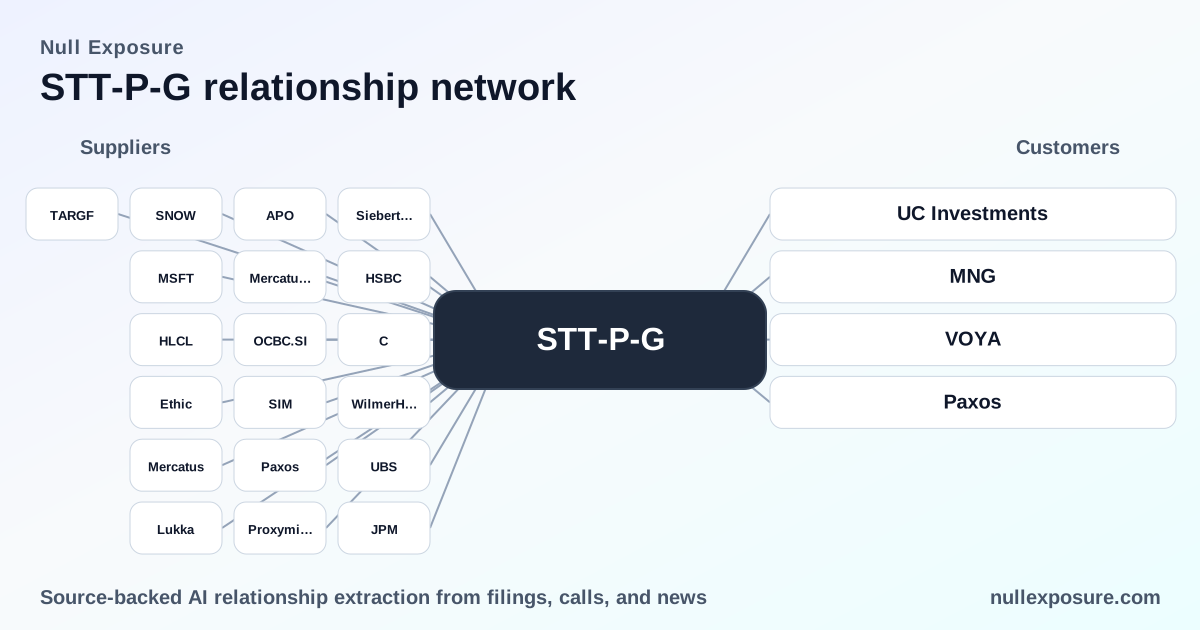
State Street (STT-P-G): Customer Relationships and What They Signal for Investors
State Street Corporation operates as a global custodian, asset servicer and institutional investor solutions provider, monetizing through custody and administration fees, investment servicing mandates, and outsourced middle-office contracts tied to assets under administration. The firm’s earnings profile depends on scale of assets serviced, longevity of institutional mandates, and the ability to convert platform capabilities (custody, middle office, settlement innovation) into sticky revenue streams. For a concise, structured view of these customer relationships and their investor implications, see more at https://nullexposure.com/.
Why customer relationships matter for this preferred security
State Street’s preferred security (STT-P-G) is directly sensitive to the durability of client contracts and the risks of revenue loss from large mandates. Custody and middle-office contracts are high-criticality, long-tenor engagements that produce stable recurring fees, while product partnerships and tech pilots produce optional upside but are less predictable. Concentration toward a handful of large institutional clients elevates earnings volatility if mandates are lost or rebid at lower fees. Investors should treat the customer map as a real-time read on revenue base composition: large institutional mandates drive scale while strategic partnerships point to future service expansion.
Detailed customer relationships (what the market has reported)
UC Investments — a major custody and management relationship
According to PlanSponsor reporting (March 2026), State Street managed $110 billion of UC Investments’ $193 billion portfolio as of July 1, providing custody and investment services across most of UC Investments’ assets. This relationship underscores State Street’s role as a core custodian for a large public institutional investor and contributes materially to fee-generating assets under administration. (PlanSponsor, FY2025)
M&G Corporate Services (MNG) — middle-office outsourcing mandate
Funds Europe reported that State Street won a mandate to supply middle-office functions to M&G Corporate Services, a strategic outsourced services engagement that converts operational capability into recurring fees and strengthens platform depth in outsourced fund administration. (Funds Europe, FY2021)
BlackRock — material client loss that reshaped run-rate expectations
Market coverage documents a significant commercial shift with BlackRock: an Investing.com SWOT analysis (FY2025) pointed to a partial impact on State Street’s financial run-rate tied to the loss of business with BlackRock, and earlier reporting flagged the shedding of ETF servicing revenue. The BlackRock relationship highlights the risk of high-concentration clients and the earnings sensitivity when large asset managers rebid or insource services. (Investing.com, FY2025; Boston Business Journal, FY2021)
Voya — DC product partnership and distribution expansion
A 401(k) Specialist article (March 2026) notes that State Street launched a Target Retirement IndexPlus strategy and entered a partnership with Voya to expand IncomeWise Target Retirement Strategies, reflecting product-level collaboration that broadens distribution into defined contribution channels and adds incremental, product-based servicing fees. (401(k) Specialist, FY2025)
Paxos — settlement innovation and pilot integration
State Street’s collaboration with Paxos (announced in a Paxos newsroom release, FY2022) integrated State Street custodial services into the Paxos Settlement Service pilot, positioning State Street at the intersection of custodial services and accelerated settlement technology and creating a potential pathway to lower-cost settlement and new product offerings for institutional clients. (Paxos newsroom, FY2022)
Note on duplicated mentions: the feed contains multiple entries for M&G and Voya reflecting distinct mentions in coverage; the summaries above capture the substantive reports associated with each referenced item.
Operating model signals: contracting posture, concentration, criticality, and maturity
- Contracting posture: State Street operates as a strategic outsourcer and custodian—winning multi-year mandates for custody and middle-office work that are structured for operational stickiness and scale economics.
- Concentration: The firm carries client concentration risk where a small number of very large institutional relationships materially affect revenue run-rate. Loss of a major asset manager’s business is already documented and has reduced near-term financial run-rate.
- Criticality: Custody and middle-office services are mission-critical for clients; they are high-priority, operationally embedded engagements that raise switching costs for clients but intensify reputational and operational risk for the provider.
- Maturity: Many State Street client relationships are long-tenor and contractually mature, while product and technology partnerships (e.g., Paxos, DC partnerships) are in adoption/growth phases that offer upside but require execution.
There are no contract-level constraints extracted in the feed for this customer scope; this is a company-level signal indicating the public coverage summarized here reflects relationship-level events and announcements, not granular contractual terms.
Investment implications and risks for STT-P-G holders
- Earnings stability vs. client concentration: The core custody/middle-office franchise delivers recurring fee revenue, but concentration among a few large clients increases downside if mandates are rebid or reduced. BlackRock’s partial exit is an explicit example of such downside crystallizing.
- Upside from outsourced services and product partnerships: Wins like M&G’s middle-office mandate and DC distribution deals with Voya expand fee pools and deepen operational lock-in, supporting medium-term revenue resilience.
- Technology and settlement innovation: The Paxos pilot places State Street in early-stage settlement innovation, which can reduce operating costs and create new service offerings—a strategic positive for long-term margins if scaled.
- Active monitoring required: Investors need to track mandate renewals, defaults, fee compression in outsourced services, and the pace at which pilots convert to revenue-generating solutions.
Key takeaways: custody and middle-office work remain State Street’s core recurring revenue engine; concentration risk is real and already impacted run-rate; product and tech partnerships provide targeted growth but require execution to offset attrition.
For a structured, ongoing view of client-level developments and how they intersect with capital structure, visit https://nullexposure.com/ to subscribe to updates and data-driven commentary.
Bottom line for business and research users
State Street’s customer map shows a classic institutional services provider profile: large, mission-critical mandates that deliver steady fees, paired with selective partnerships that create optional upside. The documented loss of business with BlackRock is the clearest concrete risk in the public record and demonstrates how client concentration translates to tangible earnings impact. For STT-P-G investors, the central questions are mandate retention, fee trajectory on renewed contracts, and the commercial scaling of strategic partnerships into predictable revenue.