Shattuck Labs (STTK) — Customer Relationships That Drive Valuation and Clinical Progress
Shattuck Labs is a clinical-stage biotechnology company that monetizes primarily through research collaborations, funded development programs, and option-to-license agreements with larger pharmaceutical partners. Revenue today is concentrated and episodic — driven by partner-funded preclinical and clinical work and by license fees when collaborators exercise options — which places partner contracts at the center of the company’s near-term valuation and liquidity profile. For investors and operators, the critical question is how durable and scalable those partner ties are and whether option rights translate into meaningful near-term cash or long-term royalties.
For a concise relationship intelligence overview, see https://nullexposure.com/.
Why partner agreements matter more than product sales today
Shattuck’s financial profile shows a market capitalization of roughly $523m against roughly $1m of trailing revenue, underscoring that the market prices the company as an option on future therapeutic value rather than a revenue-generating commercial enterprise. The company operates with a partner-first commercialization posture: external funds underwrite R&D, and licensing options convert scientific progress into monetizable events. This model produces four practical characteristics that investors must treat as operating constraints:
- Contracting posture: Shattuck structures collaborations with upfront funding plus option-to-license mechanics, which transfers near-term development risk and capital requirements to partners while preserving upside through options or downstream royalties.
- Concentration: A small number of large partners provide the majority of meaningful non-dilutive funding and license revenue, creating single-counterparty sensitivity in any given period.
- Criticality: Partner decisions (to exercise licenses, advance clinical programs, or provide follow-on funding) are direct drivers of the company’s cash flow and valuation trajectory.
- Maturity: The company is clinical-stage; commercial revenues are not yet diversified. Clinical readouts and partner license exercises are the primary near-term value inflection points.
These signals suggest high upside if partners advance programs or exercise license options, and high downside if collaborations stall or if the company cannot replace partner-funded work.
Customer relationship roll-up — what the public record shows
Below are the relationships surfaced in public reporting and press coverage, summarized plainly and cited to their sources.
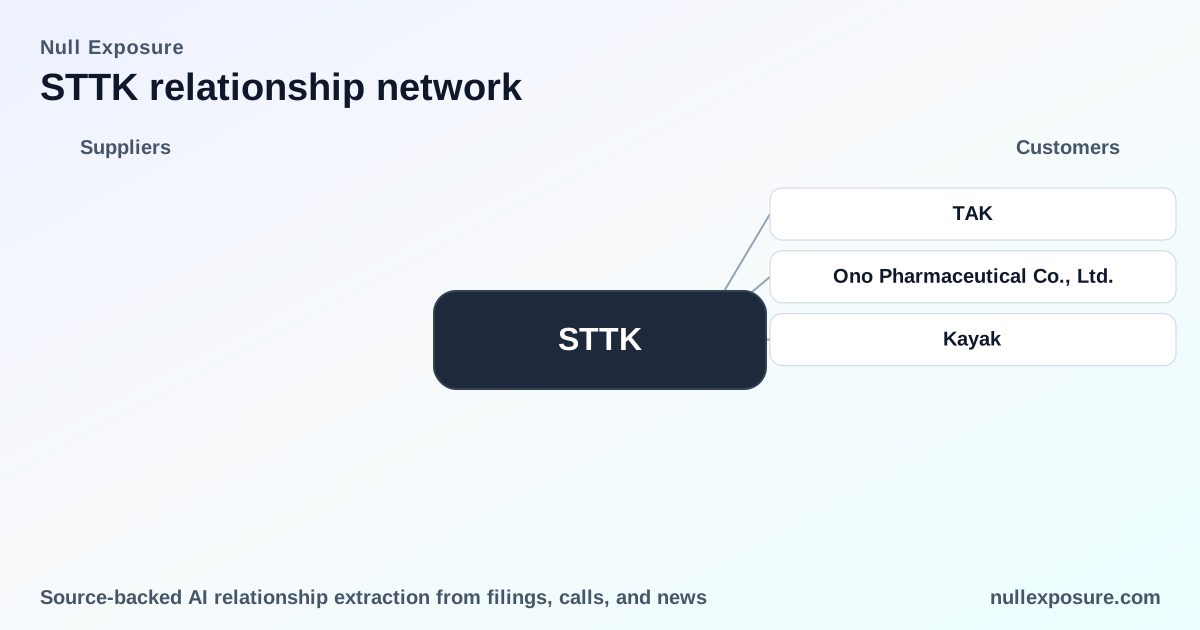
Takeda / TAK — research collaboration (FY2017)
Takeda provided funding for pre-clinical and clinical development and secured an option to take an exclusive license on up to four ARC molecules generated by the collaboration. This structure delivers development capital to Shattuck while reserving commercialization upside for Takeda through exclusive option rights. According to a DrugDiscoveryTrends article summarizing the FY2017 collaboration, Takeda’s arrangement included funded development and an option-to-license framework.
Source: DrugDiscoveryTrends coverage of the Takeda–Shattuck collaboration (referencing FY2017), reported March 10, 2026.
Takeda Pharmaceutical Company — duplicate reporting of the same Takeda relationship (FY2017)
Public feeds contain a second reference naming Takeda Pharmaceutical Company that restates the same funding-and-option terms for up to four ARC molecules; this duplicate reinforces that the Takeda collaboration is a well-documented, legacy partner arrangement. The underlying commercial mechanics and financial implication mirror the first Takeda entry.
Source: DrugDiscoveryTrends coverage (same FY2017 collaboration), reported March 10, 2026.
Ono Pharmaceutical Co., Ltd. — drug discovery collaboration and option agreement (FY2024)
Ono entered into an agreement where Shattuck generates bifunctional fusion proteins and supplies resultant drug candidates to Ono for optimization and clinical development, with Ono holding options on further advancement. The PR Newswire release details a classic biotech–pharma discovery collaboration: Shattuck supplies engineered assets and Ono funds subsequent development stages and optimization.
Source: PR Newswire announcement of the Ono–Shattuck collaboration and option agreement (FY2024), reported via press release.
Kayak — related-party license revenue recognized in 2025 (FY2026 reporting summary)
Shattuck recognized related-party license revenue from an entity identified as Kayak during 2025, indicating that at least some license activity has converted into recognized revenue. A TradingView summary of Shattuck’s SEC 10-K and year-end results also notes the completion of Ono and ImmunoGen collaborations in 2024 and the Kayak-related license revenue recognition in 2025, highlighting that partnership milestones translate into company-reported revenues in discrete periods.
Source: TradingView coverage summarizing Shattuck’s FY2025 results and 10-K disclosures (reported in FY2026 summary).
What each relationship means for valuation and risk
The Takeda and Ono arrangements share a common commercial logic: Shattuck supplies platform-engineered assets and capital from partners funds translation; partners retain exclusive commercialization rights via options. That model concentrates upside in partner decisions and milestone realizations. The Kayak license recognition demonstrates that option exercises and licensing events produce discrete revenue spikes that can materially affect near-term financials given Shattuck’s low base of recurring revenue.
Key investor implications:
- Revenue volatility is structural. License exercises produce lumpy revenue; recurring commercial revenue remains negligible.
- Valuation is binary and partner-driven. Clinical progress or exercised options unlock value; failure to secure exercise decisions or replacements increases dilution risk.
- Counterparty quality matters. Collaborations with large pharma (Takeda, Ono) de-risk development pathways but also shift commercialization economics to partners.
Tactical watchlist for the next 12–18 months
- Monitor press releases and 8-K/10-K language around option exercise triggers and any milestone payments tied to the Takeda and Ono relationships. Those events are primary de-risking catalysts.
- Track further license revenue recognitions following the Kayak event as a barometer of conversion from collaboration to monetization.
- Watch cash runway and use of proceeds language in filings; partner-funded programs should extend runway, but replacements for concluded collaborations are necessary for sustained R&D progression.
For deeper relationship-level intelligence and historical feed reconciliation, visit https://nullexposure.com/.
Bottom line
Shattuck Labs is an R&D-centric biotech whose near-term value is concentrated in a small set of collaborations and license events. Takeda and Ono represent strategic validation and funded development pathways, while Kayak’s recognized license revenue proves the mechanics of the model can convert into reported revenue. Investors should treat Shattuck as a partner-dependent story: clinical readouts and option exercises will be the primary catalysts that re-price the company, and the timetable and certainty of those partner decisions are the essential inputs for any valuation or operating plan.