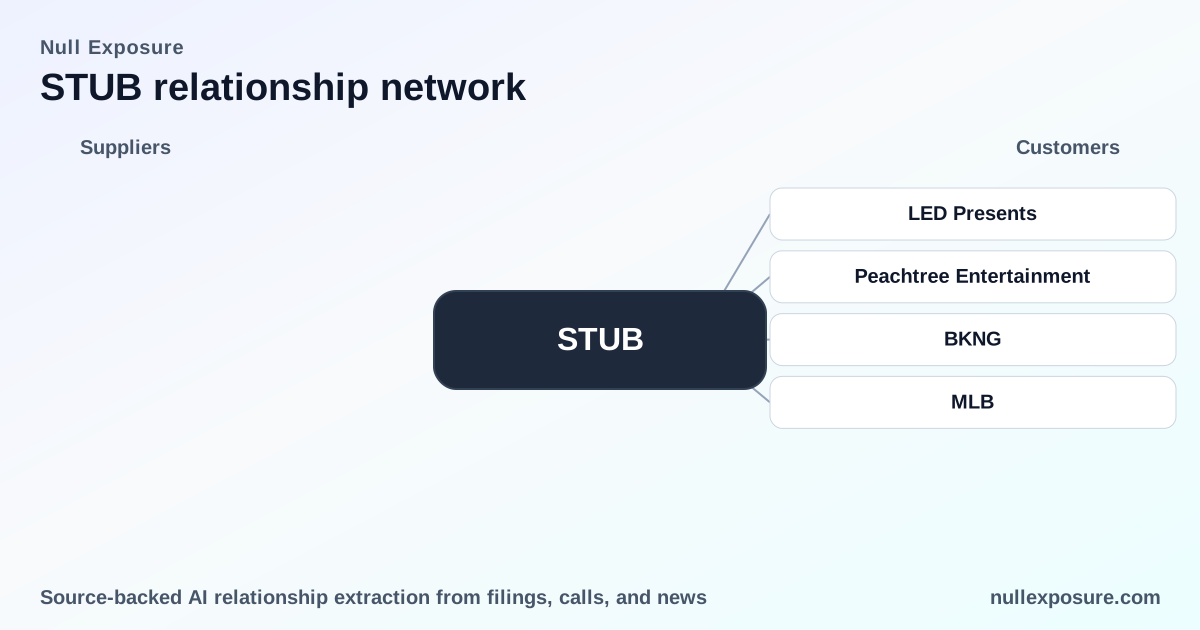
StubHub Holdings (STUB) — customer relationships that shape revenue reach
StubHub operates a two-sided marketplace that monetizes by charging fees on ticket transactions and by expanding distribution through partnerships with promoters, leagues, and travel platforms. Management sells access to live events and sells distribution — listing scale and partner endorsements drive revenue and gross profit, while promotional and platform agreements determine customer acquisition cost and geographic reach. For investors, customer relationships are a primary lever for scaling GMV and for controlling marketing expenses. For a centralized reference on STUB's disclosed partner roster and commentary, see https://nullexposure.com/.
Executive snapshot: what management emphasized on the 2025Q3 call
Management used the 2025 Q3 earnings call to underline two strategic threads: broadening promoter coverage in festivals and regional live music, and pushing open distribution with travel and league partners to capture event-driven tourism spend (2025 Q3 earnings call, Mar 7, 2026). These relationships are operationally important because they convert direct promoter inventory into marketplace supply and stretch customer acquisition outside core channels.
Customer roll call from the earnings call — who was mentioned and why it matters
Below I cover every relationship management named on the 2025Q3 earnings call, with plain-English summaries and the cited call reference.
LED Presents
LED Presents is an independent West Coast EDM promoter that management cited as part of a group of promoters hosting "dozens of events attended by hundreds of thousands of fans annually." This highlights STUB's penetration into youth-oriented, high-frequency touring niches where repeat demand supports secondary-market liquidity (2025 Q3 earnings call, Mar 7, 2026).
Peachtree Entertainment
Peachtree Entertainment was called out as "one of the largest independent promoters in the Southeast" and an example of STUB's success in the music festival category, underscoring regional promoter relationships that drive concentrated seasonal inventory and festival ticketing volume (2025 Q3 earnings call, Mar 7, 2026).
BKNG
Management referenced Booking.com (ticker: BKNG) as an example of the travel channel working with StubHub to capture event tourism demand; Booking.com exemplifies a travel-platform distribution partner funneling non-local ticket buyers into the marketplace, which extends the company's addressable market beyond local customer acquisition (2025 Q3 earnings call, Mar 7, 2026).
Booking.com
Booking.com was explicitly named alongside the BKNG ticker to illustrate event tourism growth and cross-sell potential for hotel and ticket purchasers; this endorsement emphasizes the strategic value of OTA relationships in accessing travelers who buy tickets outside their home market (2025 Q3 earnings call, Mar 7, 2026).
Major League Baseball
Management announced a new partnership with Major League Baseball as a “premier sports property endorsing open distribution,” signaling league-level validation that can unlock inventory scale, enhance credibility with fans, and lower friction for ticket flows across platforms (2025 Q3 earnings call, Mar 7, 2026).
MLB
The call referenced MLB by its acronym in the same context as Major League Baseball, reinforcing the strategic partnership with the league and the importance of top-tier sports rights for broadening marketplace supply and brand trust (2025 Q3 earnings call, Mar 7, 2026).
Operating and business-model constraints investors should treat as company-level signals
Because the disclosed constraints list for customer relationships is empty, the following characteristics should be read as company-level operating signals rather than being tied to any single partner.
- Contracting posture: StubHub operates largely on partnership and distribution agreements rather than exclusive long-term vendor lock-ins, implying flexibility but also exposure to churn if distribution economics compress.
- Concentration: Management’s callouts span several large partners and numerous independent promoters, signaling a mixed concentration profile — dependence on marquee league and OTA partners for reach, balanced by many smaller promoter relationships for supply depth.
- Criticality: League and OTA relationships are highly critical for access to broad audiences and event catalogues; promoter relationships are operationally critical for inventory; losing either type would produce asymmetric downside.
- Maturity: The mix of established global partners (e.g., Booking.com, MLB) and independent promoters indicates a maturing platform that combines institutional distribution with niche promoter penetration, which supports scale but requires tailored commercial terms.
What these relationships mean for revenue and margin dynamics
The partner roster described on the call maps directly to two margin drivers. First, travel-platform and league partnerships expand buyer reach at relatively low incremental CAC, improving take-rates on transactions sourced off-platform. Second, promoter and festival relationships increase supply density and pricing power during peak windows, which boosts gross profit per ticket when inventory liquidity is high. However, reliance on partner distribution exposes StubHub to platform fee negotiations and to seasonal concentration risk tied to festivals and sports calendars.
Key investment implications and risk checklist
- Distribution diversification is an upside: partnerships with Booking.com/BKNG and MLB materially increase addressable demand beyond local buyer pools, improving GMV growth potential.
- Promoter ecosystem is a competitive moat for liquidity: relationships with promoters like LED Presents and Peachtree Entertainment provide event-level inventory that sustains marketplace depth.
- Commercial terms and concentration are risks: league and OTA agreements are strategically critical; adverse renegotiation or loss of distribution channels would pressure growth and marketing efficiency.
- Seasonality and operational cadence matter: festival and sports calendars compress revenue into peak periods, requiring disciplined working capital and flexible cost structure.
If you want a centralized, continuously updated tracker of partner mentions and relationship changes, visit https://nullexposure.com/ for detailed coverage and alerts.
Bottom line: trade-offs worth underwriting
StubHub’s customer relationships disclosed on the 2025 Q3 call reveal a deliberate strategy: scale distribution through major travel and league partners while cementing supply with independent promoters. For investors, that combination supports top-line growth potential and gross-margin expansion if StubHub preserves favorable commercial economics. The chief risks are contract renegotiation with major partners and seasonal concentration at the promoter level — factors that should be monitored closely through subsequent earnings calls and partner announcements.
For research teams modeling STUB, treat partner distribution as a lever on customer acquisition efficiency and promoter coverage as a lever on supply elasticity; both determine unit economics and the path to profitability.