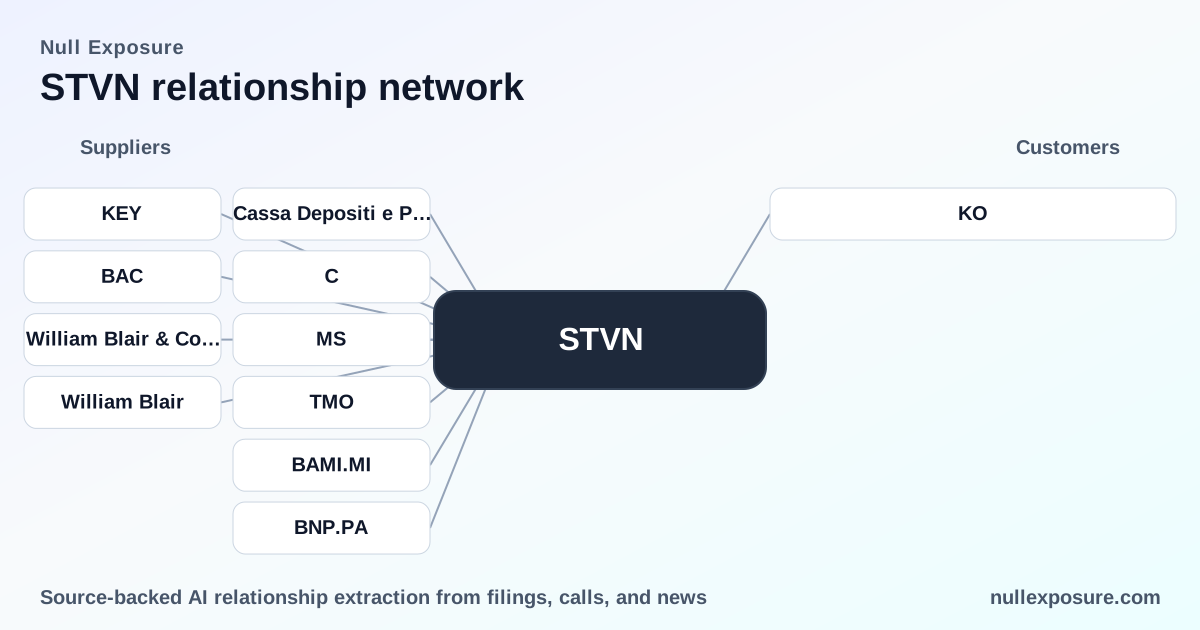
Stevanato Group (STVN): Customer relationships and what they mean for investors
Stevanato Group monetizes precision drug-delivery know‑how and high‑quality glass and polymer primary packaging by selling finished components, integrated filling lines and engineering services to pharmaceutical and biotech customers worldwide. The business converts manufacturing scale, regulatory accreditation and engineering integration into durable revenue streams, while valuation metrics reflect a premium multiple for execution and growth (Market Cap ≈ $4.86bn; Revenue TTM ≈ $1.19bn). For primary research on counterparties and customer signals, see the coverage below and our broader analysis at https://nullexposure.com/.
Business model in plain language: how revenue is earned and where the leverage sits
Stevanato sells manufactured packaging (vials, cartridges, stoppers) and sells higher‑margin systems and services (inspection, filling lines, automation). Revenue derives from product sales, capital equipment projects and long‑cycle customers with qualification hurdles that create switching friction. The operating model shows three investor-relevant characteristics:
- Contracting posture: Customers typically enter qualification and supply agreements that run multi‑year and require regulatory approvals, giving Stevanato negotiating leverage on long lead items and capital projects.
- Concentration: Commercial exposure is skewed toward the pharmaceutical and biotech vertical; non‑pharma work is incidental and does not drive core margins.
- Criticality: Primary packaging and validated filling systems are operationally critical for drug manufacturers, producing high stickiness once a product is qualified.
- Maturity and capital intensity: Production is industrial and capital‑intensive, with ongoing capex required for capacity expansion and automation; earnings profile benefits from scale once utilization is high.
These attributes justify a structural premium but also demand disciplined capex and customer diversification to protect margin cyclicality.
What the reporting shows on customer relationships
The relationship data returned for STVN is concise and focused on a single third party across two records. Both records originate from the same local news piece and point to non‑pharma work historically undertaken by Stevanato.
Coca Cola — Il Gazzettino mention (record 1)
Il Gazzettino reported that Stevanato historically produced serigraphy (screen printing) for Coca‑Cola glass bottles, indicating a legacy non‑pharma contract for decorative/printing services rather than core pharmaceutical packaging (Il Gazzettino, March 10, 2026: https://www.ilgazzettino.it/speciali/venezia_eventi/stevanato_lezione_nonno_ripartire_zero-9088670.html).
KO — Il Gazzettino mention (record 2, duplicate)
The same article references “KO” in a parallel entry and repeats that Stevanato executed serigraphy for Coca‑Cola glass bottles, reinforcing that this is a historical, peripheral relationship outside Stevanato’s primary pharmaceutical client set (Il Gazzettino, March 10, 2026: https://www.ilgazzettino.it/speciali/venezia_eventi/stevanato_lezione_nonno_ripartire_zero-9088670.html).
How to interpret these customer records for valuation and operational diligence
The Coca‑Cola mentions are informative for reputation and capability but are not evidence of material commercial reliance on beverage customers. Investors should treat the Coca‑Cola references as legacy or ancillary business activity that showcases Stevanato’s glass handling and finishing capabilities rather than indicating a material diversification of revenue away from pharma.
Key implications:
- Revenue impact: The public financials (Revenue TTM ≈ $1.19bn) and operating margins reflect a pharmaceutical‑centric revenue base; a one‑off or historical printing contract with a beverage company is unlikely to move top‑line or margin dynamics materially.
- Reputational signal: Serving global consumer brands historically demonstrates manufacturing quality and finishing competence, which is complementary to pharmaceutical credibility.
- Commercial risk: Core revenue risk remains concentration in pharma customers and the need to secure qualified supply agreements; the Coca‑Cola references do not change that risk profile.
For continuous monitoring of STVN’s customer mix, track disclosures around strategic accounts, long‑term supply agreements, and order backlog updates in quarterly filings and conference presentations. Additional commercial signals can be captured via targeted media coverage and trade reports.
Constraints and company‑level operating signals
No explicit constraints were returned for customer relationships in the extracted data. As a result, present company‑level signals are most relevant:
- High qualification barriers: The company’s model relies on regulatory approvals and qualification processes that create durable customer lock‑in and predictable replacement cycles.
- Concentration risk is structural: Business concentration in pharmaceutical packaging is a strategic feature, which amplifies sector cyclicality and exposure to biotech funding cycles.
- Capital intensity drives execution risk: Growth requires committed capex and successful ramp of new lines; operational execution of capacity projects is a performance lever for margins.
- Maturity of product set: Core glass and polymer offerings are mature products, while systems and services provide margin expansion potential.
These company‑level signals inform diligence priorities: customer retention rates, contract tenure, backlog composition, and capex-to-sales discipline.
Risk checklist and monitoring actions for investors and operators
- Confirm the materiality of non‑pharma contracts through investor presentations and segment disclosures.
- Monitor order backlog and customer qualification timelines to assess conversion risk from capital projects to recurring revenue.
- Track margin mix between product sales and systems/services; increased systems revenue supports higher margins.
- Watch capex guidance versus free cash flow to evaluate dilution risk to returns if capacity utilization lags.
For a consolidated feed of customer‑level alerts and deeper counterparty mapping, explore our coverage and tools at https://nullexposure.com/.
Bottom line: what investors should take away
Stevanato is fundamentally a pharma‑focused packaging and systems provider whose valuation reflects scale, regulatory credentials and the recurring nature of qualified supply. The Coca‑Cola references in local media document historical, peripheral work in glass finishing but do not alter the company’s core commercial profile. Investors should prioritize monitoring of pharmaceutical award pipelines, backlog conversion, and capex execution when modeling growth and margin trajectories.