Seagate (STX): Customer relationships that power the storage supercycle
Seagate generates cash by selling high-volume storage hardware (HDDs/SSDs and subsystems) to original equipment manufacturers and cloud providers, and by monetizing data retention through its Lyve consumption-based storage services. The company combines large, framework purchase agreements with hyperscalers and a growing usage-based services business, creating a dual revenue stream that is simultaneously high-volume and increasingly recurring. For a summarized analytics feed on relationships and risk signals, visit https://nullexposure.com/.
How Seagate contracts and where the money flows
Seagate’s operating model is defined by concentration and scale. The company’s disclosures show OEMs account for roughly 80% of channel revenue, with distributors and retailers representing smaller shares. Seagate sells at scale into very large enterprise customers—hyperscale cloud service providers (CSPs)—under master purchase or framework agreements, while its Lyve portfolio is sold in a consumption-based, usage model to enterprises and managed service providers. These dynamics create a blended posture: high-volume, long-term contractual relationships with powerful buyers, plus nascent recurring revenue from storage-as-a-service.
- Contracting posture: Framework agreements with hyperscalers reduce transactional overhead and drive predictable volume, while Lyve’s usage pricing creates variable, potentially sticky revenue.
- Concentration: Heavy OEM reliance concentrates revenue risk into a small set of large customers, increasing bargaining power of buyers.
- Criticality: For cloud providers and AI training workloads, Seagate’s capacity is a critical input—loss of supply would be operationally disruptive for customers.
- Maturity: Hardware is a mature, capital-intensive business; services (Lyve Cloud and partnerships) are earlier-stage growth vectors.
Customer map: hyperscalers, alliances and third-party deals
Below are the customer and partner mentions surfaced in recent coverage. Each entry is a concise, plain-English observation with source attribution.
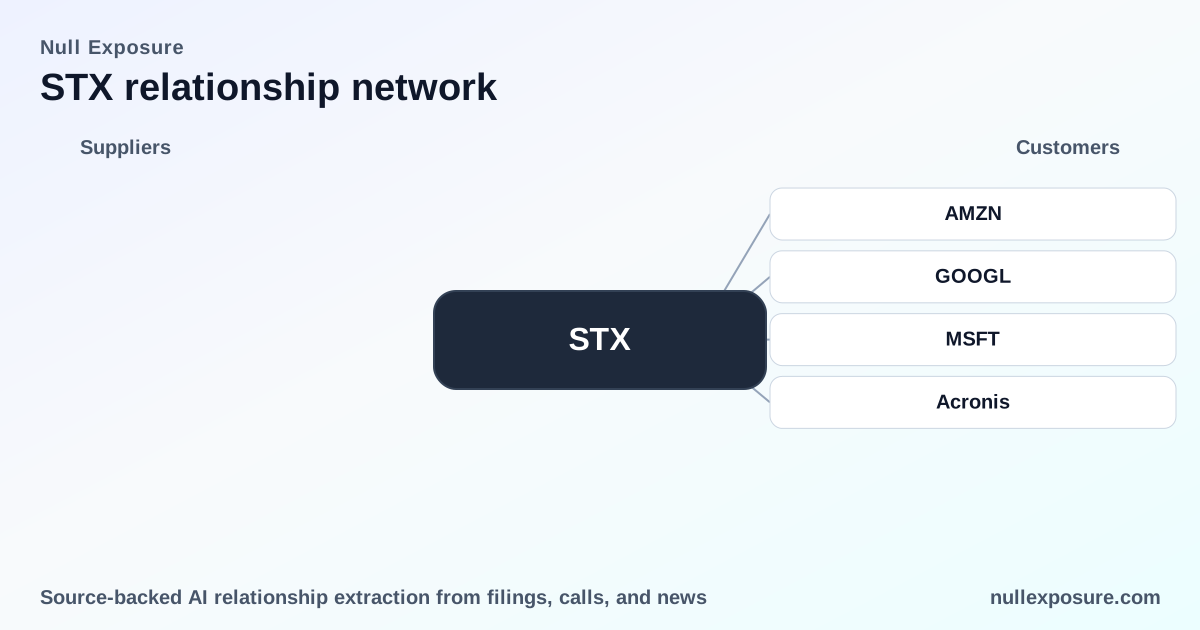
Seagate is a supplier to Google as part of its broader strategy to serve hyperscale CSPs that require petabytes of storage for cloud services and AI workloads. A market note discussing the storage supercycle lists Google alongside other major cloud buyers in FY2026. (Finterra market commentary, Mar 2026 — https://markets.financialcontent.com/stocks/article/finterra-2026-3-3-seagate-technology-stx-the-storage-supercycle-and-the-ai-data-lake-revolution)
Amazon
Amazon is identified as one of Seagate’s core Cloud Service Provider customers, purchasing mass storage capacity to support AWS and AI model training. The same FY2026 note explicitly groups Amazon with other hyperscalers that drive petabyte-scale demand. (Finterra market commentary, Mar 2026 — https://markets.financialcontent.com/stocks/article/finterra-2026-3-3-seagate-technology-stx-the-storage-supercycle-and-the-ai-data-lake-revolution)
AMZN
A duplicate mention of Amazon underscores its prominence among Seagate’s hyperscaler buyers and the repeated industry emphasis on cloud-driven storage demand in FY2026 coverage. (Finterra market commentary, Mar 2026 — https://markets.financialcontent.com/stocks/article/finterra-2026-3-3-seagate-technology-stx-the-storage-supercycle-and-the-ai-data-lake-revolution)
Microsoft
Microsoft is named as a major CSP customer that consumes Seagate’s capacity for Azure infrastructure and AI workloads, reinforcing the company’s role as a supplier to the largest cloud platforms. (Finterra market commentary, Mar 2026 — https://markets.financialcontent.com/stocks/article/finterra-2026-3-3-seagate-technology-stx-the-storage-supercycle-and-the-ai-data-lake-revolution)
Acronis
Seagate announced an alliance with Acronis in September 2025 to deliver an archival S3 offering—Acronis Archival Storage—built on Seagate’s Lyve Cloud, targeting MSPs and enterprises for compliant, cost-efficient long-term storage. This partnership extends Seagate’s go-to-market into service providers and managed channels. (TradingView/Zacks summary, Mar 2026 — https://www.tradingview.com/news/zacks:37f8047ab094b:0-3-computer-storage-devices-stocks-with-huge-upside-to-buy-on-the-dip/)
Wasabi Technologies
Wasabi Technologies is acquiring Seagate’s Lyve Cloud business, a material strategic move that transfers Seagate’s cloud-object storage operations to a specialist cloud storage provider and will alter Seagate’s services footprint. The transaction was reported on April 9, 2026. (Finviz / Business Wire reporting, Apr 2026 — https://finviz.com/quote?t=STX)
DEA
A reference in a Q1 2026 earnings call transcript mentions a project in Fort Myers being run by “a terrific group called Seagate,” indicating Seagate’s operational role in certain infrastructure projects beyond traditional product sales. (InsiderMonkey earnings call transcript, May 2026 — https://www.insidermonkey.com/blog/easterly-government-properties-inc-nysedea-q1-2026-earnings-call-transcript-1748861/)
What the relationship map signals for investors
The relationships and constrained attributes together describe a company that is simultaneously reliable at scale and exposed to concentrated buyer power.
- Large, framework buyers drive scale: Seagate’s revenue exposure to hyperscalers is a volume engine that supports margins when demand is strong, but it also gives customers leverage on pricing and lead times. Company disclosures indicate master purchase agreements are common with hyperscalers.
- A services pivot that is both strategic and non-core after the Lyve sale: Lyve’s consumption-based model created a path to recurring revenue; the Wasabi acquisition of Lyve Cloud shifts Seagate away from running object-cloud services, reallocating focus to hardware and partner-led services. (Wasabi acquisition reporting, Apr 2026 — https://finviz.com/quote?t=STX)
- Channel concentration is persistent: OEMs account for ~80% of channel revenue, with distributors and retailers making up smaller shares—this is a structural concentration signal that affects operating leverage and counterparty risk. (Company disclosures)
- Geographic diversification but APAC prominence: The company reports Asia Pacific roughly 41% of revenue, Americas around 49%, and EMEA 10%, confirming genuine global reach with outsized exposure to APAC markets. (Company disclosures)
- Strategic partnerships expand reach but do not eliminate buyer concentration: Alliances like the Acronis collaboration push Seagate into managed services and MSP channels, improving go-to-market diversification even as hyperscaler contracts remain central. (TradingView summary of the Acronis alliance, Mar 2026 — https://www.tradingview.com/news/zacks:37f8047ab094b:0-3-computer-storage-devices-stocks-with-huge-upside-to-buy-on-the-dip/)
Investment takeaways
- Bull case: The combination of hyperscaler volume and growing, albeit reconfigured, services capability positions Seagate to capture the ongoing storage demand tied to cloud and AI workloads.
- Risk case: High concentration in OEM/hyperscaler channels, plus the strategic decision to divest Lyve Cloud to Wasabi, increases reliance on hardware margins and partner distribution for services-led growth.
- Monitor: Customer contract terms, procurement cadence at Amazon/Google/Microsoft, and the operational handover to Wasabi for Lyve Cloud; the Acronis partnership should be tracked as a test of Seagate’s ability to monetize services via third-party channels.
For deeper signals on contract types, counterparty concentration and global revenue exposure, see our platform at https://nullexposure.com/.
Bottom line: Seagate’s customer relationships are the company’s competitive engine—large-scale, framework commitments from hyperscalers deliver the bulk of volume, while partnerships and previously-owned services businesses create optionality. Investors should value Seagate as a high-volume supplier to critical cloud infrastructure, with concentrated counterparty risk tempered by expanding route-to-market partnerships.