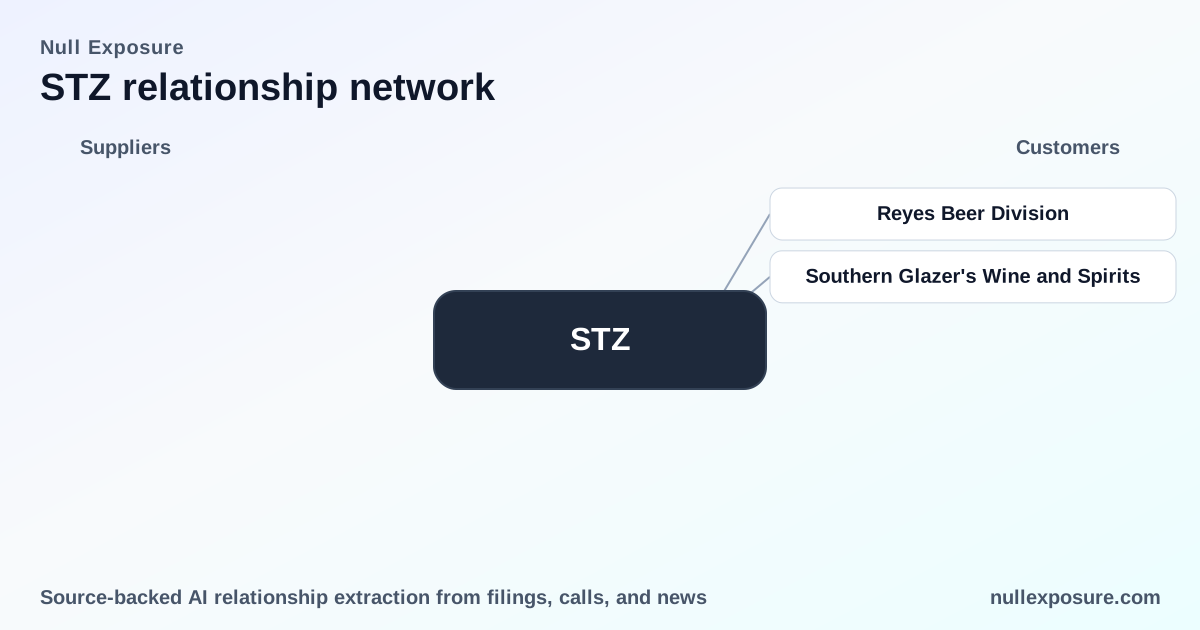
Constellation Brands (STZ) — Customers and the distribution architecture that drives the business
Constellation Brands monetizes a portfolio of beer, wine and spirits by owning and licensing brands and selling through a U.S.-centric distribution network that blends wholesale distributors, retailers, direct-to-consumer channels and, in regulated states, government-controlled distribution. Revenue is generated primarily through branded product sales and third‑party licensing agreements, with a concentrated set of large customers accounting for the majority of net sales. For investors, the economics are simple: brand strength underpins pricing power, while concentrated wholesale relationships drive both topline and working-capital dynamics.
Learn how we map STZ’s customer relationships and concentration at https://nullexposure.com/.
The commercial model in plain terms: licensing, distributors and channel concentration
Constellation operates under a mixed contracting posture. The company sells under trademarks it owns and under license, and it maintains a variety of licenses and distribution agreements with differing terms and durations. These arrangements create a combination of recurring branded revenue and contractually governed distribution economics that are central to margin stability. According to the FY2025 Form 10‑K, Constellation explicitly notes the use of trademarks and licenses alongside distribution agreements with varying time horizons.
Geographically, Constellation is overwhelmingly U.S.-focused, reporting roughly $10.0 billion of U.S. net sales versus $192 million non-U.S. in the FY2025 disclosure, which anchors both market opportunity and regulatory exposure to U.S. alcohol distribution rules. The company sells to a mix of counterparties: independent wholesale distributors, retailers, on-premise accounts, direct-to-consumer buyers (which represented 16% of Wine & Spirits net sales in Fiscal 2025), and, in certain states, state alcohol beverage control agencies that set retail prices. These distribution and counterparty dynamics inform credit risk, cash collection practices, and pricing pass-through.
Concentration and criticality: why a handful of customers matter
Constellation discloses that its 10 largest customers accounted for approximately 59% of net sales in FY2025, a structural concentration that makes individual large distributor relationships systemically important to revenue and cash flow. That concentration amplifies counterparty risk and bargaining dynamics: large wholesalers have meaningful leverage on placement, promotion, and payment terms, but Constellation’s brand strength preserves supplier status. The company also notes that the bulk of accounts receivable arise from independent distributors with predetermined electronic funds transfer collection dates, which standardizes collection cadence but concentrates settlement risk around a few counterparties.
Who shows up in the filing: the named customers and what they represent
Reyes Beer Division — a top beer distributor relationship
Reyes Beer Division is listed in the FY2025 Form 10‑K as a named counterparty, with net sales reported in the range of roughly 25.4% of the disclosed net-sales slice for the period referenced. This places Reyes among Constellation’s most material beer-channel customers and reflects the company’s reliance on large wholesale partners to move its beer portfolio. (Source: Constellation Brands FY2025 Form 10‑K, filed Feb. 28, 2025.)
Southern Glazer's Wine and Spirits — a major wine & spirits channel partner
Southern Glazer’s Wine and Spirits is disclosed with net‑sales representation of approximately 11.2% in the FY2025 period, marking it as a principal partner in the wine and spirits distribution network. Southern Glazer’s role in the filing underscores Constellation’s dependence on national wholesale distributors for the Wine & Spirits segment. (Source: Constellation Brands FY2025 Form 10‑K, filed Feb. 28, 2025.)
Operational constraints and company-level signals investors should internalize
-
Contracting posture: Constellation uses trademarks it owns as well as licensed arrangements and a variety of distribution agreements, which creates a hybrid of IP-driven margins and negotiated distribution economics. The FY2025 10‑K describes these licenses and distribution agreements as having varying terms and durations, signaling a mix of short- and longer-term commercial commitments.
-
Counterparty mix and channels: The company sells into wholesale distributors, retailers, on‑premise accounts, DTC buyers (DTC represented 16% of Wine & Spirits net sales in Fiscal 2025), and governmental distribution channels in certain states where state beverage control agencies set retail prices. That regulatory pathway introduces non-market pricing and timing considerations in affected states.
-
Geographic concentration: The business is concentrated in North America, with the U.S. representing the vast majority of net sales in FY2025. This shapes regulatory, competitive, and macro exposure.
-
Concentration/criticality: Top‑10 customer concentration is material and persistent — about 59% of net sales in FY2025. That level of concentration elevates counterparty credit risk, negotiating leverage, and the impact of any disruption to a major distributor.
-
Role of distributors in cash flow: Accounts receivable are primarily generated from independent distributors with predetermined collection dates using electronic funds transfer, which standardizes cash flows but ties timing risk to distributor performance.
For more context on how these commercial signals translate to portfolio and credit analysis, visit https://nullexposure.com/.
Investment implications: balancing brand strength against concentrated distribution risk
Constellation’s investment case rests on durable brand cash flows and a distribution model that scales through large wholesale partners. That structure supports solid margins and predictable unit economics, as shown by the company’s operating margins and EBITDA profile in recent reporting. However, investors must weigh two persistent structural risks:
- Concentration risk among a handful of large distributors — the top 10 customers provided roughly 59% of net sales in FY2025 — which increases exposure to negotiable trade terms and collection timing.
- Regulatory channel complexity — state-controlled distribution in certain jurisdictions and a meaningful direct‑to‑consumer presence create a mix of regulated and unregulated price dynamics that can compress or expand realized margins.
These factors argue for active monitoring of accounts receivable trends, distributor payment patterns, and any shifts in channel mix that would change the revenue dependency profile.
Bottom line
Constellation Brands is a brand-driven consumer staples company whose economics are amplified by a concentrated wholesale distribution network. The FY2025 filing lists Reyes Beer Division and Southern Glazer’s Wine and Spirits as material customers — together illustrating the company’s reliance on large distributors — while disclosing a company-level concentration where the top 10 customers represent roughly 59% of net sales. For investors and operators, the combination of strong brand equity and concentrated distribution relationships is a tradeoff between predictable cash generation and counterparty concentration risk that requires ongoing surveillance of distributor health and contract terms.
Explore our relationship mapping and signal analysis at https://nullexposure.com/ for deeper customer-level intelligence.