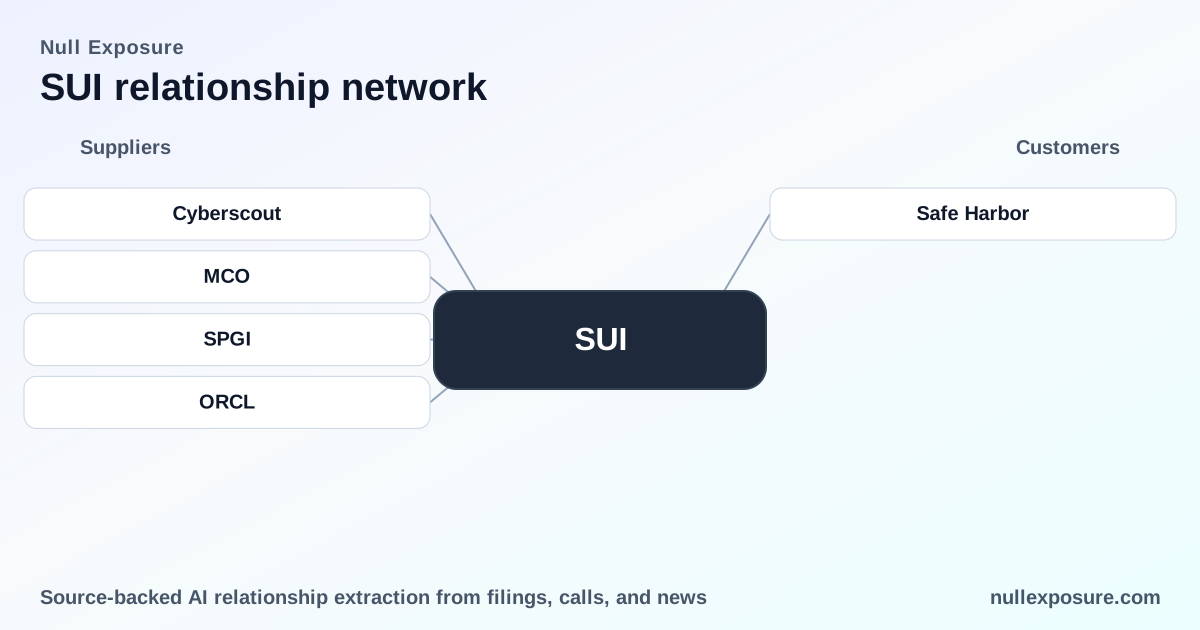
Sun Communities (SUI): Customer Relationships That Drive Recurring Real-Estate Cash Flow
Sun Communities operates and monetizes a portfolio of manufactured housing (MH), recreational vehicle (RV) communities and marinas by leasing land sites, selling homes, and providing ancillary services that generate high-margin, recurring revenue. The company combines long-term site-license economics with a large stock of short-term and seasonal leases in marinas and RV segments, capturing stable rent cash flows while preserving upside from home sales and services. For investors, the key investment thesis is exposure to durable rental income, embedded optionality from home sales and marina services, and capital recycling demonstrated through large asset monetizations. Learn more at https://nullexposure.com/.
How Sun’s customer model translates into cash generation
Sun’s revenue model is distinctly multi-layered: the core is site rental income from individuals and families who place manufactured homes or RVs on Sun-owned land; complementing that are home sales, marina services, and leisure/retail revenue. This mix produces predictable rents plus episodic upside from property-level improvements and home transactions. Sun’s 2024 footprint of roughly 645 properties underpins scale advantages in operations and ancillary monetization.
Corporate operating posture and business constraints investors should weigh
Sun’s customer relationships display a deliberate mix of contract maturities and counterparty types that drive both resilience and operational complexity:
- Contracting posture (mixed maturity): The company explicitly runs both long-term site license structures (20–40 year terms in select UK products) and short-term leases (month-to-month or up to 12-month terms for most MH/RV residents). This combination delivers headline stability from long-duration UK licenses while keeping occupancy flexibility and pricing power in North American operations.
- Revenue concentration and geography: Sun is geographically diversified across North America and the UK, with a portfolio spanning the U.S., Canada and the UK—reducing single-market concentration risk but introducing multi-jurisdictional regulatory and seasonal dynamics.
- Counterparty composition and criticality: Customers are primarily individuals and households, making the portfolio somewhat insulated from corporate tenant credit risk but sensitive to local housing affordability and consumer spending cycles. Marinas introduce seasonality and spot-demand exposure.
- Service model and maturity: Sun functions as lessor, seller and service provider—it not only leases sites but sells homes and operates marina and resort amenities—indicating a mature, vertically integrated operating model that broadens revenue per customer and raises operational complexity.
Overall, Sun’s business blends durable, rent-like income with transactional upside from home sales and asset sales, and that hybrid model requires active capital allocation to sustain growth and net-lease economics.
Customer relationships: what the market is saying (each item from available reporting)
Below are the relationships surfaced by recent reporting, each distilled to a clear investor-facing takeaway with source attribution.
LGHL (Lion Group Holding Ltd.)
Lion Group announced an allocation to acquire SUI tokens as part of a crypto treasury program—this is a capital-market action by LGHL rather than a traditional customer relationship with Sun Communities. According to CoinDesk (June 27, 2025), Lion Group planned to acquire SUI tokens as part of a broader $600 million crypto treasury strategy. Source: CoinDesk (2025).
Blackstone Infrastructure — buyer of Safe Harbor marinas
Blackstone Infrastructure’s acquisition of Sun’s Safe Harbor marinas in 2025 is a material capital recycling event that materially improved Sun’s liquidity and repositioned the company’s marina exposure under a specialist operator. Mizuho’s initiation note highlighted the potential upside to 2026–2027 earnings driven by capital allocation from Sun’s 2025 $5.25 billion Safe Harbor sale to Blackstone Infrastructure. Source: Investing.com / Mizuho coverage (May 2026).
SUIS (Canary Capital staked SUI ETF)
The SUIS product is an exchange-traded fund that tracks the spot price of SUI tokens while participating in staking rewards, which is relevant to token holders rather than Sun Communities’ property customers; it signals third‑party financial products referencing “SUI” token economics in capital markets. TheDefiant reported on Canary Capital’s launch of a staked-SUI ETF in March 2026, noting that in-kind staking rewards flow into the fund NAV. Source: TheDefiant (March 2026).
Safe Harbor (capital transfer and sale proceeds)
Sun’s 10‑K disclosures and subsequent reporting document a net capital transfer of roughly $5.5 billion associated with the Safe Harbor sale, which appears as a primary driver of financing activity and repositioning of Sun’s balance sheet. TradingView highlighted SEC Form 10‑K cash flow notes showing $372.2 million of net cash from financing activities and a $5.5 billion net capital transfer tied to the Safe Harbor sale. Source: Sun Communities SEC filing described on TradingView (FY2026 reporting).
Blackstone Infrastructure (duplicate media reference / ticker BX)
A parallel investing.com item reiterates the same theme: Blackstone (ticker BX referenced) purchased the Safe Harbor marinas, reinforcing market coverage that the 2025 sale is a defining capital allocation event for Sun. This duplicate coverage confirms consensus in the sell-side narrative about proceeds redeployment potential for 2026–2027 earnings upside. Source: Investing.com (May 2026).
Investor implications: revenues, risks, and what to watch
- Revenue durability: The company blends long-term licensed revenue with high-frequency short-term leases, preserving a base rental yield while capturing transactional home-sale income; this accelerates cash conversion but requires active portfolio management.
- Capital recycling: The $5.25B Safe Harbor sale and reported $5.5B capital transfer are large-scale balance-sheet events that materially de-risk near-term funding and create scope for buybacks, redeployments into core parks, or debt paydown—monitor Sun’s disclosed capital allocation decisions closely.
- Operational complexity and seasonality: Marina and RV segments introduce seasonal, spot-driven revenue, which amplifies quarter-to-quarter volatility compared with pure long-term lease REITs.
- Counterparty sensitivity: Heavy exposure to individual residents reduces corporate-credit risk but increases sensitivity to local labor and housing markets, and to consumer discretionary cycles for services/amenities.
Final read and data-driven action
Sun Communities presents a hybrid income profile—stable site rents plus episodic upside from asset and home sales—underpinned by geographic scale. The Safe Harbor monetization and related capital transfer are definitive events repositioning the company for the next phase of capital allocation and potential earnings reacceleration. For a deeper read on how these relationship dynamics affect credit and revenue modeling, visit https://nullexposure.com/.
Key monitoring points for investors: Sun’s disclosed redeployment of Safe Harbor proceeds, occupancy and rent trend lines across MH/RV segments, and any follow-up asset sales or buyback programs announced through FY2026.