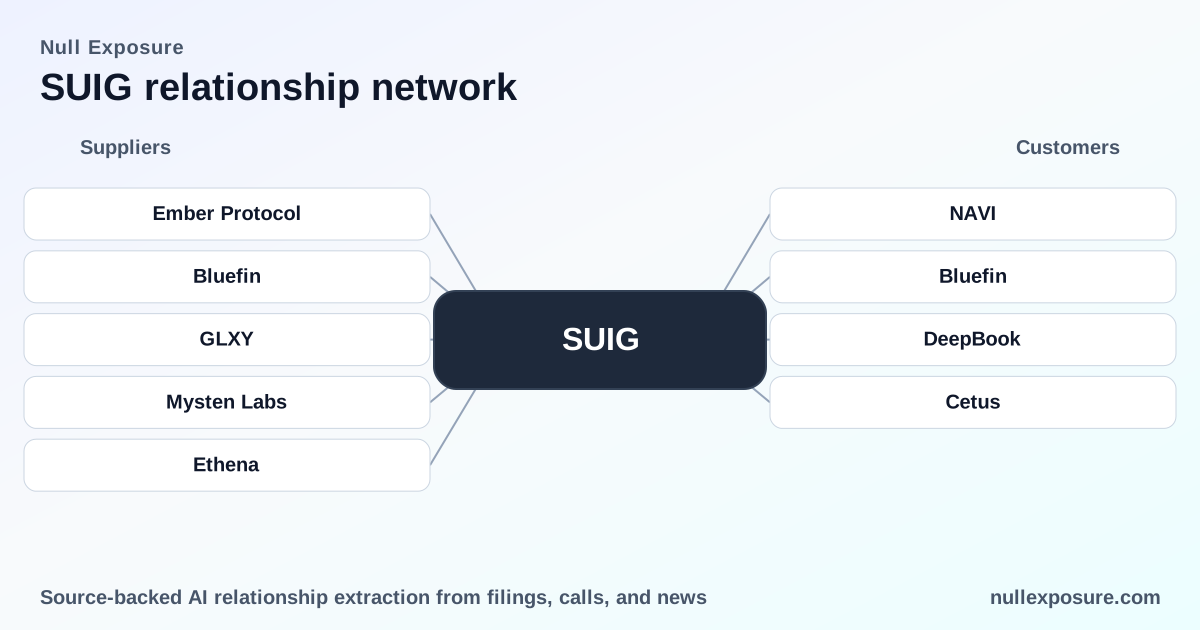
SUIG Customer Landscape: How SUI Group Converts Crypto Treasury Assets into Yield
SUI Group Holdings Limited operates as a principal investment firm that deploys capital into digital-asset lending and revenue-sharing arrangements, monetizing through interest, origination fees and fee-sharing on decentralized exchanges and related trading infrastructure. The company’s model is short-duration, yield-focused finance — lending native token inventory (SUI) and other crypto collateral into DEXs and institutional counterparties in exchange for revenue share or interest income. For investors, the critical question is how these counterparty relationships translate into recurring, scalable cash flows versus one-off opportunistic gains. For deeper company analytics visit the NullExposure homepage: https://nullexposure.com/.
Market-facing summary
- Business model driver: lending and revenue-sharing of token assets (SUI) into marketplace counterparties and DEXs.
- Revenue profile: short-term loan interest, origination fees and percentage revenue shares paid in SUI.
- Risk vectors: counterparty concentration, token-price volatility, and the short-term maturities that require ongoing redeployment.
Operational snapshot and strategy SUI Group’s public disclosures and press coverage make clear the firm is positioning its balance sheet as an active treasury manager for on-chain markets — converting static token holdings into yield-generating exposures. The firm lends token inventory to venues that then use liquidity to support derivatives and stablecoin rails, receiving either fixed interest or a slice of exchange revenue payable in SUI. That dual approach — lender and revenue partner — gives SUI Group both cash-style interest receipts and upside linked to trading volume on partner platforms.
A second point of emphasis: transactions are short-term and fee-oriented, consistent with the firm’s stated preference for financings that mature within nine months and with reported origination fee income in FY2024. This creates a high-turnover revenue stream that scales with active deployment but requires continuous deal flow and counterparty underwriting.
Active counterparty relationships — what to watch Below I cover every customer relationship surfaced in external coverage and filings. Each entry is a concise, plain-English take on the commercial link and the public source.
Bluefin — revenue-sharing partner on Sui perpetuals
SUI Group has a formal revenue-sharing and lending arrangement with Bluefin, a perpetual-futures decentralized exchange built on the Sui blockchain; SUI Group agreed to lend 2 million SUI to Bluefin in return for a 5% revenue share, with payments denominated in SUI per multiple filings and press pieces. This positions SUI Group as both liquidity provider and fee-partner in on-chain derivatives (source: company filing coverage and market reports, Investing.com and Coindesk, Mar–May 2026 — https://www.investing.com/news/company-news/sui-group-appoints-former-cftc-commissioner-quintenz-to-board-93CH-4432416; https://www.coindesk.com/business/2026/01/25/sui-group-charts-new-course-for-crypto-treasuries-with-stablecoins-and-defi).
Takeaway: Bluefin is a strategic counterparty that creates the potential for recurring, volume-linked revenue paid in SUI.
NAVI — stablecoin ecosystem usage
Coverage indicates NAVI is referenced as a primary use case for SUI Group’s stablecoin initiatives; the stablecoin is expected to be consumed across partner platforms including DeepBook and Bluefin, and to act as collateral throughout the ecosystem. NAVI’s role is operational — a payments and collateral medium within the partner network where SUI Group provides treasury liquidity (source: MEXC news, March 2026 — https://www.mexc.com/en-NG/news/554779).
Takeaway: NAVI is part of the payments/collateral fabric that expands the utility of SUI Group’s treasury assets.
DeepBook — execution and liquidity venue
SUI Group’s communications list DeepBook among platforms that will use the stablecoin and related liquidity products; DeepBook therefore functions as an execution and liquidity destination in which SUI Group’s stablecoin and lending positions are likely to be deployed (source: MEXC news, March 2026 — https://www.mexc.com/en-NG/news/554779).
Takeaway: DeepBook represents an additional liquidity destination that amplifies the reach of SUI Group’s lending and stablecoin strategy.
Cetus — DEX integration and collateral use
Public reports list Cetus, a decentralized exchange, as another venue where the stablecoin and collateral provided by SUI Group will be employed; this broadens counterparties beyond a single DEX and reduces single-venue concentration risk if execution flows materialize (source: MEXC news, March 2026 — https://www.mexc.com/en-NG/news/554779).
Takeaway: Cetus extends the distribution of SUI Group’s capital into broader DEX activity.
Constraints and structural signals shaping the business model SUI Group’s public disclosures include a set of recurring operational constraints that define how the firm contracts and captures value. These are company-level signals that inform underwriting, rate-setting and capital allocation:
- Contracting posture — short-term: The company emphasizes short-term specialty finance solutions with typical maturities within nine months, which implies a high turnover of assets and a need for persistent origination to sustain revenue. (Company disclosure.)
- Counterparty mix — individuals and small businesses: SUI Group historically serves high-net-worth individuals, micro- and small-cap public companies, and private businesses; this mix increases underwriting complexity and potential regulatory overlays (Company disclosure).
- Geographic/regulatory signal — North America exposure: The firm references state-level regulatory considerations (e.g., usury laws) for high-net-worth individual lending, indicating exposure to NA legal regimes when contracting with retail or individual borrowers (Company disclosure).
- Materiality and concentration — Malik/Mustang exposure flagged: The firm disclosed that a significant and material amount of assets were invested in Mustang through March 2027, signaling concentration risk on a named exposure (Company disclosure).
- Commercial role — service provider: SUI Group positions itself as a service-provider lender that generates income from lending and origination fees rather than from running an exchange or market-making desk (Company disclosure).
- Relationship life-cycle — mix of active and terminated: Filings show both terminated notes (paid in full September 26, 2024) and active short-term loans that generated ~$2.76M of revenue in 2024, illustrating a portfolio with both closed and ongoing short-term loans (Company disclosure).
- Economic scale per relationship — mid-range exposures: Examples include promissory notes in the $100k–$1M band (e.g., a $250k shareholder note at 10% interest), suggesting many engagements are mid-ticket and fee-driven (Company disclosure).
- Product focus — services and high-yield lending: The firm’s principal offerings are high-interest short-term lending arrangements, consistent with the revenue profile of interest and origination fees (Company disclosure).
Investor implications and risk-reward framing
- Upside: The Bluefin revenue-share gives SUI Group direct exposure to on-chain trading volumes, creating a potential recurring yield stream payable in SUI that scales with exchange activity.
- Execution risk: Short maturities require continuous redeployment and origination capacity; failure to place capital quickly compresses yield and increases idle-token exposure to price swings.
- Concentration: The flagged Mustang exposure indicates material concentration at times; management must demonstrate diversification across partners (Bluefin, DeepBook, Cetus, NAVI) to mitigate that risk.
- Regulatory and counterparty credit: Lending to individuals and small businesses under North American law adds legal and credit complexity, particularly around consumer-lending statutes.
Conclusion and next steps SUI Group has converted token holdings into an active lending-and-revenue-share business targeting on-chain derivatives and liquidity venues. The core investment hypothesis is that short-term lending plus revenue-share on DEXs can produce higher yields than passive treasury holdings, but this relies on steady deal flow, careful counterparty credit work, and diversification away from materially concentrated exposures.
For a structured view of SUI Group’s counterparties and a research dashboard, visit NullExposure for deeper relationship analytics: https://nullexposure.com/.