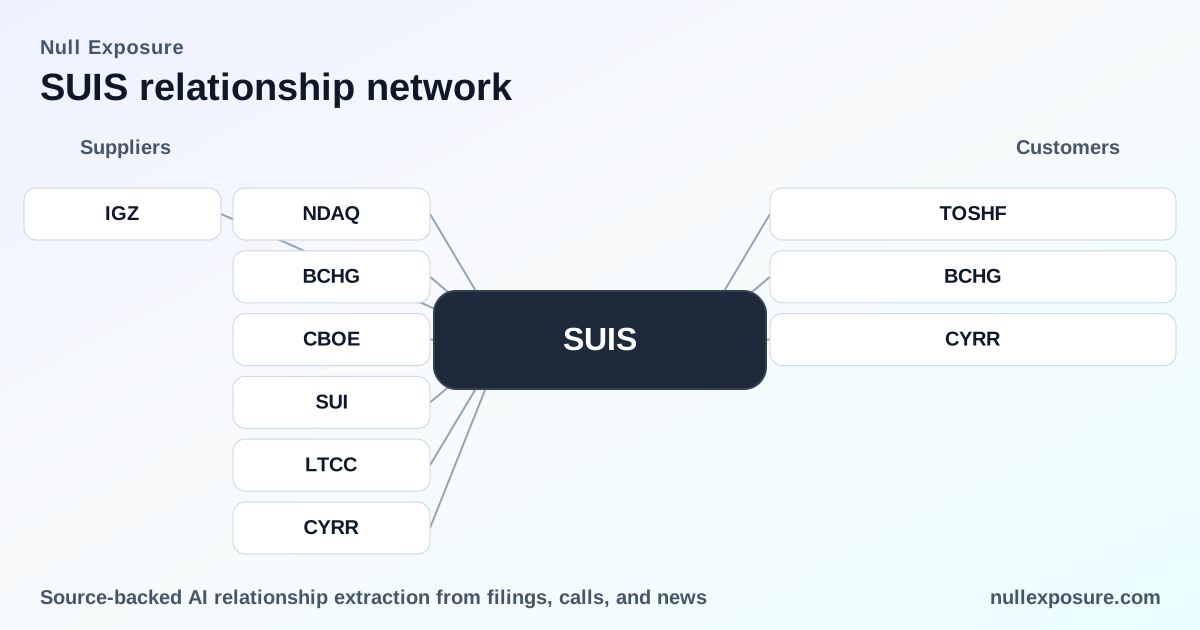
SUIS customer map: ETF issuers have turned Sui into tradable staking exposure — what investors need to know
SUIS is operating as the underlying staking exposure that institutional product issuers package and distribute to public investors; issuers capture customer demand by creating ETFs and similar products that provide access to Sui staking economics. Monetization flows through product fees, creation/redemption mechanics, and ancillary services built around staking and custody, while SUIS’s commercial footprint is evaluated primarily through the roster of asset managers that choose the token as their underlying. For a deeper view of partner activity and ongoing coverage, see https://nullexposure.com/.
Why the February ETF rollouts matter for SUIS revenue and adoption
The concentrated rollouts of Sui-focused ETFs in February 2026 converted on‑chain staking capacity into regulated, custody‑backed investment products. That sequence materially expands institutional distribution channels for SUIS exposure and compresses the time between protocol-level supply and retail/institutional demand. According to market coverage from March 10, 2026, several issuers launched Sui staking ETFs that started trading on major U.S. exchanges on February 18, 2026 (see CoinPaper and CryptoRank reporting linked below).
This commercialization creates two immediate investor-facing effects: (1) demand concentration around a small set of ETF issuers that aggregate flows, and (2) operational criticality of custody, staking and product governance for SUIS as those issuers scale inflows into the token.
Operating model and business-model signals investors should treat as material
- Contracting posture: Relationships with ETF issuers are largely arm’s-length, commercial partnerships where issuers source underlying Sui exposure and package it for investors; SUIS’s commercial counterparties are primarily asset managers and ETF sponsors.
- Concentration risk: A handful of issuers dominate early distribution, producing channel concentration that can amplify outflows if any single sponsor faces redemptions or regulatory pressure.
- Criticality: ETF listings are high-impact customers; product listings on NYSE Arca and Nasdaq institutionalize demand and make issuer relationships strategically critical to SUIS market depth.
- Maturity: These are early-stage commercial relationships—product launches in February 2026 reflect nascent institutional adoption rather than an established, diversified client base.
Customer map — who is packaging SUIS exposure today
Below are the counterparties and issuer tickers surfaced in market coverage; each entry contains a plain-English summary and the reporting source.
21Shares (issuer)
21Shares positioned a Sui product as a streamlined route for investors to gain exposure to Sui, and Market reporting tied the issuer directly to a newly listed Sui ETF in February 2026. According to CoinPaper and CryptoRank coverage (March 10, 2026), 21Shares described its TSUI product as a simple access vehicle for Sui exposure (see https://coinpaper.com/14881/sui-price-to-rally-as-sec-greenlights-21-shares-sui-etf and https://cryptorank.io/news/feed/d6a94-sui-price-to-rally-as-sec-greenlights-21-shares-sui-etf).
TOSHF (ticker / product label)
Market reports reference TOSHF/TSUI as the product ticker representing 21Shares’ Sui exposure, framed as a streamlined ETF-style vehicle for retail and institutional buyers; the ticker is the public wrapper that converts Sui staking economics into tradable shares. See CoinPaper and CryptoRank reporting from March 10, 2026 (https://coinpaper.com/14881/sui-price-to-rally-as-sec-greenlights-21-shares-sui-etf; https://cryptorank.io/news/feed/d6a94-sui-price-to-rally-as-sec-greenlights-21-shares-sui-etf).
Grayscale (issuer)
Grayscale launched a Sui staking fund product that began trading on NYSE Arca on February 18, 2026, turning its brand and distribution network toward Sui staking exposure. Market coverage on March 10, 2026 notes the debut of the Grayscale Sui Staking ETF (see https://cryptorank.io/news/feed/d6a94-sui-price-to-rally-as-sec-greenlights-21-shares-sui-etf and https://coinpaper.com/14881/sui-price-to-rally-as-sec-greenlights-21-shares-sui-etf).
BCHG (ticker / product label)
BCHG appears in reporting as the listing symbol connected to Grayscale’s Sui staking ETF that started trading on NYSE Arca on February 18, 2026; BCHG functions as the public symbol that channels investor flows into Grayscale’s Sui exposure. See March 10, 2026 market articles (https://cryptorank.io/news/feed/d6a94-sui-price-to-rally-as-sec-greenlights-21-shares-sui-etf; https://coinpaper.com/14881/sui-price-to-rally-as-sec-greenlights-21-shares-sui-etf).
Canary (issuer)
Canary launched a staked‑SUI ETF product that began trading on Nasdaq on February 18, 2026, offering another distribution path for Sui staking exposure through a recognized exchange. Coverage on March 10, 2026 reports Canary’s Nasdaq listing for its Canary Staked SUI ETF (see https://cryptorank.io/news/feed/d6a94-sui-price-to-rally-as-sec-greenlights-21-shares-sui-etf and https://coinpaper.com/14881/sui-price-to-rally-as-sec-greenlights-21-shares-sui-etf).
CYRR (ticker / product label)
CYRR is the product symbol associated with Canary’s Staked SUI ETF on Nasdaq; it represents the tradable wrapper investors buy to access Canary’s Sui staking exposure following the February 18, 2026 launch (see March 10, 2026 reporting at https://cryptorank.io/news/feed/d6a94-sui-price-to-rally-as-sec-greenlights-21-shares-sui-etf and https://coinpaper.com/14881/sui-price-to-rally-as-sec-greenlights-21-shares-sui-etf).
Risks and what investors should watch next
- Concentration of distribution: With a small set of ETF issuers driving early flows, issuer-level redemptions or reputational issues could create outsized price and liquidity swings for SUIS exposure.
- Regulatory sensitivity: The fact that these products launched in February 2026 following SEC engagement places regulatory developments and enforcement decisions squarely on the risk ledger; continue to monitor filings and exchange notices.
- Operational and custody complexity: ETFs that offer staked exposure require robust custody and staking operations; counterparty failures or technical incidents among custodians or staking providers would be immediately material to investors holding these ETFs.
- Demand-channel dependency: SUIS’s commercial adoption is currently channeled through ETF issuers; broader adoption will require more diversified product types and custodial arrangements to reduce single-channel risk.
Bottom line: institutional distribution is real — now evaluate counterparty concentration
The February 2026 ETF rollouts institutionalized SUIS exposure through a short list of major issuers. That is a positive for market access and liquidity, but it also creates counterparty concentration and operational criticality risks that investors must price explicitly. Track inflows to TSUI/TOSHF, BCHG, and CYRR tickers and monitor regulatory and custody disclosures from 21Shares, Grayscale and Canary for the clearest early indicators of sustained demand.
For ongoing coverage, issuer tracking, and relationship dashboards, visit https://nullexposure.com/ — the best single landing page for staying current on how SUIS relationships evolve.