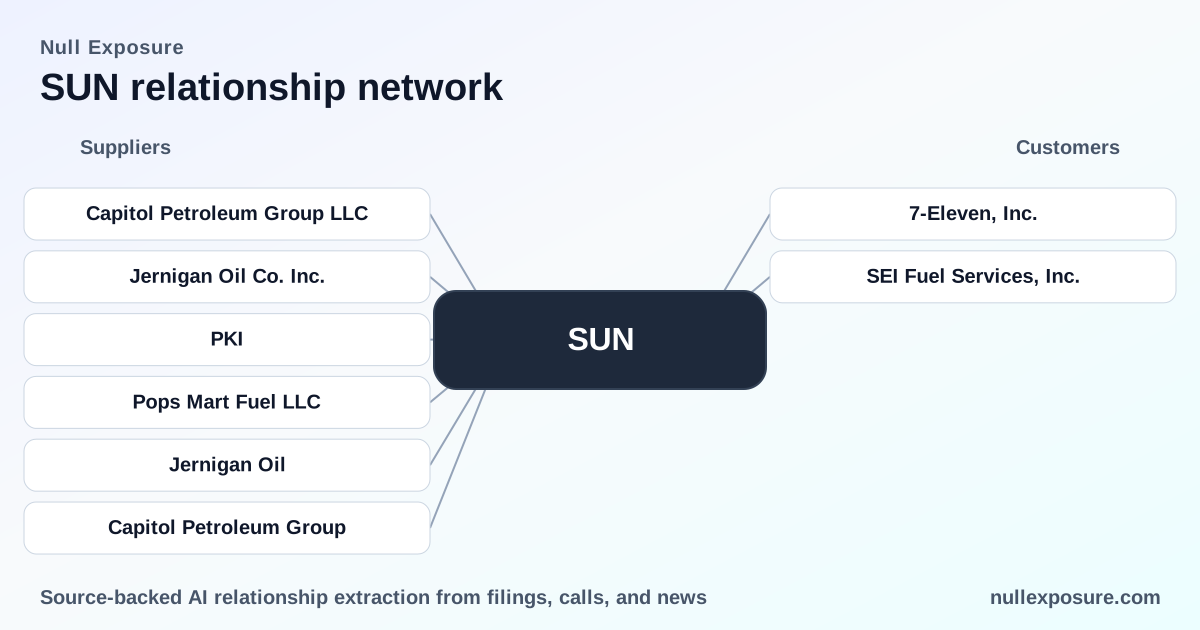
SUN (Sunoco LP) — customer relationships that shape distribution economics
Sunoco LP distributes and sells motor fuels across the United States and adjacent markets, monetizing through wholesale fuel supply contracts, branded licensing/franchise fees for retail sites, and transactional spot sales of ancillary petroleum products. The business blends long-duration, volume-committed distributor contracts with spot commercial sales and symbolic franchise licensing, producing a predictable base of gross profit from distribution while retaining upside and execution risk tied to retail asset activity and commodity price movements. For a focused view of customer counterparty concentration and contract structure, see more at https://nullexposure.com/.
How Sunoco’s contracting and geographic posture drive cashflow
Sunoco’s operating model is a hybrid of contractual stability and transactional exposure. The Partnership distributes fuel under long-term contracts to branded distributors and convenience stores, with supply contracts that typically have an initial term near ten years and a volume-weighted remaining term of roughly five years; these arrangements provide a recurring minimum gross profit corridor. At the same time, the company sells propane, lubricants and other petroleum products on both spot and contracted bases, which injects pricing volatility into margins. Franchise-style retail licenses are treated as symbolic licenses for accounting and generate evenly recognized revenue over the life of franchise agreements.
Geographically, revenue is heavily U.S.-centric: Sunoco reports virtually all of its revenues in the United States, though it maintains operations in Puerto Rico, Europe and Mexico—an arrangement that gives domestic market exposure primacy while leaving modest international touchpoints. The company also records sales to a broad commercial customer base that includes municipalities, school districts and other government entities, indicating a diversified counterparty mix beyond major branded distributors.
Customer roster: the relationships investors must know
7-Eleven, Inc. — strategic distributor and material counterparty
7‑Eleven is the only third‑party dealer or distributor that exceeds 10% of Sunoco’s Fuel Distribution segment and more than 10% of aggregate revenue, making it a material counterparty for the Partnership in FY2024. According to Sunoco’s FY2024 Form 10‑K, 7‑Eleven is uniquely large among third‑party distributors and therefore a concentration risk for distribution economics. (Source: Sunoco LP FY2024 10‑K filing.)
SEI Fuel Services, Inc. — long-term take‑or‑pay distributor partner
Sunoco is party to a 15‑year take‑or‑pay fuel supply agreement with 7‑Eleven and SEI Fuel Services under which the Distributor is contractually required to purchase minimum volumes that guarantee the Partnership a baseline gross profit annually; this creates a stable revenue floor tied to committed volumes and contract tenure. (Source: Sunoco LP FY2024 10‑K filing.)
7‑Eleven (retail asset sales coverage) — strategic retailer relationship and asset rotation
Industry reporting noted Sunoco sold many retail sites to 7‑Eleven in early 2024, a move that prompted debate about the Partnership’s role as a retail asset owner versus pure distributor; the transaction highlights active portfolio management between Sunoco and 7‑Eleven and illustrates how disposals can reallocate capital and alter revenue mix. (Source: CStore Dive, May 4, 2026.)
Braskem S.A. (BAK ticker reference) — disposal of chemicals business that alters customer footprint
Sunoco completed the sale of its polypropylene business (Sunoco Chemicals Inc.) to Braskem S.A. for approximately $350 million, removing a chemicals customer and supplier layer from the corporate footprint and crystallizing proceeds that can be redeployed into distribution or balance‑sheet priorities. (Source: ReliablePlant, March 9, 2026.)
What the constraints tell investors about risk and resilience
The company‑level signals in Sunoco’s disclosures frame important operating characteristics:
- Contracting posture: The Partnership operates with a mix of long‑term, volume‑committed distribution contracts (initially ~10 years with volume‑weighted remaining ~5 years) alongside spot sales for certain commercial products. This mix provides a predictable gross‑profit base while reserving commodity exposure via spot transactions.
- Concentration and criticality: 7‑Eleven’s outsized share (over 10% of revenue) constitutes a concentration risk that elevates counterparty importance; conversely, the presence of ~2,000 other commercial customers, including government entities, signals broad transactional reach that mitigates single‑point dependency.
- Contract maturity and revenue recognition: Franchise licenses are treated as symbolic and recognized evenly over agreement life, giving steady revenue contributions from licensing even as asset ownership changes.
- Geographic footprint: Revenue is overwhelmingly U.S.‑based, limiting exposure to foreign macro volatility but preserving pockets of LATAM and EMEA presence through operations in Mexico and Europe—useful for scenario planning but secondary to domestic dynamics.
- Spend concentration to affiliates: In 2024 Sunoco reported $28 million in revenue from fuel gallons sold to affiliates, a transparent signal of modest intra‑group flows relative to total revenue but relevant for related‑party monitoring.
Operational levers and downside scenarios investors should track
Sunoco’s principal levers are contract coverage and volume commitments, retail asset strategy, and how management redeploys proceeds from disposals. A sustained move to sell retail assets reduces direct retail margin exposure but increases reliance on distributor economics and contractual protections. Conversely, a weakening distributor counterparty, or renegotiation away from take‑or‑pay terms, would materially compress the baseline gross profit corridor. The polypropylene sale to Braskem reduces non‑fuel commodity exposure and provides liquidity—relevant for capital allocation and deleveraging scenarios.
Investor takeaways and next steps
- Concentration matters: 7‑Eleven is a material counterparty (>10% of revenue) and therefore central to stress‑testing Sunoco’s distribution cashflow under adverse scenarios.
- Contracts provide a floor: Long‑term, volume‑committed contracts and a 15‑year take‑or‑pay arrangement with major distributors create a stable earnings base.
- Asset strategy is active: Recent retail site sales and the polypropylene divestiture demonstrate management is actively rebalancing the asset base to sharpen the distribution focus.
- Geography is predominantly domestic: U.S. exposure dominates revenue and should be the primary lens for macro and regulatory risk assessment.
For analysts and operators evaluating SUN customer risk, the evidence points to a distribution business with high contractual backbone offset by notable counterparty concentration and transactional spot exposure. Deeper due diligence should prioritize contract terms, remaining volume commitments, and any changes to distributor relationships—especially with 7‑Eleven and SEI Fuel Services. Learn more about our coverage and research at https://nullexposure.com/.
Bold, focused positions on these relationship dynamics will guide valuation sensitivity and operational monitoring for Sunoco LP.