SUNation Energy (SUNE): Customer Relationships, Revenue Drivers, and Operational Constraints
SUNation Energy builds, installs and services rooftop and ground-mounted photovoltaic systems and battery storage for homeowners, businesses and municipalities, and monetizes through system sales, installation fees and ongoing maintenance contracts. Revenue is largely driven by residential system sales (the company reports 82% of 2024 consolidated revenue from residential PV and batteries) while services and grid-related offerings provide ancillary, higher-margin recurring revenue. For a concise signal overview of SUNE’s customer footprint, visit https://nullexposure.com/.
What the numbers tell investors about how customers pay the bills
SUNation is a small-cap, high-volatility operator: trailing revenue was $71.9 million with gross profit of $27.5 million, but the company reported negative EPS and negative EBITDA on a TTM basis. That financial profile underscores a business where project throughput and seasonal bookings materially affect cash flow and near-term earnings. The company operates across three U.S. states (New York, Florida, Hawaii), concentrating operational exposure regionally while selling both hardware and services to a broad set of counterparties.
According to SUNation’s 2024 Form 10‑K, the company is a domestic consolidator of residential solar, battery storage and grid services and remains exposed to project- and installation-driven revenue cycles. Market data show a low price-to-book and high beta, which reinforces the investment case as execution- and growth-sensitive rather than yield-driven.
Operating constraints that shape customer relationships
SUNation’s customer and contract profile is not incidental — it defines how the company wins and retains business.
- Contracting posture: Commercial contracts are typically short-term (generally completed within three to twelve months), which creates revenue visibility tied to bookings and installation throughput.
- Counterparty breadth: The company serves a wide spectrum of buyers — residential homeowners are primary, but SUNation also sells to municipal customers, small and mid-market businesses, non-profits and larger enterprises.
- Products and roles: SUNation’s business mixes hardware sales (photovoltaic systems, batteries) with service, repair and preventative maintenance, positioning the firm both as a seller and a long-term service provider.
- Geographic concentration: Operations focus on New York, Florida and Hawaii, concentrating regulatory and incentive risk within three state markets.
- Materiality: Residential solar is core and critical to overall performance — the company reports that residential PV and battery projects account for the majority of revenue.
These operating characteristics create a profile where short-term contract exposure amplifies revenue volatility, while service offerings offer a pathway to stabilize cash flows if scaled.
The full set of customer relationships revealed and what they mean
Below are every customer-related relationship disclosed in the available results and what each tells investors about SUNation’s commercial footprint.
-
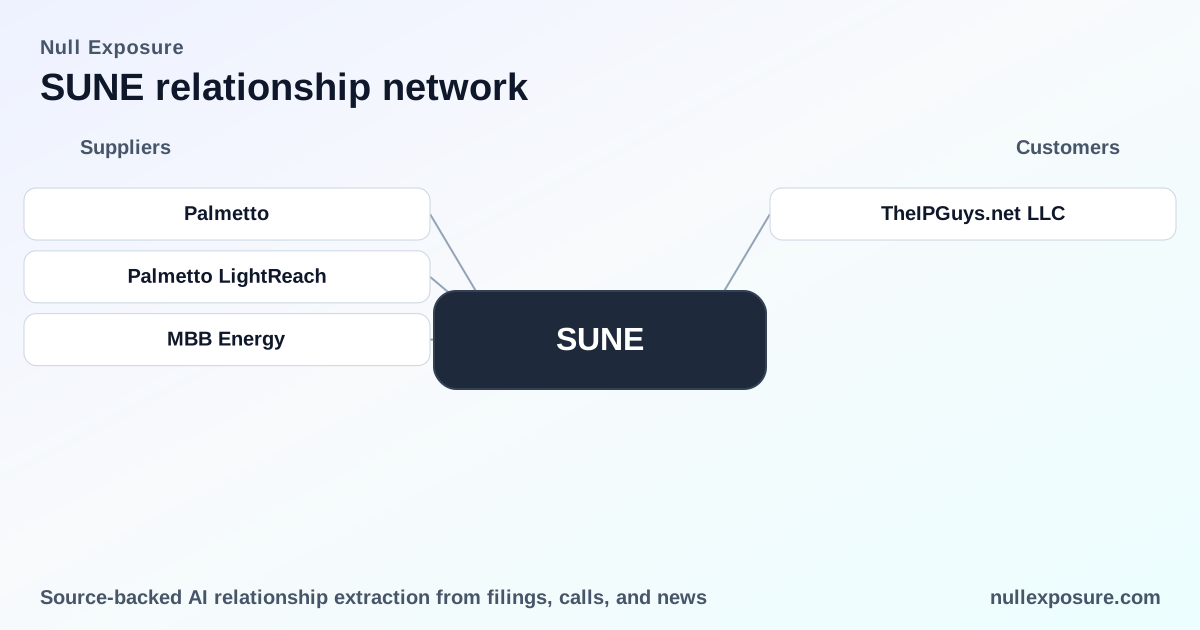
TheIPGuys.net LLC — SUNation sold substantially all assets of two legacy non-core subsidiaries, JDL and Ecessa, to TheIPGuys.net LLC (doing business as OneNet Global) for net proceeds of $1,231,616 on June 30, 2023. This divestiture reflects SUNation’s effort to dispose of non-core assets and streamline operations. According to SUNation’s 2024 Form 10‑K, the transaction closed in FY2023 and is recorded in the FY2024 disclosures.
-
Town of Islip (Islip, NY) — Local government officials stated the town has “been proud to work with SUNation over the years to strengthen our grid and diversify our region’s energy generation capacity.” That commentary in a GlobeNewswire release carried by Energy Digital (May 2026) signals ongoing municipal relationships and program-level activity on Long Island and underscores SUNation’s role as a municipal service provider.
-
PSEG Long Island — PSEG Long Island described its partnership with SUNation as part of efforts to “provide opportunities for energy efficiency and renewables” and credited such partnerships with advancing rooftop solar adoption across New York State (GlobeNewswire/ Energy Digital, May 2026). The PSEG statement positions SUNation as a partner to utility-administered programs and suggests the company can compete for or participate in utility-backed residential and community solar initiatives.
Why these relationships matter for investors and operators
The specific relationships and the broader constraints produce a clear, actionable set of strategic implications:
- Validation from municipal and utility partners: Quotes from the Town of Islip and PSEG Long Island are not mere PR — they indicate SUNation wins projects in coordinated local programs and utility ecosystems, which supports both short-term installation volumes and a pipeline for maintenance revenue.
- Divestiture discipline: The asset sale to TheIPGuys.net LLC shows management willingness to monetize legacy or non-core assets to focus capital and operational attention on core residential and commercial solar activities.
- Operational leverage vs. revenue volatility: Short-term contracts and heavy residential concentration give the company strong leverage to bookings cycles; that amplifies upside in strong incentive environments and downside in weak booking periods.
Key risks and watchlist items for investors
- Revenue concentration: With a large majority of revenue from residential PV, policy changes or incentive reductions in SUNation’s three-state footprint would have outsized effects.
- Short-duration contracts: The three- to twelve-month commercial contract window produces limited forward revenue visibility compared with multi-year service contracts.
- Financial position: Negative EPS and negative EBITDA on a TTM basis create execution pressure — margin expansion and stable gross margins are necessary for durable profitability.
- Geographic concentration: Reliance on NY, FL and HI concentrates regulatory and weather exposure.
- Ownership and capital constraints: Small market capitalization, low institutional ownership and high insider ownership concentrate control but may limit access to deep capital markets for rapid scaling.
Bottom line and next steps for due diligence
SUNation is a project-driven solar installer with a clear focus on residential systems and an expanding services footprint; municipal and utility relationships validate its go-to-market in regulated program channels, but short-term contracting and financial loss history make execution the primary investor risk. Monitor quarterly bookings, gross margin trends, the mix of hardware vs. services revenue, and contract wins with utilities and municipalities as the primary leading indicators.
For a practical signal toolkit and ongoing monitoring of SUNation’s customer relationships and commercial exposures, visit https://nullexposure.com/.