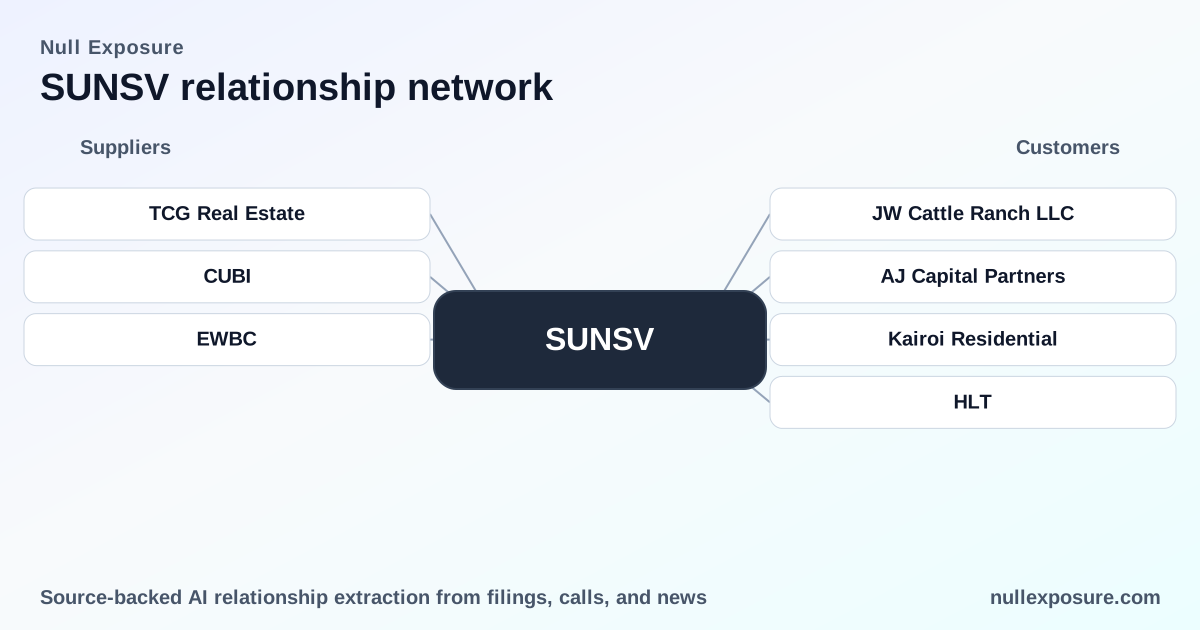
SUNSV deal map: who Sunrise Realty Trust lends to and why it matters
Sunrise Realty Trust (SUNSV) operates as a direct real-estate lender on the Tannenbaum Capital Group (TCG) platform, originating bridge loans, subordinate B-note participations and senior whole loans and monetizing through contractual interest spreads, fee income and realized gains on exits. Its business model is built around short- to medium-term commercial real-estate financing across hospitality, multifamily and specialist land transactions, with a demonstrated willingness to take subordinated positions to syndicate larger financings. For investors and operators evaluating SUNSV customer relationships, the value proposition is income generation from structured credit positions and the principal risk is credit and collateral concentration in cyclical property types. Learn more about how we track these connections at https://nullexposure.com/.
Quick takeaway: a compact set of credit relationships with broad asset coverage
SUNSV’s publicized 2025–2026 activity shows a deliberate mix of bridge and whole-loan commitments: hospitality portfolios (Graduate by Hilton), a large mixed financing where SUNSV took a B-note (AJ Capital Partners), a purpose-built multifamily refinance (Kairoi Residential), and an agricultural/ranch land acquisition bridge loan (JW Cattle Ranch). These relationships signal a lending posture that emphasizes yield from structured senior and subordinated positions across heterogeneous collateral types.
Deal-by-deal: the counterparties investors should know
JW Cattle Ranch LLC — western Colorado ranch acquisition
Sunrise originated, closed and exited a $14.0 million commitment to a $21.6 million senior bridge loan financing the acquisition of the western portion (11,000 acres) of Silver Mountain Ranch in Huerfano County, Colorado, with JW Cattle Ranch LLC as the borrower. According to Sunrise’s press release, the borrower is a specialized land investor and operator experienced in the region (Yahoo Finance, Mar 10, 2026 — https://sg.finance.yahoo.com/news/sunrise-realty-trust-commits-21-130000728.html).
AJ Capital Partners — subordinated B-note in a large structured financing
SUNSV committed $48 million of a $69 million B-note that is subordinate to a $337 million A-note held by a third-party lender on behalf of the borrower AJ Capital Partners, demonstrating SUNSV’s use of subordinate or mezzanine participations to scale exposure to larger sponsor-originated financings (Bitget news release, Mar 10, 2026 — https://www.bitget.com/asia/news/detail/12560605205973).
Kairoi Residential — refinancing for recent multifamily delivery
Sunrise acted as the lender on a $62 million refinancing for a 352-unit apartment complex in Oak Cliff developed by Kairoi Residential and delivered in 2023, a deal that signals SUNSV’s appetite for stabilization/refinancing credits in newly delivered multifamily projects (The Real Deal, Mar 18, 2025 — https://therealdeal.com/texas/dallas/2025/03/18/kairoi-lands-62-million-refinancing-for-dallas-apartments/).
Graduate by Hilton Hotels / HLT — senior whole-loan refinancing of a 15-property portfolio
SUNSV committed $48 million to a senior whole loan used to refinance a 15-property portfolio branded as Graduate by Hilton Hotels, reflecting exposure to hotel cash-flow collateral and franchise-related operating risk in a portfolio transaction (Finviz news summary, Mar 10, 2026 — https://finviz.com/news/331066/sunrise-realty-trust-inc-suns-earnings-expected-to-grow-what-to-know-ahead-of-next-weeks-release).
What these relationships say about SUNSV’s operating model and contracting posture
- Contracting posture: SUNSV executes both whole loans (senior mortgage positions) and subordinated B-note participations, indicating a flexible contracting approach that balances yield enhancement with syndicated capacity. This structure drives fee income on origination and interest spread upside on smaller, higher-yield commitments.
- Sector coverage and concentration: The publicized book covers hospitality, multifamily and specialist land — a mix that smooths single-sector concentration but remains materially cyclical given hotel and multifamily sensitivity to economic cycles.
- Counterparty profile and criticality: Borrowers include institutional sponsors and regional operators (AJ Capital Partners, Kairoi Residential, JW Cattle Ranch LLC), signaling SUNSV prefers sponsor-driven transactions where borrower sophistication can accelerate underwriting and exit paths.
- Maturity and product tenor: Transactions are predominantly short- to medium-term (bridge loans, refinancing and whole loans used to refinance portfolios), consistent with a strategy that relies on refinancing events or sales to realize proceeds rather than long-term hold-to-maturity mortgages.
- Syndication and leverage posture: The use of subordinated B-notes alongside larger A-note lenders demonstrates an appetite to lever syndication to scale exposure while preserving underwriting control on the layered structure.
Investment implications and concentrated risks
SUNSV’s model generates attractive coupon-like returns but concentrates credit risk where collateral values and operating cash flows are cyclical. Key investment considerations:
- Hotel portfolios are sensitive to occupancy cycles and brand performance; a 15-property Graduate-by-Hilton portfolio is exposed to both local market demand and franchisor dynamics.
- Subordinated B-note positions increase recovery risk in stressed scenarios because A-note holders are senior in the capital stack.
- Bridge loans and refinancings depend on exit liquidity (sale or refinance windows) and market sentiment; tightening credit markets or lower property valuations compress exit options.
For research teams, the visible deal list is useful for tracking how SUNSV allocates capital across asset classes and how often it plays subordinate vs. whole-loan roles. For operators, the presence of sponsor-backed deals indicates potential partnership pathways where SUNSV can provide hold-down capital or flexibility in timing exits.
How to use this intelligence
- Use the deal map above to stress-test SUNSV’s recovery assumptions by asset class and by capital-stack position.
- Monitor future press releases for similar participations or whole-loan commitments as signs of scaling or shifting risk appetite.
- Consider counterparty credit quality for sponsors like AJ Capital and Kairoi Residential when modeling default and recovery scenarios.
If you want a live view of SUNSV’s counterparties and structured-credit positions, visit https://nullexposure.com/ for the platform overview and subscription options.
Bottom line: clear strategy, concentrated cyclical exposure
Sunrise Realty Trust deploys capital across short- and medium-term structured real-estate financings with a preference for yield-enhancing subordinate positions alongside whole-loan commitments. The portfolio tilts toward cyclical sectors — hotels and recently built multifamily — balanced by opportunistic land and sponsor-backed transactions. Investors should weigh the attractive spread profile against concentration and refinancing risk, particularly in subordinated positions.